
Publishing Talks: David Wilk Interviews Margo Baldwin
April 25, 2010 by David
Filed under Ebooks and Digital Publishing, Publishing History, PublishingTalks, The Future
 In this series of interviews, called Publishing Talks, I have been talking to book industry professionals about the future of publishing, books, and culture. This is a period of disruption and change for all media businesses.
How will publishing evolve as our culture is affected by technology, climate change, population density, and the ebb and flow of civilization and its economics? Publishing Talks interviews help us understand the outlines of what is happening, and how we might ourselves interact with and influence the future of publishing as it unfolds.
These interviews give people in the book business a chance to talk openly about ideas and concerns that are often only talked about “around the water cooler,” at industry conventions and events, and in emails between friends. I believe these interviews give people inside and outside the book industry a chance to hear first hand some of the most interesting and challenging thoughts, ideas and concepts being discussed within the industry.
Margo Baldwin is the co-founder of Chelsea Green Press, an outstanding and fiercely independent publisher now based in White River Junction, Vermont. We’ve known each other a long time, and over the years, we’ve had opportunities to talk about publishing and politics on many different levels, so this interview is really a continuation of that ongoing conversation about books and ideas, and the role independent publishing can play in making real social change. Chelsea Green’s work extends far beyond the books it publishes, to blogs, websites, video, political movements, and community involvement. The company’s 2003 mission statement is a powerful – and sobering – expression of what a socially engaged publisher might be in the 21st century.
“Indeed, one begins to wonder what “living” really means or will come to mean in the opening decade of the twenty-first century. Can anything be deemed sustainable when life itself–in all its myriad forms–is threatened at so many levels? Is it enough to focus on the how-to of ‘green living’ in the face of such overwhelming force, the ‘shock and awe’ of forest and ecosystem destruction, the rampant plundering of the world’s oceans, the terror of GMO-contaminated-food, and the unintended consequences of biotechnology? We wish to move the company forward boldly and with a new sense of urgency. While continuing our commitment to remain at the forefront of information about green building, organic growing, and renewable energy – the practical aspects of sustainability – we will also publish for a new politics of sustainability, for the cultural resistance that living demands of us now.”
In our Publishing Talks conversation, Margo talks about the history of Chelsea Green, where it is today, and where her vision of publishing will lead the company in the future as it tries to carry out its bold and important mission. The recently announced partnership between Chelsea Green and Vermont’s Northshire Books is a great example of the creative thinking that Margo and her company are practicing.
Podcast: Play in new window | Download
Publishing Talks: David Wilk interviews Ron Hogan
April 18, 2010 by David
Filed under PublishingTalks, The Future
 In this series of interviews, called Publishing Talks, I have been talking to book industry professionals about the future of publishing, books, and culture. This is a period of disruption and change for all media businesses.
How will publishing evolve as our culture is affected by technology, climate change, population density, and the ebb and flow of civilization and its economics? Publishing Talks interviews help us understand the outlines of what is happening, and how we might ourselves interact with and influence the future of publishing as it unfolds.
These interviews give people in the book business a chance to talk openly about ideas and concerns that are often only talked about “around the water cooler,” at industry conventions and events, and in emails between friends. I believe these interviews give people inside and outside the book industry a chance to hear first hand some of the most interesting and challenging thoughts, ideas and concepts being discussed within the industry.
Ron Hogan has been a very busy guy in the book business over the past fifteen years or so, starting in the book business at the well known and now lamented Dutton’s Bookstore in Los Angeles. He founded Beatrice.com in 1995 (the site is still going strong today as a popular book-centric blog), worked for Amazon, and then for Mediabistro’s Galleycat (“the first word on the book publishing business”), and is now the new Director of E-Marketing Strategy for publisher Houghton Mifflin Harcourt in New York City. If you look him up online, he seems to be everywhere at once, involved in many aspects of publishing, books and new media. It’s difficult to imagine someone more aware of how books and readers interact in the online environment.
Ron is also an author, including The Stewardess Is Flying the Plane!: American Films of the 1970s and most recently Getting Right with Tao: A Contemporary Spin on the Tao Te Ching.
In his new role at HMH, he will now have an opportunity to apply what he knows about marketing and online communities to the practical issues of helping to connect books and readers. In this interview, Ron talked with me about his past work, and particularly what he has learned from his experience in retail bookselling, as well as his extensive online experience, and provides some specific and useful advice for authors (and publishers) to help them thrive in the brave new world of publishing.
Podcast: Play in new window | Download
Publishing Talks: David Wilk interviews Jan Weissmiller
April 8, 2010 by David
Filed under PublishingTalks, The Future
 In this series of interviews, called Publishing Talks, I have been talking to book industry professionals about the future of publishing, books, and culture. This is a period of disruption and change for all media businesses.
How will publishing evolve as our culture is affected by technology, climate change, population density, and the ebb and flow of civilization and its economics? Publishing Talks interviews help us understand the outlines of what is happening, and how we might ourselves interact with and influence the future of publishing as it unfolds.
These interviews give people in the book business a chance to talk openly about ideas and concerns that are often only talked about “around the water cooler,” at industry conventions and events, and in emails between friends.
I believe these interviews give people inside and outside the book industry a chance to hear first hand some of the most interesting and challenging thoughts, ideas and concepts being discussed within the industry.
Jan Weissmiller recently achieved her fifteen minutes of fame when President Barack Obama visited her store – and the picture of her selling him a book went viral very quickly. But Prairie Lights Bookstore has more going for it than simply being the backdrop for the first citizen’s book buying habit writ large. It’s been a fixture in the strongly literary community of Iowa City since Jim Harris started the store there in the late ’70s.
As times have changed, so has the store, and today Prairie Lights has an active web presence in addition to its longstanding role as “the” local bookstore in one of the great small towns of middle America. I’ve been to the store many times over the years, and deeply admire the vision and care demonstrated first by Jim and Jan, when she was the first employee of the store, and now by Jan and her current wonderful staff of book devotees. Many towns no longer have the opportunity to experience the depth of knowledge that a great bookstore can provide. What Jan and Prairie Lights show us about bookselling is important – people use technology to make life easier, but people need other people to make life meaningful.
In case you missed it, here is the link to the NY Times story about Prairie Lights. And here’s the now famous photo.
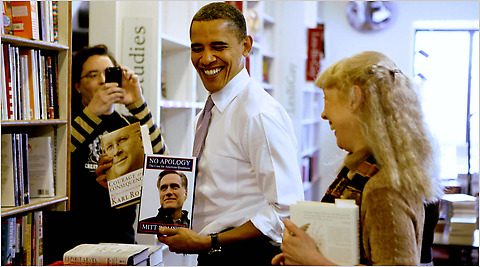
Jan Weissmiller was the first employee of Prairie Lights, beginning in 1979, and is now its co-owner.
Podcast: Play in new window | Download
Publishing Talks: David Wilk Interviews Peter Broderick
April 1, 2010 by David
Filed under PublishingTalks, The Future
 In this series of interviews, called Publishing Talks, I have been talking to book industry professionals about the future of publishing, books, and culture. This is a period of disruption and change for all media businesses.
How will publishing evolve as our culture is affected by technology, climate change, population density, and the ebb and flow of civilization and its economics? Publishing Talks interviews help us understand the outlines of what is happening, and how we might ourselves interact with and influence the future of publishing as it unfolds. These interviews give people in the book business a chance to talk openly about ideas and concerns that are often only talked about “around the water cooler,” at industry conventions and events, and in emails between friends.
I believe these interviews give people inside and outside the book industry a chance to hear first hand some of the most interesting and challenging thoughts, ideas and concepts being discussed within the industry.
Peter Broderick comes from an independent film background and has a perspective that I think is terrifically useful and important. Peter is President of Paradigm Consulting, which helps filmmakers and media companies develop strategies to maximize distribution, audience, and revenues. His work now is completely focused on working with film-makers to utilize new tools in marketing and distribution, and his ideas are very much in concert with my own thoughts about publishing. I strongly recommend reading his article “Maximizing Distribution” and his reports, “Welcome to the New World of Distribution” and “Declaration of Independence;” as concise and spot on as they are for film, they will be useful to anyone thinking about media distribution today and in the future.
I believe there should be more cross-discipline conversations like this one.
Podcast: Play in new window | Download