
Jack El-Hai: The Nazi and the Psychiatrist
March 31, 2026 by David
Filed under Non-Fiction, WritersCast
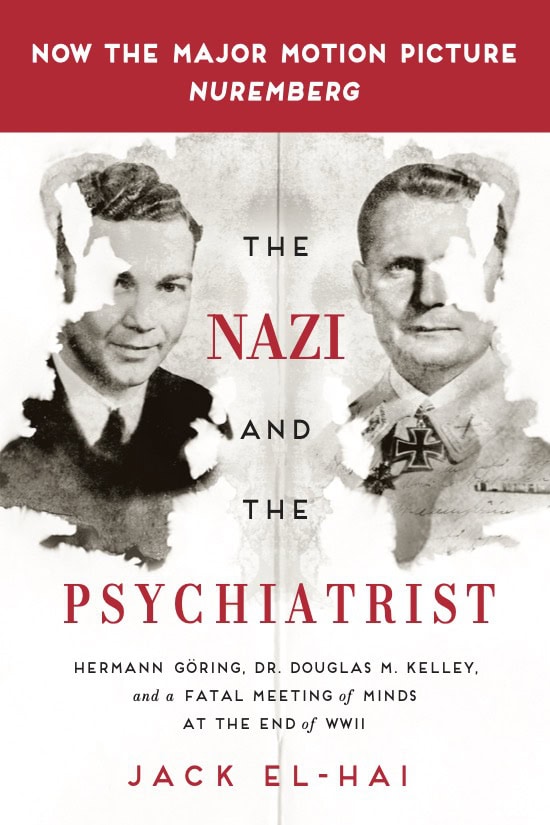 The Nazi and the Psychiatrist: Hermann Göring, Dr. Douglas M. Kelley, and a Fatal Meeting of Minds at the End of WWII — Jack El-Hai — PublicAffairs — 9781610394635 — 304 pages — Published September 2, 2014 — Paperback — $21.99 (ebook available at lower prices; audiobook download also available)
The Nazi and the Psychiatrist was originally published more than ten years ago. It had some terrific reviews, and then became, like most books published today, a “backlist” title mostly available from online retailers. But now that it has become the basis of the well received film, Nuremburg, directed by James Vanderbilt, with a star studded cast, including Rami Malek, Russell Crowe, and Michael Shannon, the book has been re-issued in paperback and has deservedly found many new readers.
In my conversation with its author, Jack El-Hai, we talked mostly about the book itself, and not so much about what it is like for an author to find his book rediscovered because of a movie, though Jack did explain that the film only focuses on a small part of the story El-Hai explored in the book. The Nazi and the Psychiatrist takes on what was a complex relationship between the American psychiatrist Douglas M. Kelley and the 22 Nazis who became his patients as they were imprisoned before their trial as war criminals in the 1945-46 International Military Tribunal at Nuremberg. Of course the key figure among the Nazis was Herman Göring, who was not only an important early supporter of Hitler, as well as one of the central figures in the rise of Nazism, the conduct of WWII as head of the Luftwaffe, and of course one of the architects of the Holocaust. At the time he was captured by the Americans, he expected to become the next leader of Germany.
Kelley was brought in to examine the Nazi leaders who were to be the first tried for war crimes by the Allies – the idea being to determine whether they were each rational enough to stand trial for their horrific actions. As a psychiatrist, this gave him an exceptional opportunity – to gather information about the psychology of Nazis and to understand whether they were indeed within the range of normal human behavior or pathological.
Kelley became especially close with Göring, a formidable figure, who ultimately committed suicide rather than experience the humiliating death by hanging to which he was sentenced by the Tribunal. Kelley’s life was deeply influenced by his experiences with the Nazis, and El-Hai, who had access to Kelley’s files and talked extensively with his surviving children, paints a compelling portrait of a man whose suffering was extreme and led ultimately to his own unfortunate suicide some years later.
Given our present circumstances, a book about the psychological components of authoritarianism and the individuals who led Germany’s fascist enterprise cannot help to resonate. Reading this book will make you think about the nature of evil (and Arendt’s calling it “banal”) as well as the way that fascism masks the personal greed and pursuit of power that drove it.
I do recommend this book at anyone who is trying to grapple with what is happening to us now. And this conversation will be illuminating as well.
Jack El-Hai is an award-winning writer who has published innumerable articles and more than a dozen books. Jack’s other books include Face in the Mirror, The Lost Brothers, and The Lobotomist: A Maverick Medical Genius and His Tragic Quest to Rid the World of Mental Illness.
He has contributed articles to Scientific American, Wired, Discover, GQ, The Atlantic, Smithsonian, Aeon, The Washington Post Magazine, and many other publications. He lives in Minneapolis.
“This intimate and insightful portrait of two intersecting, outsized personalities‑‑one an exemplar of public service and the other an avatar of evil‑‑is as suspenseful as a classic Hitchcock film that hinges on an eerie psychological secret. Readers of The Nazi and the Psychiatrist will be riveted by Jack El‑Hai’s moving study of how good and evil can converge in a heightened instant and across a lifetime.”—Andrew Solomon, National Book Award winning author of Far from the Tree

Podcast: Play in new window | Download