
Jack El-Hai: The Nazi and the Psychiatrist
March 31, 2026 by David
Filed under Non-Fiction, WritersCast
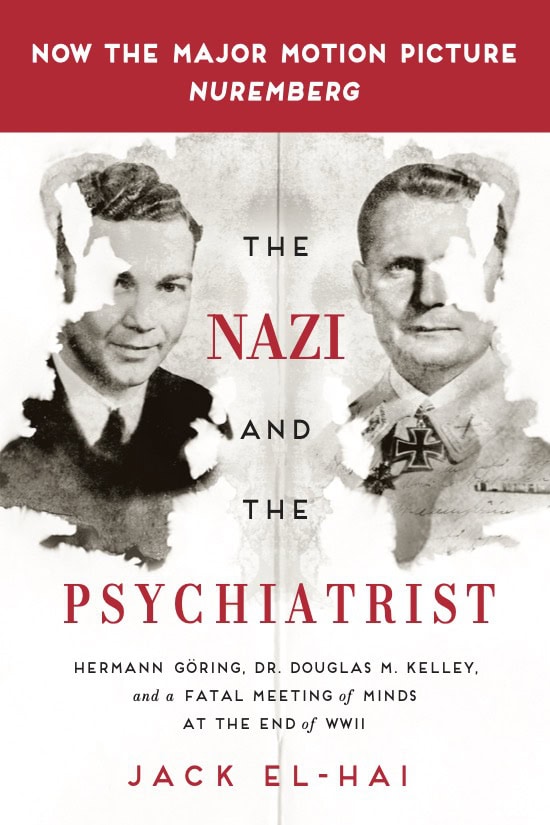 The Nazi and the Psychiatrist: Hermann Göring, Dr. Douglas M. Kelley, and a Fatal Meeting of Minds at the End of WWII — Jack El-Hai — PublicAffairs — 9781610394635 — 304 pages — Published September 2, 2014 — Paperback — $21.99 (ebook available at lower prices; audiobook download also available)
The Nazi and the Psychiatrist was originally published more than ten years ago. It had some terrific reviews, and then became, like most books published today, a “backlist” title mostly available from online retailers. But now that it has become the basis of the well received film, Nuremburg, directed by James Vanderbilt, with a star studded cast, including Rami Malek, Russell Crowe, and Michael Shannon, the book has been re-issued in paperback and has deservedly found many new readers.
In my conversation with its author, Jack El-Hai, we talked mostly about the book itself, and not so much about what it is like for an author to find his book rediscovered because of a movie, though Jack did explain that the film only focuses on a small part of the story El-Hai explored in the book. The Nazi and the Psychiatrist takes on what was a complex relationship between the American psychiatrist Douglas M. Kelley and the 22 Nazis who became his patients as they were imprisoned before their trial as war criminals in the 1945-46 International Military Tribunal at Nuremberg. Of course the key figure among the Nazis was Herman Göring, who was not only an important early supporter of Hitler, as well as one of the central figures in the rise of Nazism, the conduct of WWII as head of the Luftwaffe, and of course one of the architects of the Holocaust. At the time he was captured by the Americans, he expected to become the next leader of Germany.
Kelley was brought in to examine the Nazi leaders who were to be the first tried for war crimes by the Allies – the idea being to determine whether they were each rational enough to stand trial for their horrific actions. As a psychiatrist, this gave him an exceptional opportunity – to gather information about the psychology of Nazis and to understand whether they were indeed within the range of normal human behavior or pathological.
Kelley became especially close with Göring, a formidable figure, who ultimately committed suicide rather than experience the humiliating death by hanging to which he was sentenced by the Tribunal. Kelley’s life was deeply influenced by his experiences with the Nazis, and El-Hai, who had access to Kelley’s files and talked extensively with his surviving children, paints a compelling portrait of a man whose suffering was extreme and led ultimately to his own unfortunate suicide some years later.
Given our present circumstances, a book about the psychological components of authoritarianism and the individuals who led Germany’s fascist enterprise cannot help to resonate. Reading this book will make you think about the nature of evil (and Arendt’s calling it “banal”) as well as the way that fascism masks the personal greed and pursuit of power that drove it.
I do recommend this book at anyone who is trying to grapple with what is happening to us now. And this conversation will be illuminating as well.
Jack El-Hai is an award-winning writer who has published innumerable articles and more than a dozen books. Jack’s other books include Face in the Mirror, The Lost Brothers, and The Lobotomist: A Maverick Medical Genius and His Tragic Quest to Rid the World of Mental Illness.
He has contributed articles to Scientific American, Wired, Discover, GQ, The Atlantic, Smithsonian, Aeon, The Washington Post Magazine, and many other publications. He lives in Minneapolis.
“This intimate and insightful portrait of two intersecting, outsized personalities‑‑one an exemplar of public service and the other an avatar of evil‑‑is as suspenseful as a classic Hitchcock film that hinges on an eerie psychological secret. Readers of The Nazi and the Psychiatrist will be riveted by Jack El‑Hai’s moving study of how good and evil can converge in a heightened instant and across a lifetime.”—Andrew Solomon, National Book Award winning author of Far from the Tree


Podcast: Play in new window | Download
The Vanishing Sky (A Novel) by L. Annette Binder
October 27, 2020 by David
Filed under Fiction, WritersCast
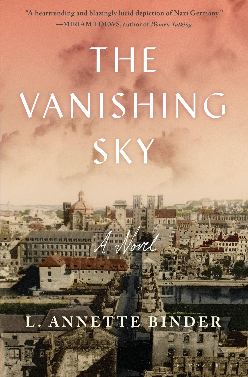 The Vanishing Sky (A Novel) – L. Annette Binder – 9781635574678 – Bloomsbury Publishing – Hardcover – 288 pages – July 21, 2020 – $27.00 – ebook versions for sale at lower prices
I did not know what to expect when I started reading The Vanishing Sky. Initially, I was looking forward to reading a book that did not focus on the victims of Nazi Germany, but on Germans themselves. Yet I found that it was much more difficult for me to get into than I anticipated. I am not sure why, but I resisted the book and almost set it aside. I wanted to not like the characters. I wanted to not be sympathetic to them, or their situation, my deep-seated antipathy toward mid-century Germany and its people emerging from my psyche.
The Vanishing Sky is about a family struggling to survive at a time when World War II is coming to an end. The focus of the book is on Etta Huber, a hausfrau in a small town, whose eldest son had joined the army and gone to fight in the east, now coming home a broken man, and whose younger son, is dreamier and unmilitaristic child-like, and struggles with the country’s expectations for a German male. At the same time, Etta’s husband is a difficult, quite traditional German man, a veteran of WWI, but who does not know how to act in his stage of life during wartime.
Binder is a fine writer who builds a slow burning fire from a few tiny sparks and I found myself fully engaged with her characters, and immersed in their lives as I continued reading this book. The story and the characters bring us face to face with uncomfortable realities. These are humans struggling to find their identities in horrible circumstances, where there is nothing approaching normality. And of course, as it is set in Germany in the very final months of World War II, it is not a typical war novel. The book is about the people on the home front and it becomes impossible to not feel an uncomfortable resonance to our own time.
It was truly a pleasure to speak with Annette about this remarkable novel and I will be looking forward to reading her next book.
The Vanishing Sky quietly sneaks up on the reader and makes us confront our understanding of ourselves with carefully wrought details and a surprising story line. It’s a rewarding novel that requires attention from the reader that is fully rewarded in the end.
“The Vanishing Sky reveals the German home front as I’ve never seen it in fiction… Binder tells her story patiently, like an artist placing tiny pieces into a mosaic; this literary novel isn’t one to race through. But I find it gripping, powerful, and a brave narrative, unsparing in its honesty.” — Larry Zuckerman, Historical Novels Review
Annette Binder was born in Germany and grew up in Colorado. The Vanishing Sky is her first novel, inspired by her family’s experiences in World War II Germany. Her collection of short stories, Rise, received the Mary McCarthy Prize in Short Literature. Annette has degrees from Harvard, UC Berkeley and the Programs in Writing at the University of California, Irvine. She lives in New England.

Podcast: Play in new window | Download
Ken Krimstein: The Three Escapes of Hannah Arendt
November 28, 2018 by David
Filed under Graphic Novels, Non-Fiction, WritersCast
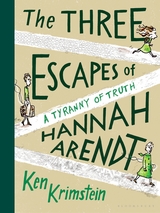 The Three Escapes of Hannah Arendt: A Tyranny of Truth – Ken Krimstein – Bloomsbury – 240 pages – Hardcover – 9781635571882 – $28.00 – September 25, 2018 – ebook versions also available at lower prices.
What a completely cool and unexpected pleasure it was to discover this amazing book! Yes, I had seen Ken Krimstein’s cartoons in the New Yorker, and I have even read a bit of Hannah Arendt’s powerful writing over the years, but neither Ken’s humorous work, nor my limited knowledge of Arendt’s life prepared me for the serial delight of this graphic novel biography of one of the twentieth century’s most important thinkers.
Hannah Arendt is one of those intellectual figures whose reputation obscures her actual story. Her books were highly influential and widely read in the mid and late twentieth century, though I suspect in present times, now are consumed mostly by college students and scholars, as serious political philosophy does not have a broad readership anymore (if it ever did). We know of her mainly through her many famous books, including The Human Condition, On Totalitarianism, and Eichmann in Jerusalem, among her many, many others.
Arendt’s writing on the nature and form of authoritarianism, couched in her direct experience with Hitler’s Germany, and the rise of Stalin after the war, certainly has become increasingly resonant today, for obvious reasons. And with the increase in modern day anti-Semitism, it is difficult to not draw comparisons between the 1930s world she inhabited and our current troubled experiences.
So it is timely to think about Hannah Arendt’s work, and especially to learn how that work was shaped by her extraordinary life and mind. As revealed in this wonderful biography, Hannah Arendt’s story is heroic and rich. The details about her life continually surprise and delight us. The men and women she knew are some of the greatest thinkers and artists of the century, and it is remarkable just how many now-famous people appear in her life. She knew and associated with so many,from philosophers like Heidegger and Jaspers, to political theorists like Walter Benjamin, writers like Mary McCarthy and geniuses like Albert Einstein and Sigmund Freud, and her own writing and thinking have influenced generations of thinkers and writers.
The escapes Krimstein documents so heart wrenchingly in this book were all determinative to the development of her thinking and writing, and shaped her individualistic, powerful thinking about what it means to be an engaged citizen in a modern world in constant strife. Reading this book was inspiring, and I give full credit to Ken Krimstein for bringing Hannah Arendt to life for me in a way I doubt a prose biography could have done.
Ken Krimstein’s cartoons have been published in the New Yorker, Barron’s, The Harvard Business Review, Prospect Magazine, Punch, The National Lampoon, the Wall Street Journal, Narrative Magazine and many others magazines. His writing has been published in The New York Observer’s “New Yorker’s Diary” and a number of humor websites, including McSweeney’s Internet Tendency, Yankee Pot Roast, and Mr. Beller’s Neighborhood.
Ken is also a teacher at De Paul University and The School of the Art Institute of Chicago. You can read more about him, his work, and The Three Escapes at his website here, where you can also see sample pages from the book.
It was a pleasure for me to meet Ken, and I think you will enjoy our conversation just as much as I did.
“Ken Krimstein’s deeply moving graphic memoir about the life and thoughts of philosopher Hannah Arendt is not only about Hannah Arendt. It’s also, through her words, about how to live in the world, the meaning of freedom, the perils of totalitarianism, and our power as human beings to think about things and not just act blindly. Krimstein explains Arendt’s ideas with clarity, wit, and enormous erudition, and they still resonate.” – Roz Chast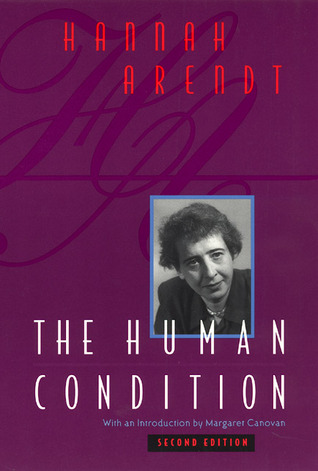

Podcast: Play in new window | Download
Charles Kaiser: The Cost of Courage
December 12, 2016 by David
Filed under Non-Fiction, WritersCast
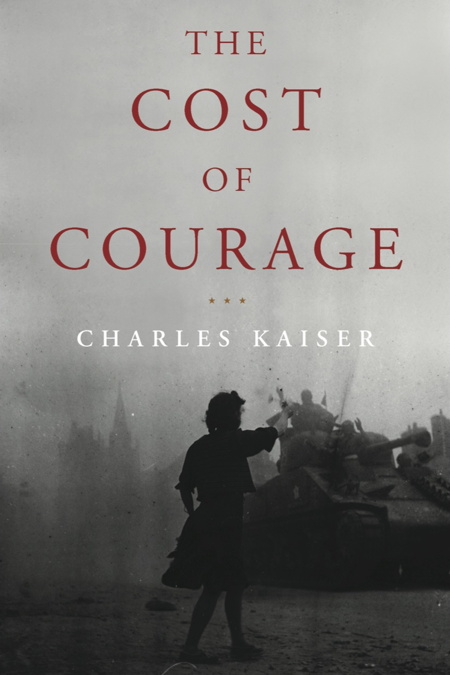 The Cost of Courage – Other Press – Hardcover – 288 pages – 9781590516140 – $26.95 (ebook versions available at lower prices)
I read this beautifully written book about one family’s experience of World War II in France just before our recent election. At that time, I was not expecting to have to think about it in the context of our own political situation. Even without understanding that the incredible courage of his subjects may be instructive to us today, this book is about an incredible story of bravery and sacrifice. As of this moment, The Cost of Courage must be read in a new context.
All of us need to consider the lessons learned from the experience of everyday people in horrible circumstances like those of the French in occupied France. These were times of brutal repression and daily violence for individuals who constantly made momentous moral decisions with life and death consequences.
The Cost of Courage recounts the true story of the three youngest children of a bourgeois Catholic family, who worked heroically in the French Resistance during the Nazi occupation of France. Charles Kaiser was lucky enough to know this family from the time he was a small boy, because his uncle was billeted with them after the liberation of Paris by Allied forces.
In 1943, André Boulloche was working underground as General Charles de Gaulle’s military representative in Paris, coordinating Resistance activities in northern France. Unfortunately, he was betrayed by one of his associates, arrested and taken prisoner by the Gestapo. His two younger sisters continued to fight against the Germans until Paris was freed in 1944. André Boulloche managed to survive his time in three concentration camps through sheer force of will.
The elderly Boulloche parents and the oldest brother were also arrested when the Gestapo tried to capture the two sisters. Tragically, these three were on the last train the Germans ran from Paris to Germany before the Allies liberated the city, and they died soon after in Nazi concentration camps.
After the war, the Boulloches remained silent about their terrible wartime. Ultimately, Charles was able to convince the last surviving sister to finally tell her family’s incredible story. The Boulloche story is moving and powerful, and we are fortunate it could be told to us by this fine and sensitive writer.
It was a true pleasure for me to be able have this opportunity to talk to Charles about his book and his experience of writing it. Charles and I were in high school together, but have had very little contact since then, and while I have followed his outstanding career as a journalist and author, we have not talked often over these many years. I am gratified to have read this book, and have been inspired by its story. I urge my listeners to read The Cost of Courage, as we are ourselves now live through times that will challenge our own willingness to pay the true cost of courage.
Charles Kaiser started writing for The New York Times while still an undergraduate at Columbia. He spent five years at the Times as a reporter, and after that was the press critic at Newsweek for two years. After writing about media and publishing for the Wall Street Journal, he wrote his first book, 1968 in America, published in 1988. His highly praised book, The Gay Metropolis was published in 1997.
His writing has appeared in New York, the New York Observer, Vanity Fair, the Washington Post, the Los Angeles Times and Manhattan,Inc. among many other publications.
Kaiser was a founder and former president of the New York chapter of the National Lesbian and Gay Journalists Association. He has taught journalism at Columbia and Princeton, where he was the Ferris Professor of Journalism. To learn more about his work, visit his website here.
“In this poignant personal tale, Kaiser explores the emotions and breaks through the silences that haunted an amazing family after their experiences in the French resistance to Nazi occupation. The result is a compelling and heart-wrenching book about courage, love, and the complex shadings of heroism.”
—Walter Isaacson

OLYMPUS DIGITAL CAMERA
Podcast: Play in new window | Download