
Anya Kamenetz: DIY U: Edupunks, Edupreneurs, and the Coming Transformation of Higher Education
April 29, 2010 by David
Filed under Non-Fiction, WritersCast
 978-1603582346 – Chelsea Green Publishing – paperback – $14.95 (also available in e-book formats)
In some ways the title of this book is a bit misleading, as there is no reference to a major part of the book – an extensive discussion at the beginning of DIY U that is a history and analysis of American higher education. It’s an important discussion for millions of Americans who question how the system got to where it is, and how it could be made to change. I think of myself as pretty knowledgeable about how things work but I was completely surprised at some of the things I learned about modern higher education in this part of the book. I’m willing to say that it’s a must-read for anyone interested in public policy and the future of our society (hopefully that’s alot of people). We need to question every aspect of how we educate our citizenry.
Which leads us to the next part of the book, which is really what the title refers to. Whereas the entrenched systems appear to be immoveable, there is so much ferment and change afoot, so much that is enabled by the web and the networked, decentralized, open source nature of emerging, modern culture, that there really is hope for the meaningful and significant change we need. As Chelsea Green says about DIY U on their website: “The future lies in personal learning networks and paths, learning that blends experiential and digital approaches, and free and open-source educational models. Increasingly, you will decide what, when, where, and with whom you want to learn, and you will learn by doing. The university is the cathedral of modernity and rationality, and with our whole civilization in crisis, we are poised on the brink of a new Reformation.”
I loved talking to Anya Kamenetz and wish we had more time to talk – not just about her book and the work she did to write it, but her incisive ideas and her many interests in modern, connected culture. We had a great conversation talking about her book and so many of her ideas. She’s incredibly intelligent, has complete command of her subject and is a terrific writer – her extensive experience as a journalist serves her well both in conversation and in the longer form of a full length book. She can work with big swatches of information and ideas and make them clear and understandable, and importantly, never bores her readers. Hopefully I’m not alone in wanting see this book help us envision and then implement significant change in education, learning and social change. This is a book that can make a real difference.
Anya Kamenetz is a staff writer for Fast Company magazine. The Village Voice nominated her for a Pulitzer Prize for contributions to the feature series Generation Debt, which became a book in 2006. She has written for the New York Times, appeared on CNN and National Public Radio, and been featured as a “Yahoo Finance Expert.” A frequent speaker nationwide, Anya blogs at Fastcompany.com, The Huffington Post, and anyakamenetz.blogspot.com. She lives in Brooklyn with her husband.
Podcast: Play in new window | Download
Publishing Talks: David Wilk Interviews Margo Baldwin
April 25, 2010 by David
Filed under Ebooks and Digital Publishing, Publishing History, PublishingTalks, The Future
 In this series of interviews, called Publishing Talks, I have been talking to book industry professionals about the future of publishing, books, and culture. This is a period of disruption and change for all media businesses.
How will publishing evolve as our culture is affected by technology, climate change, population density, and the ebb and flow of civilization and its economics? Publishing Talks interviews help us understand the outlines of what is happening, and how we might ourselves interact with and influence the future of publishing as it unfolds.
These interviews give people in the book business a chance to talk openly about ideas and concerns that are often only talked about “around the water cooler,” at industry conventions and events, and in emails between friends. I believe these interviews give people inside and outside the book industry a chance to hear first hand some of the most interesting and challenging thoughts, ideas and concepts being discussed within the industry.
Margo Baldwin is the co-founder of Chelsea Green Press, an outstanding and fiercely independent publisher now based in White River Junction, Vermont. We’ve known each other a long time, and over the years, we’ve had opportunities to talk about publishing and politics on many different levels, so this interview is really a continuation of that ongoing conversation about books and ideas, and the role independent publishing can play in making real social change. Chelsea Green’s work extends far beyond the books it publishes, to blogs, websites, video, political movements, and community involvement. The company’s 2003 mission statement is a powerful – and sobering – expression of what a socially engaged publisher might be in the 21st century.
“Indeed, one begins to wonder what “living” really means or will come to mean in the opening decade of the twenty-first century. Can anything be deemed sustainable when life itself–in all its myriad forms–is threatened at so many levels? Is it enough to focus on the how-to of ‘green living’ in the face of such overwhelming force, the ‘shock and awe’ of forest and ecosystem destruction, the rampant plundering of the world’s oceans, the terror of GMO-contaminated-food, and the unintended consequences of biotechnology? We wish to move the company forward boldly and with a new sense of urgency. While continuing our commitment to remain at the forefront of information about green building, organic growing, and renewable energy – the practical aspects of sustainability – we will also publish for a new politics of sustainability, for the cultural resistance that living demands of us now.”
In our Publishing Talks conversation, Margo talks about the history of Chelsea Green, where it is today, and where her vision of publishing will lead the company in the future as it tries to carry out its bold and important mission. The recently announced partnership between Chelsea Green and Vermont’s Northshire Books is a great example of the creative thinking that Margo and her company are practicing.
Podcast: Play in new window | Download
Joanna Smith Rakoff: A Fortunate Age
April 22, 2010 by David
Filed under Fiction, WritersCast
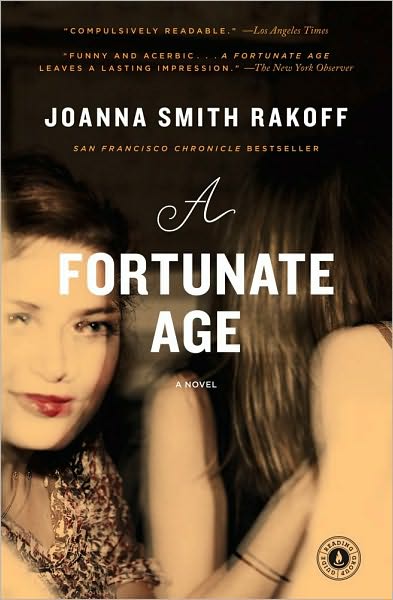 978-1416590804 – Paperback – Scribner – $15.00
Joanna Smith Rakoff is a wonderful writer – she’s a poet and an essayist, and her skill as a writer shines throughout her novel A Fortunate Age. This was not a book I expected to enjoy as much as I did; Rakoff won me over with the details of her sprawling story, and her characters, whom I similarly did not expect to like so much. The book is modeled directly on Mary McCarthy’s now classic, The Group, whose characters were Vassar women, in a story set in the 1930s and 1940s, whereas Rakoff’s characters are all friends from Oberlin, living in New York City in the late 1990s and the early years of the new century.
Like the novel Rakoff used for inspiration, this is a complicated story with a number of characters told over a number of years. This novel is set mostly in New York City with flashbacks to her characters’ earlier lives, especially their time in college in Oberlin, and some side stories as well. Essentially, it’s a coming of age story, and based on the supposition, I think, that for so many of us, the decade crossing from our twenties to our early thirties truly marks the painful bridge from still youthful adulthood to “real” life. It’s not an easy transition, and for many has the sense of hyper-focused reality that makes it all the more powerful for those experiencing it.
In talking with Joanna, I wanted to explore her interest in Mary McCarthy and her novel that A Fortunate Age is based on (and The Group is also a book I recommend to modern readers, it is a book that is probably more neglected than it should be). Joanna talks about the striking similarities she felt between the lives of her own age group and that of McCarthy’s and how that led her to write her own book. We also talked about the way her book is imagined and how through fiction she worked to represent a particular time and place, a milieu that she evokes through this story, the breadth of her characters and their individual linked stories. As she points out, this novel is, for her almost Victorian in the way its characters function against and within an overall cultural structure toward understanding their social being. There is alot going on in her book, which Rakoff manages quite masterfully, and her ability to handle complexity of story and persona shines in this interview as well. I’m certainly looking forward to reading her next book and to talking to her again.
Podcast: Play in new window | Download
Publishing Talks: David Wilk interviews Ron Hogan
April 18, 2010 by David
Filed under PublishingTalks, The Future
 In this series of interviews, called Publishing Talks, I have been talking to book industry professionals about the future of publishing, books, and culture. This is a period of disruption and change for all media businesses.
How will publishing evolve as our culture is affected by technology, climate change, population density, and the ebb and flow of civilization and its economics? Publishing Talks interviews help us understand the outlines of what is happening, and how we might ourselves interact with and influence the future of publishing as it unfolds.
These interviews give people in the book business a chance to talk openly about ideas and concerns that are often only talked about “around the water cooler,” at industry conventions and events, and in emails between friends. I believe these interviews give people inside and outside the book industry a chance to hear first hand some of the most interesting and challenging thoughts, ideas and concepts being discussed within the industry.
Ron Hogan has been a very busy guy in the book business over the past fifteen years or so, starting in the book business at the well known and now lamented Dutton’s Bookstore in Los Angeles. He founded Beatrice.com in 1995 (the site is still going strong today as a popular book-centric blog), worked for Amazon, and then for Mediabistro’s Galleycat (“the first word on the book publishing business”), and is now the new Director of E-Marketing Strategy for publisher Houghton Mifflin Harcourt in New York City. If you look him up online, he seems to be everywhere at once, involved in many aspects of publishing, books and new media. It’s difficult to imagine someone more aware of how books and readers interact in the online environment.
Ron is also an author, including The Stewardess Is Flying the Plane!: American Films of the 1970s and most recently Getting Right with Tao: A Contemporary Spin on the Tao Te Ching.
In his new role at HMH, he will now have an opportunity to apply what he knows about marketing and online communities to the practical issues of helping to connect books and readers. In this interview, Ron talked with me about his past work, and particularly what he has learned from his experience in retail bookselling, as well as his extensive online experience, and provides some specific and useful advice for authors (and publishers) to help them thrive in the brave new world of publishing.
Podcast: Play in new window | Download
Katharine Weber: True Confections
April 15, 2010 by David
Filed under Fiction, WritersCast
 978-0307395863 – Hardcover – Shaye Areheart Books – $22.00
What a fun (and challenging) book! Any novel that takes place in my favorite city, New Haven, Connecticut, is a book I will want to read. And I did really enjoy reading this book. Katharine Weber has created a wonderful main character, the complicated and challenging Alice Tatnall Ziplinsky, who has married into the family that runs the famous Zip’s Candy Company. True Confections is her story, and through her, it is also the story of an immigrant family in America, the romance of candy, family secrets, and the complexity of relationships. Because the entire story is told by Alice, we don’t ever quite know what is real and what is not, and we are forced to confront actual meaning of narrative.
So it turns out that this this funny, warm, and sometimes poignant novel masks an underlying depth of transposed loves, where family becomes defined by relationship rather than blood. In fact, almost every important character in the book has to deal with displacement. It’s great to read a book with depth and complexity. As the author says: “… at its heart, True Confections is about timeless and universal themes: love, betrayal, and of course, sweets.” I should also add that fire – of the destructive kind – also plays an important role in this story, so it’s not all about the sugar.
I enjoyed the opportunity to interview Katharine Weber about the novel, her characters, and of course, New Haven, where she lives, and where this novel is set. The book is rich in subjects and so is our discussion; we talked extensively about her novel, New Haven, the unreliability of narrators, candy, Jewish families and their businesses, and of course, candy. True Confections is a terrific novel; Katharine Weber is a fine writer who also knows how to talk engagingly about her work.
Podcast: Play in new window | Download
Karl Marlantes: Matterhorn: A Novel of the Vietnam War
April 10, 2010 by David
Filed under Fiction, WritersCast
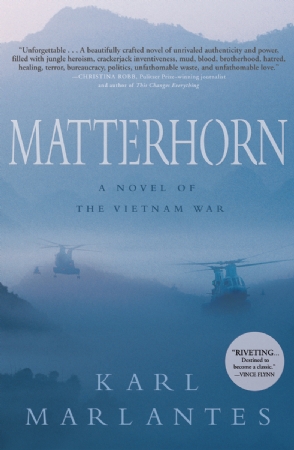 978-0802119285 – Hardcover – Grove/Atlantic – $24.95 (e-book edition available).
When I started reading books and interviewing authors for Writerscast, I made a commitment to only interviewing writers whose books I liked. In the year since, I’ve started quite a few I could not finish, but have read and liked a good fifty books of all different kinds. Several of them kept me up well past my already late bedtime, which is always a great feeling, even if it does make me tired.
I have to say that Matterhorn: A Novel of the Vietnam War, at 590 pages, kept me up later and longer than any book I have read in the past year. It’s just impossible to put down. Karl Marlantes takes you right into the psyche of a young, smart, scared Marine lieutenant, landing in ‘Nam for his first tour of duty early in the war, and keeps you with him and the soldiers he fights and dies with all the way through to the end of the book. There’s no doubt that the war in Vietnam was an unforgettable, painful, and highly charged experience for the men and women who were there.
Most of us who are old enough either to have been there, or to have lived through the war at home, have had difficulty finding a voice for what happened, and there has been precious little fiction to come out of that period in America’s history that has resonated as great art. I believe this book qualifies as such a thing. Marlantes has captured so much of what America was in the mid-to-late sixties, it becomes possible to inhabit that world, and most importantly, to understand it. Fiction transforms experience into transcendent understanding; a greater truth emerges. Through the terrible grind of war, the intensity of combat, individual heroism and pain, Marlantes has created a great work of art that celebrates the human spirit, a brilliantly glowing prism of suffering and soul.
Karl Marlantes went to Yale, was a Rhodes Scholar, and like his main character, was a Marine infantry officer in Vietnam where he was awarded the Navy Cross, the Bronze Star, two Navy Commendation Medals for valor, two Purple Hearts, and ten air medals. He wrote Matterhorn over a long period of time – 35 years at least – in many drafts and many forms. At various times, he attempted to have the novel published commercially, but it was never “the right time” for any publisher, until the tiny El Leon Literary Arts agreed to publish earlier this year. When they submitted the novel to Barnes & Noble’s Discover New Authors series, and the book was read by that company’s fiction buyer, Sessalee Hensley, who knew that this book would need a larger publisher to help bring it to the large audience it deserves.
Morgan Entrekin (whom I interviewed for Publishing Talks a few weeks ago and who told me about this book when I talked to him) brilliantly chose to put the full resources of Grove/Atlantic behind this book, and I believe it will end up being recognized as one of the great war novels America has produced. In our conversation, Karl Marlantes tells the story of his life and how this book came to be written, what it took to write it, and what it means for him now that it has been published. He is a terrific writer, and one who well deserves the accolades he and his novel are receiving now.
Podcast: Play in new window | Download
Publishing Talks: David Wilk interviews Jan Weissmiller
April 8, 2010 by David
Filed under PublishingTalks, The Future
 In this series of interviews, called Publishing Talks, I have been talking to book industry professionals about the future of publishing, books, and culture. This is a period of disruption and change for all media businesses.
How will publishing evolve as our culture is affected by technology, climate change, population density, and the ebb and flow of civilization and its economics? Publishing Talks interviews help us understand the outlines of what is happening, and how we might ourselves interact with and influence the future of publishing as it unfolds.
These interviews give people in the book business a chance to talk openly about ideas and concerns that are often only talked about “around the water cooler,” at industry conventions and events, and in emails between friends.
I believe these interviews give people inside and outside the book industry a chance to hear first hand some of the most interesting and challenging thoughts, ideas and concepts being discussed within the industry.
Jan Weissmiller recently achieved her fifteen minutes of fame when President Barack Obama visited her store – and the picture of her selling him a book went viral very quickly. But Prairie Lights Bookstore has more going for it than simply being the backdrop for the first citizen’s book buying habit writ large. It’s been a fixture in the strongly literary community of Iowa City since Jim Harris started the store there in the late ’70s.
As times have changed, so has the store, and today Prairie Lights has an active web presence in addition to its longstanding role as “the” local bookstore in one of the great small towns of middle America. I’ve been to the store many times over the years, and deeply admire the vision and care demonstrated first by Jim and Jan, when she was the first employee of the store, and now by Jan and her current wonderful staff of book devotees. Many towns no longer have the opportunity to experience the depth of knowledge that a great bookstore can provide. What Jan and Prairie Lights show us about bookselling is important – people use technology to make life easier, but people need other people to make life meaningful.
In case you missed it, here is the link to the NY Times story about Prairie Lights. And here’s the now famous photo.
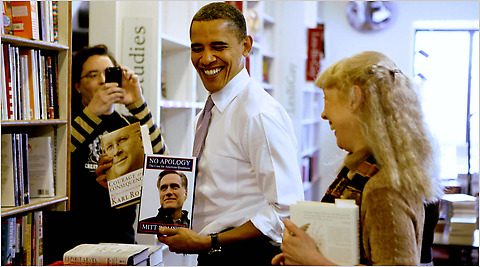
Jan Weissmiller was the first employee of Prairie Lights, beginning in 1979, and is now its co-owner.
Podcast: Play in new window | Download
Derrick Jensen: Lives Less Valuable
April 4, 2010 by David
Filed under Fiction, WritersCast
 978-1-60486-045-0 – paperback – Flashpoint Press/PM Press – $18.00
Derrick Jensen is one of the most intelligent nonfiction writers around. His intellectual ability, brilliant writing and passionate voice for nature, for the powerless (not just people, but our fellow plant and animal species), and for the wounded, have made him a hero for many who oppose the structures of modern society. I was not familiar with his fiction before reading Lives Less Valuable. It’s very difficult to write fiction with a political message, but Jensen succeeds here. Even though the reader knows there is a political subtext, the story and the characters work well, they’re both believable and instructive.
The story centers on Malia, an environmental activist in a modern city where people are dying from a toxic river. The corporation that is at the root of the problem does everything possible to maximize its profits and does not care about the environmental cost borne by the poor people of the city. She is drawn into a complex web of events that forces her to make choices about her beliefs and what she must do to make meaningful change, and when she does, the effects of her choices resonate through the lives of many others. And they do make a difference.
Talking to Derrick Jensen was a great experience for me. He has so much to say about human beings, our relationship to nature, and the meaning of political action, not to mention writing and story telling. In this interview he talked about many subjects, including the nature of activism, the difference between writing fiction and nonfiction, and the details of the writing of this book. He’s as eloquent and brilliant a speaker as he is a writer. Derrick Jensen truly is one of our great public intellectuals. Please note that this interview is longer than usual at 32 minutes, but should reward the listener with a worthwhile experience.
Podcast: Play in new window | Download
E.M. Broner: The Red Squad
March 28, 2010 by David
Filed under Fiction, WritersCast
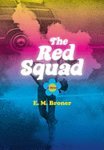 978-0307-37791-3 – Hardcover – Pantheon – $24.00 (also available as an e-book; a paperback edition will be out in July 2010 – 978-0307-45584-0 – $15.00)
This is a sometimes hilarious, always engaging, warm and sexy novel about a group of midwestern academics from the sixties, told from the vantage point of Anka Pappas, who, forty years after this fraught period in her life, finds out the entire group was under surveillance by the federal, state and local governments. The story weaves together past and present, as Anka reconnects with her friends and associates – much drama, emotion, and memory unfolds, demonstrating that the past is not at all a dead or forgotten issue. It’s a complicated story that Ms. Broner tells quite skillfully, keeping alot of balls in the air (it does help to have a cast of characters in the front of the book to which the reader can refer, as there is alot of perspective changing going on, sometimes at very high speed).
Broner knows that the political engagement of the sixties and early seventies can not be seen as an isolated period. It is deeply connected to our present. And through this book, she shows us that the issues that engaged the young activists of that earlier period are still with us today. The power relationships in our society ultimately have not been changed; there is much work to be done, and much more engaged life to be lived.
There’s no preaching here, this is a book written by a smart, accomplished writer, who knows how to make a story work, and who clearly had a great time writing this book. Talking to Esther Broner about the book was alot of fun for me. In this interview, she talks about this book and how it relates to her own life. We talk about politics, the nature of fiction and nonfiction, memoir and story, reality and imagination, appearance and reality, and of course the connection between the activism of the 1960’s and how it relates to us today.
This is an enjoyable, funny book that carries a powerful political and emotional punch, written by a skilled and experienced author whose work deserves a wide audience.
Podcast: Play in new window | Download
Publishing Talks: David Wilk Interviews Don Linn
March 23, 2010 by David
Filed under Ebooks and Digital Publishing, PublishingTalks
 In this series of interviews, called Publishing Talks, I have been talking to book industry professionals, each of whom has a different perspective about the future of publishing, books, and culture. This is a period of disruption and change for all media businesses.
Publishing has been a crucial part of human culture for as long as people have been writing and reading.
In this series of interviews, called Publishing Talks, I have been talking to book industry professionals, each of whom has a different perspective about the future of publishing, books, and culture. This is a period of disruption and change for all media businesses.
Publishing has been a crucial part of human culture for as long as people have been writing and reading.
How will publishing evolve as our culture is affected by technology, climate change, population density, and the ebb and flow of civilization and its economics? Publishing Talks interviews help us understand the outlines of what is happening, and how we might ourselves interact with and influence the future of publishing as it unfolds. Publishing Talks interviews give people in the book business a chance to talk about ideas and concerns in a public forum that are often only talked about “around the water cooler,” at industry conventions and events, and in emails between friends.
I believe that these interviews give people inside and outside the book industry a chance to hear first hand some of the most interesting and challenging thoughts, ideas and concepts that are currently being discussed within the industry.
I’ve know Don Linn for a number of years, dating back to when he took over the then beleaguered Consortium Book Sales & Distribution, the very excellent but financially challenged distributor of independent literary publishers based in St. Paul, Minnesota. At that point Don took on the very tough job of running a stand-alone book distribution business at a time of great flux in the book business, and did a very fine job of it, by all accounts, finally selling Consortium to the much larger Perseus Books, where it and its many outstanding publisher clients have found safe haven. Don later went on to be publisher at Taunton Books in Newtown, Connecticut, and now has joined the ranks of the independent publishing professional. He’s blogging too, his Mississippi roots showing, at Bait ‘n’ Beer which is both entertaining and edifying.
Here’s his current bio: “Don has a sordid past as an investment banker, cotton and catfish farmer, book distributor, publisher, entrepreneur and general ne’er-do-well. He’s a graduate of Harvard Business School and Vanderbilt University and is endlessly fascinated by books and publishing and their collision with technology. Among other things.”
Don’s intelligence and wit are on display in our talk. His business background and love of books, publishing and the people in the business provide him with a really interesting perspective, and it’s clear he has been thinking hard about the book business and where it is going. He wrote a terrific report on the recent O’Reilly Tools of Change that attracted my attention, and led to this conversation about where publishing is headed in the emerging digital distribution environment. I think his views and opinions will be valuable to publishers of all sizes.
Podcast: Play in new window | Download