
Publishing Talks: David Wilk interviews Jan Weissmiller
April 8, 2010 by David
Filed under PublishingTalks, The Future
 In this series of interviews, called Publishing Talks, I have been talking to book industry professionals about the future of publishing, books, and culture. This is a period of disruption and change for all media businesses.
How will publishing evolve as our culture is affected by technology, climate change, population density, and the ebb and flow of civilization and its economics? Publishing Talks interviews help us understand the outlines of what is happening, and how we might ourselves interact with and influence the future of publishing as it unfolds.
These interviews give people in the book business a chance to talk openly about ideas and concerns that are often only talked about “around the water cooler,” at industry conventions and events, and in emails between friends.
I believe these interviews give people inside and outside the book industry a chance to hear first hand some of the most interesting and challenging thoughts, ideas and concepts being discussed within the industry.
Jan Weissmiller recently achieved her fifteen minutes of fame when President Barack Obama visited her store – and the picture of her selling him a book went viral very quickly. But Prairie Lights Bookstore has more going for it than simply being the backdrop for the first citizen’s book buying habit writ large. It’s been a fixture in the strongly literary community of Iowa City since Jim Harris started the store there in the late ’70s.
As times have changed, so has the store, and today Prairie Lights has an active web presence in addition to its longstanding role as “the” local bookstore in one of the great small towns of middle America. I’ve been to the store many times over the years, and deeply admire the vision and care demonstrated first by Jim and Jan, when she was the first employee of the store, and now by Jan and her current wonderful staff of book devotees. Many towns no longer have the opportunity to experience the depth of knowledge that a great bookstore can provide. What Jan and Prairie Lights show us about bookselling is important – people use technology to make life easier, but people need other people to make life meaningful.
In case you missed it, here is the link to the NY Times story about Prairie Lights. And here’s the now famous photo.
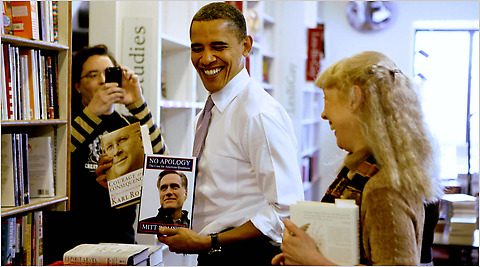
Jan Weissmiller was the first employee of Prairie Lights, beginning in 1979, and is now its co-owner.
Podcast: Play in new window | Download
Derrick Jensen: Lives Less Valuable
April 4, 2010 by David
Filed under Fiction, WritersCast
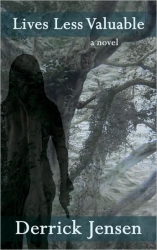 978-1-60486-045-0 – paperback – Flashpoint Press/PM Press – $18.00
Derrick Jensen is one of the most intelligent nonfiction writers around. His intellectual ability, brilliant writing and passionate voice for nature, for the powerless (not just people, but our fellow plant and animal species), and for the wounded, have made him a hero for many who oppose the structures of modern society. I was not familiar with his fiction before reading Lives Less Valuable. It’s very difficult to write fiction with a political message, but Jensen succeeds here. Even though the reader knows there is a political subtext, the story and the characters work well, they’re both believable and instructive.
The story centers on Malia, an environmental activist in a modern city where people are dying from a toxic river. The corporation that is at the root of the problem does everything possible to maximize its profits and does not care about the environmental cost borne by the poor people of the city. She is drawn into a complex web of events that forces her to make choices about her beliefs and what she must do to make meaningful change, and when she does, the effects of her choices resonate through the lives of many others. And they do make a difference.
Talking to Derrick Jensen was a great experience for me. He has so much to say about human beings, our relationship to nature, and the meaning of political action, not to mention writing and story telling. In this interview he talked about many subjects, including the nature of activism, the difference between writing fiction and nonfiction, and the details of the writing of this book. He’s as eloquent and brilliant a speaker as he is a writer. Derrick Jensen truly is one of our great public intellectuals. Please note that this interview is longer than usual at 32 minutes, but should reward the listener with a worthwhile experience.
Podcast: Play in new window | Download
E.M. Broner: The Red Squad
March 28, 2010 by David
Filed under Fiction, WritersCast
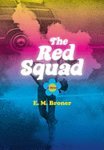 978-0307-37791-3 – Hardcover – Pantheon – $24.00 (also available as an e-book; a paperback edition will be out in July 2010 – 978-0307-45584-0 – $15.00)
This is a sometimes hilarious, always engaging, warm and sexy novel about a group of midwestern academics from the sixties, told from the vantage point of Anka Pappas, who, forty years after this fraught period in her life, finds out the entire group was under surveillance by the federal, state and local governments. The story weaves together past and present, as Anka reconnects with her friends and associates – much drama, emotion, and memory unfolds, demonstrating that the past is not at all a dead or forgotten issue. It’s a complicated story that Ms. Broner tells quite skillfully, keeping alot of balls in the air (it does help to have a cast of characters in the front of the book to which the reader can refer, as there is alot of perspective changing going on, sometimes at very high speed).
Broner knows that the political engagement of the sixties and early seventies can not be seen as an isolated period. It is deeply connected to our present. And through this book, she shows us that the issues that engaged the young activists of that earlier period are still with us today. The power relationships in our society ultimately have not been changed; there is much work to be done, and much more engaged life to be lived.
There’s no preaching here, this is a book written by a smart, accomplished writer, who knows how to make a story work, and who clearly had a great time writing this book. Talking to Esther Broner about the book was alot of fun for me. In this interview, she talks about this book and how it relates to her own life. We talk about politics, the nature of fiction and nonfiction, memoir and story, reality and imagination, appearance and reality, and of course the connection between the activism of the 1960’s and how it relates to us today.
This is an enjoyable, funny book that carries a powerful political and emotional punch, written by a skilled and experienced author whose work deserves a wide audience.
Podcast: Play in new window | Download
Publishing Talks: David Wilk Interviews Don Linn
March 23, 2010 by David
Filed under Ebooks and Digital Publishing, PublishingTalks
 In this series of interviews, called Publishing Talks, I have been talking to book industry professionals, each of whom has a different perspective about the future of publishing, books, and culture. This is a period of disruption and change for all media businesses.
Publishing has been a crucial part of human culture for as long as people have been writing and reading.
In this series of interviews, called Publishing Talks, I have been talking to book industry professionals, each of whom has a different perspective about the future of publishing, books, and culture. This is a period of disruption and change for all media businesses.
Publishing has been a crucial part of human culture for as long as people have been writing and reading.
How will publishing evolve as our culture is affected by technology, climate change, population density, and the ebb and flow of civilization and its economics? Publishing Talks interviews help us understand the outlines of what is happening, and how we might ourselves interact with and influence the future of publishing as it unfolds. Publishing Talks interviews give people in the book business a chance to talk about ideas and concerns in a public forum that are often only talked about “around the water cooler,” at industry conventions and events, and in emails between friends.
I believe that these interviews give people inside and outside the book industry a chance to hear first hand some of the most interesting and challenging thoughts, ideas and concepts that are currently being discussed within the industry.
I’ve know Don Linn for a number of years, dating back to when he took over the then beleaguered Consortium Book Sales & Distribution, the very excellent but financially challenged distributor of independent literary publishers based in St. Paul, Minnesota. At that point Don took on the very tough job of running a stand-alone book distribution business at a time of great flux in the book business, and did a very fine job of it, by all accounts, finally selling Consortium to the much larger Perseus Books, where it and its many outstanding publisher clients have found safe haven. Don later went on to be publisher at Taunton Books in Newtown, Connecticut, and now has joined the ranks of the independent publishing professional. He’s blogging too, his Mississippi roots showing, at Bait ‘n’ Beer which is both entertaining and edifying.
Here’s his current bio: “Don has a sordid past as an investment banker, cotton and catfish farmer, book distributor, publisher, entrepreneur and general ne’er-do-well. He’s a graduate of Harvard Business School and Vanderbilt University and is endlessly fascinated by books and publishing and their collision with technology. Among other things.”
Don’s intelligence and wit are on display in our talk. His business background and love of books, publishing and the people in the business provide him with a really interesting perspective, and it’s clear he has been thinking hard about the book business and where it is going. He wrote a terrific report on the recent O’Reilly Tools of Change that attracted my attention, and led to this conversation about where publishing is headed in the emerging digital distribution environment. I think his views and opinions will be valuable to publishers of all sizes.
Podcast: Play in new window | Download
J. Phillips L. Johnston: Biscuitville: The Secret Recipe for Building Sustainable Competitive Advantage
March 22, 2010 by David
Filed under Non-Fiction, WritersCast
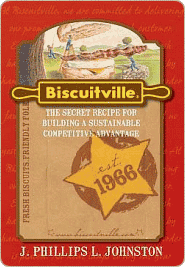
978-1-935212-05-8 – Hardcover – Easton Studio Press – $21.95
Biscuitville – the company – is a small family owned chain of breakfast restaurants based in North Carolina. It’s a very successful company financially, but what makes it special is its commitment to real values and to its people above everything else. This is a company that “walks the talk” in ways that are really striking and deserve attention.
Despite knowing about and even having lived in North Carolina at one point, I had not heard of the company before reading this book. I was really impressed by what I learned here. This is not your standard issue company, nor is this your standard issue business book. Author Phil Johnston is a veteran in business himself, as his biography indicates: he’s a “serial CEO”, having founded 10 successful venture-backed companies, earning him the CED Entrepreneur of the Year award in 1997. He has been a director of five public companies, including a NYSE-listed company. He holds degrees in economics from Duke University, The Stern Graduate School of Business at NYU, his J.D. from the University of North Carolina Law School and was a scholar at the JFK School of Government at Harvard.
This book tells the story of Biscuitville, the company, but the focus of the book is really about seeing this successful small business as a model for how all business should work. Scale is no excuse for giving up the values that have marked the growth of the Biscuitville chain. Anyone in business can learn from the lessons taught by the founders and subsequent generations that are now operating Biscuitville. It’s really a great story, optimistic and uplifting for anyone who wonders whether American business can be saved.
In my interview with author Johnston, we talked about the Biscuitville company story, and how he came to write it, and we touched upon his wide experience in business, especially on the public side, and how the lessons of this small private company can be transferred to bigger businesses and organizations. Phil is a great storyteller, with broad and deep knowledge, and an understanding of business issues I hope more people will get to experience through this talk.
Posted 3.22.10. An excerpt of the book can be found at Chptr1.com.
Podcast: Play in new window | Download
Mary Sharratt: Daughters of the Witching Hill
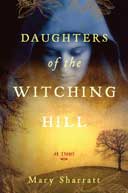
978-0547069678 – Hardcover – Houghton Mifflin Harcourt – $24.00
I really enjoyed reading this book and came to admire its author, not only for her writing skills, which are very good indeed, but because she was able to so deeply and movingly inhabit her characters in a place and time so foreign from our own. Mary Sharratt’s novel is transcendent in many ways. It centers around the years leading up to the 1612 Lancashire, England, witch trials that resulted in the executions of nine supposed witches. Mary Sharratt has brilliantly imagined her story, in which witchcraft is real, albeit not evil in the way the accusers made out. It’s much more complicated – in fact this witchcraft is the folk medicine and healing power of the local spirits of pre-Christian England. Never preachy, Sharratt gives us a countryside where politics and money separate people from one another, and crushing poverty is the lot of so many.
Widowed mother Bess Southerns supports her family and friends by healing the sick, telling fortunes, and blessing those facing misfortune, conjuring charmes that combine forbidden Catholic ritual, medicinal herbs, and guidance provided by her spirit-friend, Tibb. Bess is always careful, knowing the dangers her powers create for her but eventually everything unravels in a series of events that finally gets Bess, her family, friends and supporters into inevitable trouble with the law. Sharratt has crafted a beautiful historical novel that brings this era to life and gives its people she writes about a deep and complex life that many will find surprising. The conflicts between religions, as well as the conflicts between class are here, as well as mystery and suffering and beauty too. The book is set in the English countryside where the author, an American, currently lives. It’s clear to me that Mary Sharratt has allowed this place to inhabit her, as much as she it. She has put together a beautifully crafted story, full of complexity and compelling characters, and even knowing how the book must end, I was hooked from beginning to end.
As a reader I was transported there with her, and found her story uplifting, painful, and beautiful all at the same time. This is a wonderful book.
In my interview with Mary, we talked about her experience as an American living in the English countryside, and how she came to write this book. We talked about the story itself, her characters, their lives, the nature of English witchcraft of the 16th century, power and politics and the warp and weave of her excellent story.
Podcast: Play in new window | Download
Dolen Perkins-Valdez: Wench
March 4, 2010 by David
Filed under Fiction, WritersCast
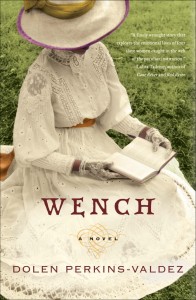 978-0061706547 – Hardcover – Amistad/HarperCollins – $24.99
Dolen Perkins-Valdez’ first novel, Wench, just blew me away. The writing is beautiful, and the story is compelling. Perkins-Valdez has been able to imagine her characters in a very difficult time, in very difficult circumstances, capturing their pain and suffering as well as their joys, and the complexity of life lived by humans. No stick figures here, male or female, black or white. The author is sympathetic in the strongest sense of that word – she understands people. She does not excuse anything, but she is able to imagine who they are, and therefore her readers are given no excuses either. Here’s the story of the book (I took this from the author’s own website, which is one of the better author websites I have seen recently):
In 1851, a lawyer named Elias P. Drake purchased a plot of land near Xenia, Ohio with the intent to establish a summer vacation resort where the country’s elite could relax and enjoy the mineral springs in the area. At the time, it was believed that natural water could cure illnesses and bring about good health. What made this resort unusual, however, was that it became a popular vacation destination for southern slaveholders and their enslaved mistresses. Ultimately, these flagrantly open relationships offended the northern abolitionists who also frequented the resort. After four years, the resort closed.
This part of the story has been confirmed by historians. I took this forgotten historical note and sketched in a fictional account of what it would have been like to be an enslaved woman traveling to this free state each summer. Why wouldn’t the women try to escape? What kinds of emotional attachments did they have with these men? Initially, I believed that it was entirely possible that they actually loved the men. Ultimately, I discovered that it was much more complicated than that.
Situated in the free state of Ohio, Tawawa House offers respite from the summer heat. A beautiful, inviting house surrounded by a dozen private cottages, the resort is favored by wealthy Southern white men who vacation there, accompanied by their enslaved mistresses.
Regular visitors Lizzie, Reenie, and Sweet have forged an enduring friendship. They look forward to their annual reunion and the opportunity it affords them to talk over the changes in their lives and their respective plantations. The subject of freedom is never spoken aloud until the red-maned, spirited Mawu arrives and voices her determination to escape. To run is to leave behind the friends and families trapped at home. For some, it also means tearing the strong emotional and psychological ties that bind them to their masters.
When a fire on the resort sets off a string of tragedies, Lizzie, Reenie, and Sweet soon learn tragic lessons,that triumph and dehumanization are inseparable and that love exists even in the cruelest circumstances as they bear witness to the end of an era.
That’s the bare bones of the story. Obviously, you need to read this book to understand how good it is. And do listen to this interview. In it, Dolen talks about how she became a writer, how this book came about, how she feels about her characters, and a great deal more. Dolen Perkins-Valdez is a writer who deserves our attention. I’m very much looking forward to her next book, and hoping she will be writing many more after that.
As an aside, the cover is beautiful, and perfect for this book, and has a sort of subliminal effect on me, which maybe contributed subtly to how much I liked reading this book and talking to its author.
Podcast: Play in new window | Download
Kelli Stanley: City of Dragons
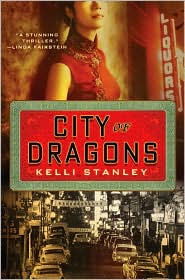
978-0312603601 – Hardcover – Thomas Dunne/Minotaur Books – $24.99
Reading Kelli Stanley’s City of Dragons was a pleasure from beginning to end. I liked her incredible attention to details in the San Francisco of the 1940s setting. I really liked her main character, the wounded private eye, Miranda Corbie. Kelli’s love of noir fiction, and love for a great story really show. Good fiction should be able to take you into another place and time coupling the author’s skills with your own imagination. This book certainly succeeds in grabbing you early, and keeping your attention. Anyone who has read and loved the great classic detective novels will feel at home with Kelli Stanley’s writing. And she has that political edge that so many writers of the 30s and 40s brought to their work.
There’s a lot going on here. You can feel San Francisco in the dark of pre-World War II, taste the cigarettes and booze, and feel the very real danger her characters experience, the otherness of Chinatown, and the deaths and broken lives that dot this sometimes harsh and painful cityscape. And you can feel throughout how much heart and soul the author has put into this book. It’s a pleasure to read, and has a story that won’t let go. Lots of fun overall, and City of Dragons works on many levels, so it will satisfy readers looking for entertainment or something with a bit more depth as well.
Kelli loves her work and loves to talk about it too, so we had a great conversation. This is a writer with a great future and I am very much looking forward to her next book. I’m also hoping to get her to contribute a reading from this novel to Writerscast in the near future. Kelli’s own website is worth a visit as well. City of Dragons is available as an e-book in various formats, and in digital audio as well.
Podcast: Play in new window | Download
David M. Carroll: Following the Water
February 7, 2010 by David
Filed under Non-Fiction
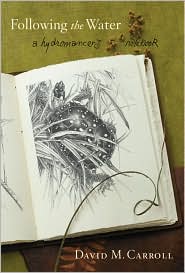 978-0547069647 – Hardcover – Harcourt Houghton Mifflin – $24.00
David M. Carroll has been “following the water” for almost his entire life. He grew up in Connecticut, then lived in Massachusetts, and moved to New Hampshire to find places less disturbed by humans, where he could study turtles and their woodland, waterine habitats. Which he has done now for many years. Following the Water is subtitled “A Hydromancer’s Notebook; a hydromancer would be one who divines by the motions or appearance of water, which is certainly descriptive of what David Carroll does in his life and in this book, a poetic journal of a year of divining the natural world by close observation of it.
Most of us spend far too little time in nature, and many of those who do “use” the natural world for entertainment or work in a way that would be difficult to distinguish from how they treat the non-natural world. What is so beautiful about Carroll’s work and his writing about it, is the depth of his observation, and his literal being in place. Reading his elegiac descriptions of the watery environments of New England transported me to an almost metaphysical trance-like state of mind where I could imagine myself inhabiting the outside space in which he spends so much of his time.
Of course there is a terrible sadness in this book, as Carroll experiences the changes in the places he has known so well and so long, always brought on by the effects of constantly encroaching human development. He knows the turtles and their environments will soon be threatened and knows there is almost nothing that can be done to protect them. This is a feeling that many who work in and strive to protect our remaining wild places share, an ever present sense of desperation, as we near the tipping point of urban and suburbanization.
Carroll writes beautifully, and his drawings are exquisite. Reading this book made me wonder how I had managed to miss reading his earlier books, and has spurred me to go out and get them all. Here’s a perfect example of the quiet power of his prose:
“As daylight diminishes, the peep-frog chorus intensifies in the backwaters of a fen a quarter mile away. With raucous clamor and a rushing wind of wings beats a flurry of grackles lifts off from the topmost canopy of the red maple swamp. In the quieting that follows, I hear again the drift of evensong from their red-winged cousins on the far side of the wetland mosaic. The season, like the water glimmering all around, extends before me.”
David Carroll is as enjoyable to hear talking as his writing is to read. Interviewing him was a pleasure, tinged with a shared sense of dismay about what has happened to our shared New England natural environment. Both this book and this talk are among my favorites, and I hope listeners will agree.
Podcast: Play in new window | Download
Matthew Aaron Goodman: Hold Love Strong
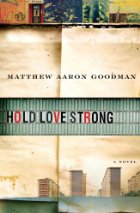 978-1416562030 – Hardcover – Simon & Schuster Touchstone – $24.99
This is flat out one of the best books I have read in a long time. It begins with an incredible story that grabs you instantly and will not let go. I felt like I was holding my breath almost throughout the book. Matthew Aaron Goodman avoids cliches at every turn, loves his characters, demands respect for them from beginning to end, but never hides from the pain and suffering they experience. As readers, we feel like we are living in, through and with his characters, which is a triumph of both the author’s imagination and his deeply felt love for the people he writes about.
It’s difficult to believe that this is Goodman’s first novel. His mastery of language, his ability to inhabit the hearts and souls of his characters, and the simple clarity of his voice are all remarkable for any author, much less a first novelist. I was blown away, and have been recommending this book widely to friends and colleagues.
Cornel West gave it a very fine blurb that is worth reprinting here: “Matthew Aaron Goodman’s Hold Love Strong is a powerful and poignant story of the gallant Abraham who struggles on the night side of American society yet exudes a light of genuine hope. Goodman is an activist and artist who never loses sight of the humanity of those either imprisoned or free!”
I also recommend readers to visit Matthew’s own site where you can read some more of his work. In 2007, working hand and hand with formerly incarcerated men and women, Matthew created The Leadership Alliance, a community empowerment project that unites recently freed people with volunteer partners. And there is a wonderful review of Hold Love Strong by Nina Sankovitch on Readiac that I think describes perfectly the power and impact this book can have on readers.
In my interview with Matthew, we talked about his own life story to help understand how he came to write Hold Love Strong, the work he has done in New York communities and elsewhere, and alot about the book itself, its characters and story, and of course what he is working on now. He is as compelling talking about his work and ideas as he is writing about them.
Podcast: Play in new window | Download