
Colin G. Calloway: The Victory with No Name
January 2, 2017 by David
Filed under Non-Fiction, WritersCast
 The Victory With No Name: The Native American Defeat of the First American Army – Oxford University Press – paperback – 214 pages -978-0190614454 – $16.95 (ebook versions available at lower prices)
I think it’s safe to say that most Americans have not given much thought to the very early history of the United States. During the first decades after the country was formed, there was much concern about the survival of the new nation. The British were still well established in the north, the Spanish were in the south and southwest, and large numbers of Indians inhabited the vast area to the west. Pressure was being exerted on the federal government to open these western lands to settlement, putting the US on a collision course with the natives who lived there.
This area was known as the Northwest Territory – comprising what are now the states of Ohio, Indiana, Illinois, Michigan, Wisconsin and parts of Minnesota. Almost all Americans dismissed the land claims of the Native Americans. These tribes they saw simply as impediment to American growth. While some American leaders preferred to purchase the Indians’ land, the need for the government to pay its debts by selling (Indian owned) land overwhelmed all other concerns, and led ultimately to a war of extermination with the tribes.
Historian Colin G. Calloway is exceptionally perceptive and knowledgeable about the early history of the United States of America. This short, well written book focuses on a single unnamed battle that took place in late 1791 in what is now Fort Wayne, Indiana. In this period, before there was a standing army, President George Washington ordered Arthur St. Clair, the governor of the Northwest Territory, to direct a military campaign aimed at defeating the tribes that had refused to accept the unfair land deals the United States had proposed to them.
Calloway shows that the Native Americans were well organized and well-led, both politically and militarily. This surprised St. Clair as much as it may surprise us today. The American Indians were led by Little Turtle of the Miamis, Blue Jacket of the Shawnees and Buckongahelas of the Delawares (Lenape). Their war party numbered more than one thousand warriors, and included a large number of Potawatomis from eastern Michigan, a broad confederacy presaging similar Indian efforts to come in later years.
As Calloway points out: “Indians fielding a multinational army, executing a carefully coordinated battle plan worked out by their chiefs, and winning a pitched battle—all things Indians were not supposed to be capable of doing—routed the largest force the United States had fielded on the frontier.” It’s useful to note that the American army was poorly organized, included a large number of ill-trained militia, and was also victimized by crooked suppliers, starting a longstanding American tradition of private gain by military purveyors we recognize all too well today.
Unfortunately for the Native Americans, their victory was short lived. The stunning American defeat led directly to a number of changes in the way the new government operated. The House of Representatives initiated the first investigation of the executive branch, Congress established a standing army and gave the president authority to wage war. A liquor tax was created to finance the Army (which led to the Whiskey Rebellion that ironically, President Washington used the tax-financed militia to put down). The Indian confederacy did not last, and in 1794, General “Mad Anthony” Wayne built Fort Recovery and defeated another Indian war party at the Battle of Fallen Timbers, ultimately bringing an end to Northwest Territory Indian resistance and opening the way for the first stage of westward growth of the new American nation.
There is so much interesting history that relates directly to the story told in this book. It’s a compelling read for anyone interested in the early period of the American republic. My conversation with Colin Calloway reflects the stirring nature of his book, and the breadth of his knowledge. This book is an important American story, well told, and I highly recommend it.
Colin Calloway is the author of a number of excellent works, including one of my personal favorites, One Vast Winter Count: The Native American West before Lewis and Clark. He is the John Kimball, Jr. 1943 Professor of History and Professor of Native American Studies at Dartmouth, where he has taught since 1990. He received his Ph.D. from the University of Leeds in England.
Length note – this interview is slightly longer than average at about 35 minutes.

Podcast: Play in new window | Download
Charles Kaiser: The Cost of Courage
December 12, 2016 by David
Filed under Non-Fiction, WritersCast
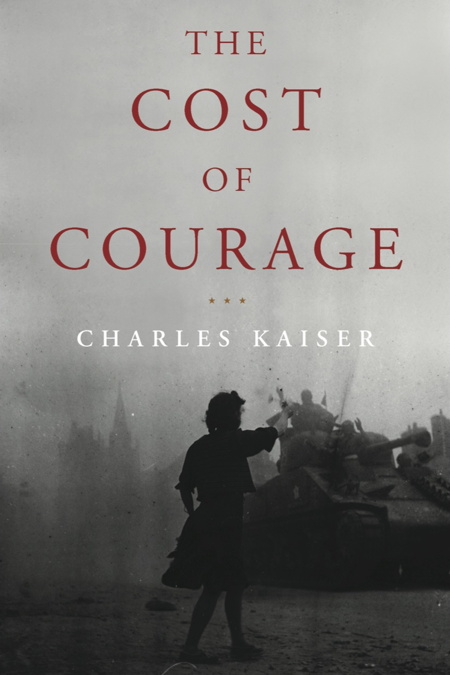 The Cost of Courage – Other Press – Hardcover – 288 pages – 9781590516140 – $26.95 (ebook versions available at lower prices)
I read this beautifully written book about one family’s experience of World War II in France just before our recent election. At that time, I was not expecting to have to think about it in the context of our own political situation. Even without understanding that the incredible courage of his subjects may be instructive to us today, this book is about an incredible story of bravery and sacrifice. As of this moment, The Cost of Courage must be read in a new context.
All of us need to consider the lessons learned from the experience of everyday people in horrible circumstances like those of the French in occupied France. These were times of brutal repression and daily violence for individuals who constantly made momentous moral decisions with life and death consequences.
The Cost of Courage recounts the true story of the three youngest children of a bourgeois Catholic family, who worked heroically in the French Resistance during the Nazi occupation of France. Charles Kaiser was lucky enough to know this family from the time he was a small boy, because his uncle was billeted with them after the liberation of Paris by Allied forces.
In 1943, André Boulloche was working underground as General Charles de Gaulle’s military representative in Paris, coordinating Resistance activities in northern France. Unfortunately, he was betrayed by one of his associates, arrested and taken prisoner by the Gestapo. His two younger sisters continued to fight against the Germans until Paris was freed in 1944. André Boulloche managed to survive his time in three concentration camps through sheer force of will.
The elderly Boulloche parents and the oldest brother were also arrested when the Gestapo tried to capture the two sisters. Tragically, these three were on the last train the Germans ran from Paris to Germany before the Allies liberated the city, and they died soon after in Nazi concentration camps.
After the war, the Boulloches remained silent about their terrible wartime. Ultimately, Charles was able to convince the last surviving sister to finally tell her family’s incredible story. The Boulloche story is moving and powerful, and we are fortunate it could be told to us by this fine and sensitive writer.
It was a true pleasure for me to be able have this opportunity to talk to Charles about his book and his experience of writing it. Charles and I were in high school together, but have had very little contact since then, and while I have followed his outstanding career as a journalist and author, we have not talked often over these many years. I am gratified to have read this book, and have been inspired by its story. I urge my listeners to read The Cost of Courage, as we are ourselves now live through times that will challenge our own willingness to pay the true cost of courage.
Charles Kaiser started writing for The New York Times while still an undergraduate at Columbia. He spent five years at the Times as a reporter, and after that was the press critic at Newsweek for two years. After writing about media and publishing for the Wall Street Journal, he wrote his first book, 1968 in America, published in 1988. His highly praised book, The Gay Metropolis was published in 1997.
His writing has appeared in New York, the New York Observer, Vanity Fair, the Washington Post, the Los Angeles Times and Manhattan,Inc. among many other publications.
Kaiser was a founder and former president of the New York chapter of the National Lesbian and Gay Journalists Association. He has taught journalism at Columbia and Princeton, where he was the Ferris Professor of Journalism. To learn more about his work, visit his website here.
“In this poignant personal tale, Kaiser explores the emotions and breaks through the silences that haunted an amazing family after their experiences in the French resistance to Nazi occupation. The result is a compelling and heart-wrenching book about courage, love, and the complex shadings of heroism.”
—Walter Isaacson

OLYMPUS DIGITAL CAMERA
Podcast: Play in new window | Download
Abigail Tucker: The Lion in the Living Room
December 4, 2016 by David
Filed under Non-Fiction, WritersCast
 The Lion in the Living Room: How House Cats Tamed Us and Took Over the World – Simon & Schuster – 256 pages – ISBN 9781476738239 – October 2016 – $26.00 (ebook versions available at lower prices)
Let me start off by stating forthrightly that I am not a cat person. I much prefer dogs. But I am intrigued by the fact that so many otherwise rational people are completely irrational about cats. And while I don’t love them, I certainly do not hate cats, and am interested in understanding their role in human culture. It’s always seemed that the cat’s relationship to humans is more complicated than that of the dog, and this thoroughly compelling – and entertaining – book by science writer, Abigail Tucker, certainly makes that clear.
Tucker covers alot of ground with this book, and it will be a fun read not just for those who are besmirched with cat fancy. As the fine science writer she is, Abigail Tucker has taken years of research into animal biology, as well as human and animal behavior, and made a great story out of it all.
If you love cats, this book will help you understand why, and may even teach you how to be a better (and more effective) cat owner. If you are more of a cat tourist, or even if you don’t like them at all, you still will want to know more about what makes them tick. After all, these are semi-untamed apex predators living in our homes. That’s a pretty interesting notion to consider just by itself.
Tucker shows great humor and personality throughout this book, as she demonstrates that these animals, whose powers we have probably underestimated, have managed (us) to become one of the most dominant species on our planet. That may help all of us understand who these beasts are that live among us.
As Tucker says about the book herself:
It wasn’t until recently that I felt ready to cover an animal whose habitat is also my own house. But as soft and fuzzy as domestic cats may initially seem, The Lion in the Living Room presented a major journalistic challenge, since I hoped to simultaneously draw from the two schools of animal-writing: using the strange story of house cats’ rise to global dominance as a means to understand humanity’s vast environmental influence and — more importantly — as a narrative end unto itself. Rather than snuggling my subjects close, I tried to keep house cats at arm’s length, like termites or red-painted rattlers, to be handled with snake hooks and trembling hands — the better to see them for the exquisite conquerors they really are.
Abigail Tucker is a correspondent for Smithsonian magazine, where she has covered a wide range of topics from vampire anthropology to bioluminescent marine life to the archaeology of ancient beer. The Lion in the Living Room is her first book. She now lives in Ridgefield, Connecticut, where she grew up (as I did as well).
Abigail and I had a wide-ranging chat about this book that I hope you will enjoy as much as I did. You can read or listen to an excerpt of the book here at the (very good) Simon & Simon site.

Podcast: Play in new window | Download
Louie Cronin: Everyone Loves You Back
November 20, 2016 by David
Filed under Fiction, WritersCast
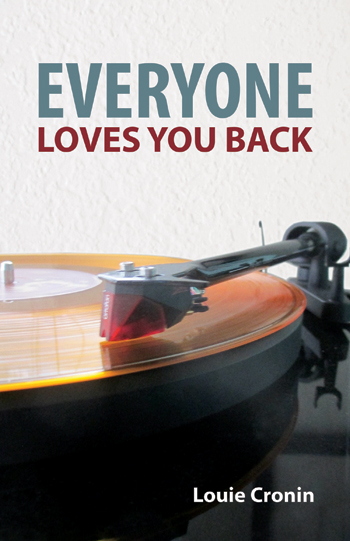 Everyone Loves You Back – 9781941576229 – Gorky Press – paperback – $15.95
I very much enjoyed reading this well written and humorous novel. It’s set in Cambridge (“our fair city” MA), and depicts the sort of culture clash that has occurred all over America as livable cities are reinhabited by the latest version of what we used to call yuppies. These newcomers to city neighborhoods have completely different values – and economic realities – than the folks who grew up there. It’s a rich environment for fiction too. So this is a novel that will likely resonate for many readers on a sociopolitical basis, in addition to its deft handling of the relationships between the sexes. And because Cronin comes from public radio – she was a producer and writer for the much loved and missed Car Talk – the setting of this novel is one that many of us whose industries have undergone wholesale modernization, can appreciate as well.
Is there a category of novel for “late Baby Boomer” coming of age stories set in the present? I am not well enough read to say. The publisher calls this a “coming of middle-age novel,” which seems apt. I do think that especially for readers of “a certain age” this book could become a favorite. And you don’t have to struggle with a changing neighborhood or have issues with your love life to appreciate the joyfulness and humor of this novel.
Louie and I had a fun time talking about her book, her work and the way she was able to inhabit her male main character, a feat of imagination and courage for any novelist.
Louie Cronin is a writer, radio producer, and audio engineer. She worked as a producer/writer for Car Talk on NPR for ten years. Her fiction and essays have been published in a variety of magazines and journals. She is not the technical director for PRI’s The World and lives in Boston with her husband, the sculptor James Wright.
Podcast: Play in new window | Download
Lara Naughton: The Jaguar Man
November 12, 2016 by David
Filed under Non-Fiction, WritersCast
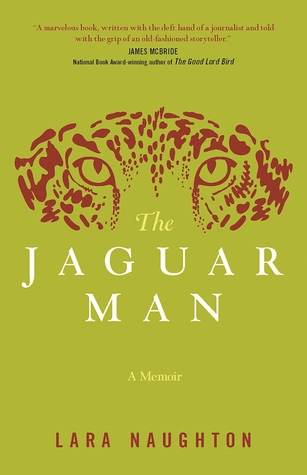 The Jaguar Man – 9781942094203 – paperback – Central Recovery Press – $15.95 – ebook editions available at lower retail prices
The Jaguar Man is a harrowing, powerful and uplifting memoir. On the fourth day of a long awaited vacation in tropical Belize, and in the midst of a new romance, author Lara Naughton was kidnapped by a man who pretended to be a cabdriver. He drove her into the forest, held her captive and raped her.
In this deftly written memoir, Naughton describes how she coped with her ordeal with the figure she called the Jaguar Man. As she makes so clear in a beautiful, complicated and difficult narrative, compassion for her attacker became her only defense, her only coping method, and myth making a passage of self therapy and reclaiming of her personal power.
There is so much going on in this very short memoir, it is difficult to easily describe. I don’t think I can remember reading such a vivid, honest and convincing story. Lara Naughton changes up all our expectations of what it means to be a victim of sexual assault.
In her story telling, Naughton works with myth and spirituality to make sense out of her difficult experience and to be open to the power of compassion. Talking or writing about rape and assault is scary and challenging. Naughton has taken on this difficult task with grace and brilliance. She works through an impossibly difficult experience, using the magic of telling as a way to both navigate and make sense of the psychological effects of trauma both for herself and for readers. It’s completely transformational. I can’t think of any book I can compare to this one.
Our conversation about this book and Lara’s experience was truly rewarding for me and I hope for all my listeners. The opportunity to speak with her about this book was important and deeply meaningful to me.
 I have seen many amazing reviews for this book. Clearly, this book has been extremely powerful to many readers, and can be highly recommended.
“A marvelous book written with the deft hand of a journalist and told with the grip of an old fashioned storyteller.The magic of this book is not so much that Lara Naughton had to reach deep into a cauldron of wit and courage to survive an ordeal from a vicious, twisted villain, but rather that her redemption created a new level of understanding and wisdom that she embraced, so that she might live long enough to share this wisdom with others.That is why we read books.And that is why this is an excellent one.”
—James McBride, National Book Award-winning author of The Good Lord Bird
Lara Naughton, MPW, is Director of New Orleans based Compassion NOLA. She has worked with students K-12 as well as adults, and has led workshops with individuals who have faced challenging circumstances, including homelessness, HIV/AIDS, wrongful conviction, incarceration, and torture. As a writer and documentarian, she often incorporates personal narrative exercises into her classes, and assists individuals who wish to tell their own stories. She is Chair of Creative Writing at New Orleans Center for Creative Arts, and a certified Compassion Cultivation Trainer through the Center for Compassion and Altruism Research and Education (CCARE) at Stanford University School of Medicine. Visit her website for much more about this book and her work.
Podcast: Play in new window | Download
David Wilk interviews poet and publisher Bill Corbett
October 30, 2016 by David
Filed under Publishing History, PublishingTalks
 Publishing Talks began as a series of conversations with book industry professionals and others involved in media and technology about the future of publishing, books, and culture. As we continue to experience disruption and change in all media businesses, I’ve been talking with some of the people involved in our industry about how publishing might evolve as our culture is affected by technology and the larger context of civilization and economics.
I’ve now expanded the series to include conversations that go beyond the future of publishing. I’ve talked with editors and publishers who have been innovators and leaders in independent publishing in the past and into the present, and will continue to explore the ebb and flow of writing, books, and publishing in all sorts of forms and formats, as change continues to be the one constant we can count on.
For the past several years, I’ve been talking to editors and publishers of independent presses about their work, including a number of important literary publishers. It’s a great pleasure for me to add Bill Corbett to this group. He’s been a key figure in the Boston literary scene for more than forty years, though he has now moved to Brooklyn.
Corbett’s house in the South End was an essential literary salon for local and many visiting artists, poets, and writers. Corbett has been active in what has been known as the “New York School” of poets, with a deep and abiding interest in the intersections of art and poetry. In a review of Corbett’s All Prose, Kevin Gallagher said “Corbett is ambassador to a strange land.”
Editing and publishing have also been central to Corbett’s work. He edited the literary journal Fire Exit with Fanny Howe and The Boston Eagle, with Lewis Warsh and Lee Harwood, wrote for the Boston Phoenix, and has been involved with literary magazines Ploughshares, Agni, and Grand Street. In 1999, Corbett founded Pressed Wafer, a small press publishing poetry, essays, and art writing. Corbett taught writing at MIT, and also has taught at Harvard and Emerson.
Patrick Pritchett summed up Corbett’s work rather well as follows:
For several decades now, Corbett has been one of our leading men of letters – the phrase itself has been rendered almost extinct in this age of ubiquitous bloggery and relentless peer-review – but I use it here to indicate a breadth of range and a fineness of attention that once upon a time was the norm, rather than the exception. As poet, essayist, memoirist, art critic, literary historian, publisher and tireless promoter of other writer’s work, Corbett is – yet ought not to be – sui generis. But even if the present time were more thickly populated by writers of comparable range, he would still be a force to be reckoned with, in a category of his own.
In this conversation, we talked about a wide range of topics, but it seems we may have barely scratched the surface of Corbett’s work in art and writing. I hope we will have a chance to talk again soon.
Links:
Pritchett essay about Bill Corbett on the blog Writing the Messianic
Pressed Wafer books “poetry fiction essays art memoir etc”
Podcast: Play in new window | Download
David Wilk interviews Lee Klancher of Octane Press
September 6, 2016 by David
Filed under Publishing History, PublishingTalks
 Publishing Talks began as a series of conversations with book industry professionals and others involved in media and technology about the future of publishing, books, and culture. I’ve talked with publishing industry leaders about how publishing has and will continue to evolve and now include conversations that go beyond the future of publishing. I’ve had conversations with editors and publishers who have been innovators and leaders in independent publishing in the past and present. This series of talks continues to explore the ebb and flow of writing, books, and publishing.
For the past several years, I’ve been talking to editors and publishers of independent presses about their work. Many of them have been literary publishers. But there are a number of really excellent independent presses that have achieved success in other subject areas. It usually requires being specialized and knowledgeable about a specialized field, and being integral to a specific community of enthusiasts and readers, to find and sustain success.
Octane Press is one such endeavor. This fine publisher focuses on cars, farm machines, motorsports and motorcycles. This may seem a relatively narrow niche of readers, but it is one that works well for this publisher. Founded by photographer, writer and editor Lee Klancher, Octane Press is an excellent example of how to successfully build a print-based publishing business in the modern era. The company has won an array of awards, and has grown steadily since it began. I am very pleased to have had the opportunity to talk to Lee about his work and the story of Octane Press, and I think listeners interested in contemporary publishing will find his story compelling and his experience valuable.
Lee Klancher has been publishing great stories for more than twenty years. As an editor and publisher, he has worked on some of the most-respected and best-selling books in transportation publishing. He is a prolific author and an excellent photographer, and has contributed content to more than 30 books, as well as dozens of national magazines including Men’s Journal, Draft, and Motorcyclist.
Lee has taught writing and photography at the Minneapolis College of Art and Design. He is best-known for his photography of collectible farm tractors that appears in his books and calendars. Lee lives in Austin, Texas, where Octane Press is located. 

Podcast: Play in new window | Download
George Gmelch: Playing With Tigers, A Minor League Chronicle of the Sixties
August 1, 2016 by David
Filed under Non-Fiction, WritersCast
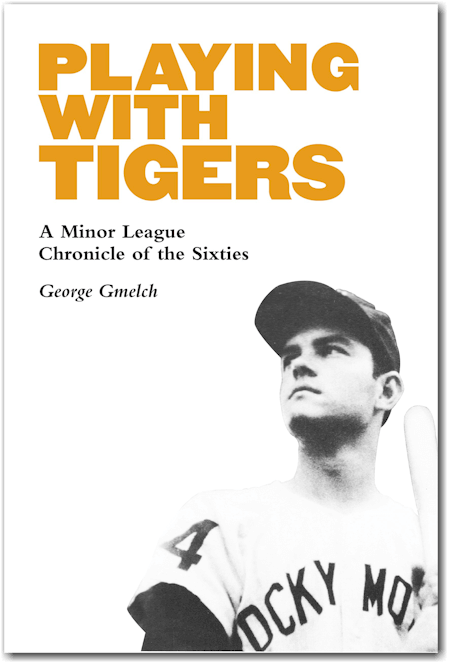 9780803276819 – University of Nebraska Press – 288 pages – Hardcover – $26.95 (ebook versions available at roughly similar prices)
Today, George Gmelch is a successful anthropologist, with a number of books to his credit. But when he was a young man, he was a very good baseball player, with the typical dreams so many shared of becoming a professional baseball player and making it to the Major Leagues. Growing up in an all-white suburb in California in the late fifties and early sixties, George led a fairly sheltered childhood, playing ball and having fun. In 1965 he signed a contract to play professional baseball with the Detroit Tigers organization and so began a four year period of coming of age, during which George experienced the challenges of life in baseball’s minor leagues.
While learning to be a professional athlete, he also became aware of the realities of race and class; minor league baseball in the nineteen sixties was often played in small towns in the south where segregation was still in effect, despite the advances of the civil rights movement. And as an adolescent on his own with other boys in the cocoon like world of pro sports, he also had his first experiences of sex and romance, living, traveling and playing ball. Somewhat unlike most of his teammates, George paid attention to the events of the era, including the Vietnam War, the rise of the counter culture, and civil rights protests.
Playing with Tigers is a memoir certainly unlike most others written by baseball players. The sixties was a time of turmoil involving young people of all backgrounds and professional baseball was not immune from its disruption. George was likely more socially aware than most of his compatriots, and his direct experience of racial issues ultimately led to the end of his professional baseball career.
To write this book, George relied on the journals he kept as a player, as well as letters from that time, and in addition he used his skills and experience as an anthropologist to interview thirty former teammates, coaches, club officials – and even some former girlfriends. This is a unique story, documenting a socially disrupted period in American history through the lives of many of the young people who lived through it. We get to experience first hand the naivete, frustrations and joys of a young man trying to find his way in a complex time. And clearly, some of the motivation for writing this book was unfinished business, events, relationships with people, his baseball experience, on which George wanted to gain some closure.
I read alot of baseball books, as many listeners know. Among the many I have read the past couple years, I found Playing With Tigers extremely compelling, and one I had fun reading. I very much enjoyed the opportunity to speak with George Gmelch for the second time – in 2013, George and I talked for Writerscast about another of his baseball books, Inside Pitch. In addition to being an intensely personal memoir, Playing With Tigers opens a door to a period in our history that deserves a lot more exploration than it seems to have been given. George has some great stories and a deep understanding and love for the people and places he’s experienced. This is a fine book and you do not need to know anything about baseball to like it.
George Gmelch is a professor of anthropology at the University of San Francisco and at Union College in Schenectady, New York. His books include In the Ballpark: The Working Lives of Baseball People, with J. J. Weiner (Bison Books, 2006), and Inside Pitch: Life in Professional Baseball (Bison Books, 2006). He is the editor of Baseball without Borders: The International Pastime (Nebraska, 2006). His writing has also appeared in the New York Times, the Washington Post, Psychology Today, Society, and Natural History.

Podcast: Play in new window | Download
David Wilk interviews Brooke Warner of She Writes Press
July 19, 2016 by David
Filed under PublishingTalks, The Future
 Publishing Talks began as a series of conversations with book industry professionals and others involved in media and technology about the future of publishing, books, and culture. As we continue to experience disruption and change in all media businesses, I’ve been talking with some of the people involved in our industry about how publishing might evolve as our culture is affected by technology and the larger context of civilization and economics.
I’ve now expanded the series to include conversations that go beyond the future of publishing. I’ve talked with editors and publishers who have been innovators and leaders in independent publishing in the past and into the present, and will continue to explore the ebb and flow of writing, books, and publishing in all sorts of forms and formats, as change continues to be the one constant we can count on.
I really enjoy talking to the innovators in our industry who are creating new modes of publishing and opportunities for writers. Brooke Warner and Kamy Wicoff founded She Writes Press in 2012 to provide writers with new publishing opportunities. Kamy operated the online community, She Writes, which was created to connect and serve women writers, both established and aspiring, and Brooke came from independent publishing.
Brooke’s first job in publishing was with the renowned North Atlantic Books in Berkeley (founded by Richard Grossinger and Lindy Hough). Subsequently, she was Executive Editor at Seal Press, working there for eight years. Toward the end of her time there, she felt she was witnessing firsthand the contracting publishing environment, where as editor, she was frequently rejecting well-written books, simply because the authors she was working with did not have the kinds of “author platforms” that commercial publishers now virtually require.
Kamy and Brooke envisioned a new kind of publishing company that would enable authors to be invited to publish based on the merit of their writing alone. They wanted to establish a publishing business for women writers that would itself enable the kind of a platform that could launch – and grow – the writing careers of their client authors. In 2014, She Writes Press became part of SparkPoint Studio, LLC., whose CEO is Crystal Patriarche.
She Writes is now a solid publishing partner for authors who might otherwise struggle with self publishing. With a strong editorial effort, traditional book distribution (through Ingram Publisher Services) and an in-house marketing and publicity team (through Patriarche’s publicity company, BookSparks) available to SWP authors, She Writes Press has become successful in the emerging category of “hybrid” publishers.
In this interview, where Brooke explains how She Writes works and the problems it is solving for now more than a hundred writers, and talks about the current and future of trade book publishing.
In addition to being publisher of She Writes Press, Brooke is president of Warner Coaching Inc., and author of Green-light Your Book, What’s Your Book?, How to Sell Your Memoir, and the co-author of Breaking Ground on Your Memoir. She currently sits on the boards of the Independent Book Publishers Association, the Bay Area Book Festival, and the National Association of Memoir Writers. She blogs actively on Huffington Post Books and SheWrites.com. She lives and works in Berkeley, California.
Length alert – we had a good time talking so this interview runs just over 45 minutes.
Podcast: Play in new window | Download
David Wilk interviews Jess Brallier
June 21, 2016 by David
Filed under Ebooks and Digital Publishing, Publishing History, PublishingTalks, The Future
 Publishing Talks began as a series of conversations with book industry professionals and others involved in media and technology about the future of publishing, books, and culture. As we continue to experience disruption and change in all media businesses, I’ve been talking with some of the people involved in our industry about how publishing might evolve as our culture is affected by technology and the larger context of civilization and economics.
I’ve now expanded the series to include conversations that go beyond the future of publishing. I’ve talked with editors and publishers who have been innovators and leaders in independent publishing in the past and into the present, and continue to explore the ebb and flow of writing, books, and publishing in all sorts of forms and formats, as change continues to be the one constant we can count on.
Jess Brallier is one of those interesting, experienced innovators in publishing with whom I enjoy talking about all sorts of book related subjects. He’s worked in adult trade publishing, but has also had significant success with children’s and YA books, has long been involved in digital technologies, and notably was instrumental in the creation of the wildly best selling Diary of a Wimpy Kid by Jeff Kinney. And he is a prolific book writer himself, as well. His vast experience has provided him with a unique perspective about books and publishing, and he is just the kind of person who makes this interview series interesting and fun for me to do.
Here’s the more or less “official” biography Jess sent me: Jess M. Brallier currently serves the publishing industry as a media and revenue agnostic consultant to small, mid, and large publishing houses, and a developer of original IP, both print and animated. His career spans th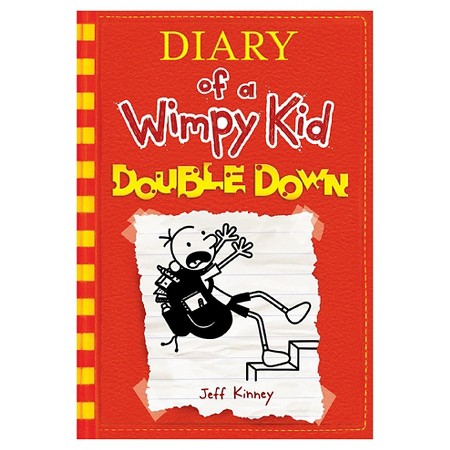 e publishing of books and digital storytelling from brick-and-mortar and the web, to virtual worlds and social media. He had his own children’s imprint, Planet Dexter (Penguin) and used the web to establish and launch newly $800M in original IP (Diary of a Wimpy Kid, Big Nate, Poptropica, Galactic Hot Dogs, etc.)
He also worked closely with, and was essential to causing bestsellers for, Norman Mailer, William Manchester, William Least Heat Moon, Herman Wouk, William Shirer, Bailey White, Anne Morrow Lindbergh, and many others. Brallier is a frequent speaker at both digital and book industry conferences, has served on the faculty of university-based publishing programs, and is the author or co-author of over 30 adult and children’s books.
I hope you enjoy listening to Jess as much as I did.
And not too long at 41 minutes, in case you were wondering.
Podcast: Play in new window | Download