
David Margolick: When Caesar Was King
June 30, 2026 by David
Filed under Non-Fiction, WritersCast
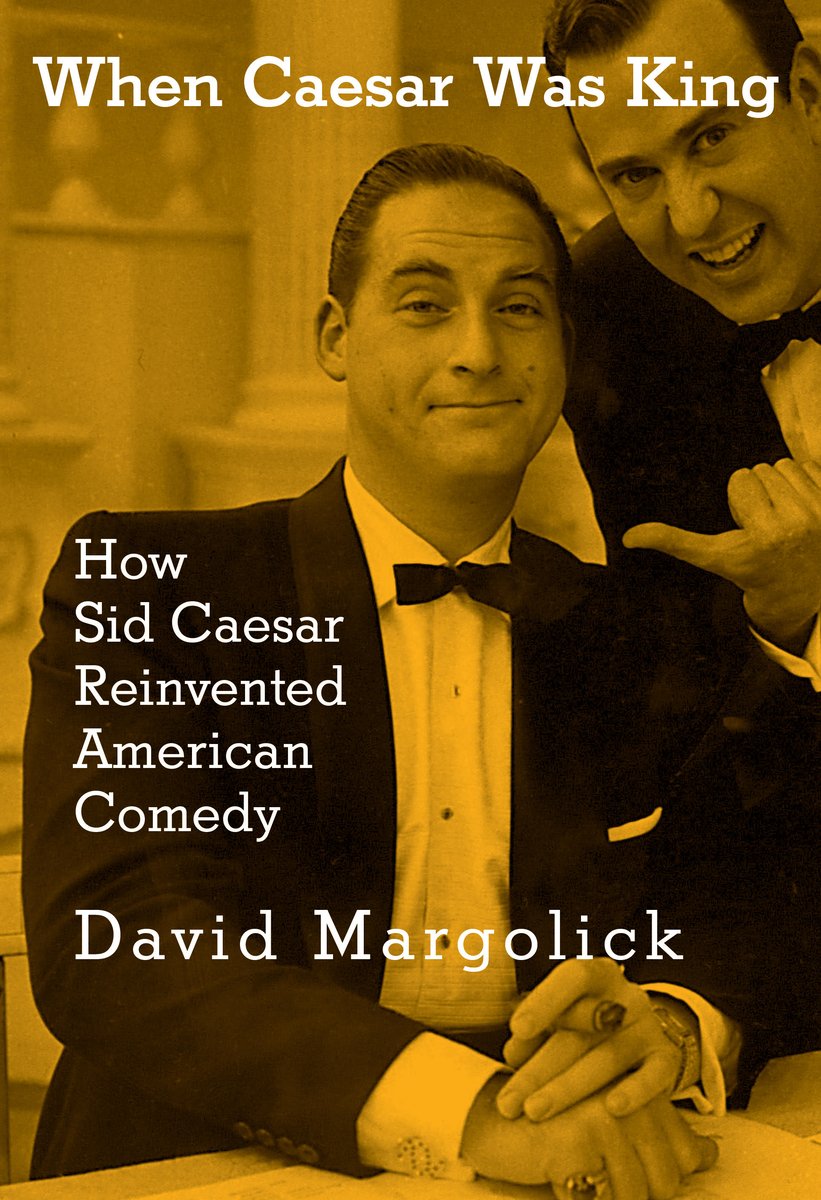 When Caesar Was King: How Sid Caesar Reinvented American Comedy – David Margolick – Shocken Books – Hardcover – 9780805242553 – 400 pages – $35.00 – November 11, 2025 – ebook edition available at lower cost, audio book also available.
I am almost the same age as author David Margolick, so was born too late to see any of Sid’s early classic shows that aired when he was establishing the way comedy would work on the then new medium, television. Growing up with a comedy writer father, Sid Caesar was legendary in our house as a revered progenitor of the current crop of television comedy, but by the time I was old enough to know who he was, Sid Caesar was no longer at the pinnacle of his success. Despite being active on TV through the sixties, seventies and beyond, he was no longer culturally relevant as he had been earlier in his career. Yet his impact on television and its audiences was massive, and I remember hearing my parents and their friends talk about Sid Caesar, Imogen Coca, Carl Reiner, and Mel Brooks and their less well-known writers, always with admiration and joy.
Whether you are lucky enough to have seen Sid Caesar in action in his early days, or know nothing about him at all, David Margolick’s biography brings Sid to life. He provides us with a vivid rendering of an extremely complicated actor/comedian. In the early 1950s, Caesar was television’s first real star, his show drawing am audience of twenty million people at a time before televisions were not even present in most homes in America. His sketches helped define the nature of television comedy for generations to come even to this day. (All you have to do is watch a Caesar sketch followed by a modern SNL sketch and you will get it.)
Most of Caesar’s writers and actors went on to their own successful and influential careers and helped define television culture for decades. His writers included Neil Simon (The Odd Couple), Larry Gelbart (M*A*S*H), Mel Tolkin (All in the Family), Woody Allen (too many to list), Mel Brooks (Blazing Saddles, The Producer) and Carl Reiner (Dick Van Dyke Show).
Sid Caesar success was relatively short-lived. As television moved to take over the heartland of America, other stars supplanted him. As Margolick makes clear, Caesar was a complicated, introverted, socially awkward person, completely unlike the public personae he portrayed in performance. He could not or would not adapt to the changing tastes of television audiences—perhaps because Caesar’s humor was based on and drawn from 20th century urban American Jewish experience, and was more sophisticated than what mass market television would support. And Caesar’s personality was not suited for the massive success he achieved.
Margolick’s research and attention to detail, interviews with key people involved in Caesar’s life and his obvious love for Caesar’s humor and culture all contribute to make this a highly readable and enjoyable book for anyone who is interested in American culture and especially television comedy.
David Margolick was a reporter on legal affairs for the New York Times, where he wrote the weekly “At the Bar” column and covered, among other stories, the trial of O. J. Simpson. He was subsequently a contributing editor at Vanity Fair. His books include Beyond Glory: Joe Louis vs. Max Schmeling, At the Bar, Strange Fruit: The Biography of a Song, Dreadful: The Short Life and Gay Times of John Horne Burns; and Elizabeth and Hazel: Two Women of Little Rock, and The Promise and the Dream. He lives in New York City.
I very much enjoyed reading this biography, which is appropriately entertaining as well as informative. It broadened and deepened my appreciation for early television comedy, a milieu I enjoy. With the ubiquity of old television clips now available on YouTube, I was able to sample some of the sketches that are described in the book, including some I had never seen. Watching Caesar in action with his great supporting casts, while reading about those people in the book will change the way you see them now. David and I had a terrific conversation which I hope you will enjoy as much as I did.



Podcast: Play in new window | Download
Kermit Moyer: The Chester Chronicles

978-1579621940 – Hardcover – Permanent Press – $28.00
What a pleasure it was to discover this writer. The Chester Chronicles is a collection of interlocking stories that serve to create what is essentially a coming-of-age novel. We are introduced to Chet Patterson as a pre-adolescent and stay with him as he grows unto early manhood. He is the son of a military man, so at the heart of the book is the peripatetic journey of a budding intellectual, who often does not fit in with the crowd and is always in search of both his internal and his social identity. There are lots of adventures along the way, many having to do with girls and sex, boys and drinking.
There are certainly elements here that will be most familiar to people of a certain age, who lived through the ’50s and ’60s, especially the defining moments of those times. But as with any good book, the character and his story transcend the specifics of the place and time in which the book is set. The point is, after all, for us to see him as a person on a journey, and to understand where he has been, and perhaps also, therefore, to understand who he will become. As the author says of himself and of his character, he is “plagued with Oedipal anxieties and existential doubt, yet nonetheless convinced of his heroic destiny.” There are several moment in the book that can make the reader laugh out loud, and there are others where it is equally impossible not to deeply feel his pain. I’d say that’s a pretty good accomplishment for any writer.
In my interview with Kermit Moyer, we talked about some of the autobiographical elements of the book, some of the stories which stood out for me as a reader, as well as some of the characters in the book that affected me the most. We talked quite a bit about autobiographical fiction and how this book fits into the tradition of fictionalized autobiography and works transformationally both for the author and the reader. Moyer provides an interesting explanation of his writing which I hope will help introduce new readers to his fine writing.
Podcast: Play in new window | Download