
Todd Goddard: Devouring Time: Jim Harrison a Writer’s Life
February 1, 2026 by David
Filed under Fiction, Non-Fiction, WritersCast
 Devouring Time: Jim Harrison, a Writer’s Life — Todd Goddard — 9781799902362 – Blackstone Publishing — Hardcover — 558 pages — $29.99 — November 4, 2025
Jim Harrison was for so many readers – and other writers – one of the central voices of American literature for the last half century. When Harrison began writing, it was as a poet, and most readers came to his fiction and nonfiction much later. It was the novels and many novellas that drew large numbers of readers to him, while his first hand style nonfiction writing about food and his many adventures introduced him to a completely different audience who in many case, I am sure, also read his fiction. And then there was the film writing and the stories of fishing, carousing and gourmand like intake of food, alchohol, and drugs with friends like Thomas McGuane, Peter Matthiessen, Jimmy Buffett, and Jack Nicholson in Key West, Montana and Hollywood. Harrison became more than a writer, but also a publicly imagined character much like Ernest Hemingway and F. Scott Fitzgerald, whose persona became entwined with his writing and made him that much more attractive to some of his readers.
His output as a writer was amazing: poetry, novels, novellas, short stories, magazine nonfiction, film scripts. His appetite for life was immense. His friendships were legendary and he was loved by many whose lives he touched. Fittingly, he died alone while in the midst of writing a poem.
In Devouring Time, Todd Goddard presents a meaningful account of this writer’s life, from beginning to end, including much about his persona that many readers could not have otherwise known. I’ve read much of Jim Harrison’s writing, and knew more than a little about his life. But I learned much more from this book, feeling after reading it that I understood Harrison more clearly both as a writer and a person. This is not a celebratory paean to someone’s hero, or the work of a starry eyed fan. Nor is it a reductionist scholarly account. This book is a carefully constructed narrative worthy of the subject’s complicated, sometimes very painful, but always meaningful life. Goddard refuses to turn away from Harrison as a human being whose life included physical and emotional challenges, who suffered, who lived a full life also of joy and beauty, and despite his foibles, his accomplishments were immense and lasting.
Jim Harrison was born in Michigan in 1937 and died Patagonia, Arizona in 2016. He wrote twenty-one books of fiction and fourteen books of poetry that influenced many other writers of all kinds and won him legions of readers. Harrison helped shape the course of contemporary American literature, revitalizing in particular the novella, a form he mastered and reinvigorated.
Though it was his fiction, nonfiction, and film writing that made him famous (and by which he made his living), it was always poetry that he loved most, and while he was a thoroughly social writer who enjoyed the company of many friends (and lovers), he was simultaneously a private person who cherished remoteness, the singularity of the wilderness, and solitude, and also the company of his wife and children at home.
Todd Goddard conducted over a hundred interviews and had full access to Harrison’s collected papers, as well as the cooperation of Harrison’s family to create this fully formed literary biography of one of our most important writers of the last half century.
I very much enjoyed the opportunity to speak with Todd. We talked about Harrison, of course, but also about the art of biography and the process of writing a book with so much depth of attention and detail. Whether you are a reader of Jim Harrison’s poetry or prose, this biography will capture your attention and in all likelihood, lead you to want to read further in Harrison’s extensive body of work.
“Todd Goddard tells the story of this bon vivant, outdoorsman, hellion, and great poet from his ancestors to his end with grace, momentum, generosity, and insight…and what a great American life it was, wreckage, glory, gifts, and ALL.”—Rebecca Solnit, author of Orwell’s Roses
Calendars
Back in the blue chair in front of the green studio
another year has passed, or so they say, but calendars lie.
They’re a kind of cosmic business machine like
their cousin clocks but break down at inoppormne times.
Fifty years ago I learned to jump off the calendar
but I kept getting drawn back on for reasons
of greed and my imperishable stupidity.
Of late I’ve escaped those fatal squares
with their razor-sharp numbers for longer and longer.
I had to become the moving water I already am,
falling back into the human shape in order
not to frighten my children, grandchildren, dogs and friends.
Our old cat doesn’t care. He laps the water where my face used to be.
from IN SEARCH OF SMALL GODS, Copper Canyon Press, 2010

Podcast: Play in new window | Download
David Wilk and Thomas Meyer talking about Jargon Society
May 26, 2014 by David
Filed under Publishing History, PublishingTalks
 Publishing Talks began as a series of conversations with book industry professionals and others involved in media and technology about the future of publishing, books, and culture. As we continue to experience disruption and change in all media businesses, I’ve been talking with some of the people involved in our industry about how they believe publishing might evolve as our culture is affected by technology and the ebb and flow of civilization and economics.
I’ve now expanded the series to include conversations that go beyond the future of publishing. I’ve talked with editors and publishers who have been innovators and leaders in independent publishing in the past and into the present, and will continue to explore the ebb and flow of writing, books, and publishing in all sorts of forms and formats, as change continues to be the one constant we can count on.
It’s my hope that these conversations can help us understand the outlines of what is happening in publishing and writing, and how we might ourselves interact with and influence the future of publishing as it unfolds. This new interview reflects my interest in the history of independent literary publishing, an area in which I have been active for a long time. And this particular conversation reflects some longstanding personal relationships as well.
Jargon Society, founded in 1951 by poet, essayist and photographer Jonathan Williams (1929-2008), was operated for many years by Jonathan alone, then with friends and associates, and later with his life partner, the poet Thomas Meyer. The long list of Jargon publications reflects the aesthetics, thinking, whimsy and artistic vision of Jonathan Williams, for whom the press was, along with his own writing and deep friendships, his life’s work. Jonathan’s commitment was singularly to find and present the unusual, mostly brilliant, sometimes quirky work of writers, artists and photographers those he believed in and found exalting, transformative, and sometimes just plain strange.
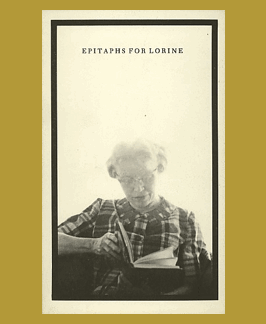
Over the course of a half century, beginning when he was a student at Black Mountain College in North Carolina studying with Charles Olson and other mid-century writers, artists and thinkers, Jargon published an incredible range of highly individualized creators, some now famous and fully accepted into the American canon. The list of books and broadsides and other works published by Jargon numbers 115 pieces, and wonderfully reflects the enthusiasms of Jonathan’s life. Included are early works by Black Mountain identified writers like Charles Olson, Robert Duncan, Robert Creeley and Joel Oppenheimer, then unknown but now well known writers like Denise Levertov, Kenneth Patchen, Michael McClure, Guy Davenport, Gilbert Sorrentino, Louis Zukofsky, Buckminister Fuller and Larry Eigner, and outliers like Douglas Woolf, Peyton Houston, Alfred Starr Hamilton and Bill Anthony. Still others must be accounted to Jonathan’s indefatigable championing of the then virtually unknown writers whom he felt must be shared, including Lorine Niedecker and Mina Loy.
The photography books on the list represent JW’s brilliant visual sensibilities, and include work by Doris Ulmann, Lyle Bonge, Ralph Eugene Meatyard, John Menapace and Elizabeth Matheson, among others, altogether a meaningful aesthetic contribution to photographic publishing. And so do the books on outsider art (which Jonathan was following long before the popular culture caught on).
In all cases, at all times, Jargon books were reflective of Jonathan Williams’ extreme commitment to making beautiful books whose look and feel would always do justice to the writing, photography and art within.
Williams and Meyer, along with a diverse cast of supporters throughout the world, devoted an immense amount of time and energy raising money for the varied endeavors of the Jargon Society. Fundraising was, it seemed, almost as much work for the press’ principals as creating great books. Asking people with money to support the kind of literature and art they might not themselves find compelling is not an easy thing to do. Making pleas for money year after year can be exhausting and it is rare today to find an arts organization whose founder maintains the role of chief fundraiser throughout its history.
Jonathan Williams and Tom Meyer have been hugely influential to my own work as a writer, editor, and publisher. For me they each exemplify the committed life of the artist. Over the years I published two books of Jonathan’s poems and will soon publish his third and final collection of essays. Over the years I often visited Jonathan and Tom in Highlands, North Carolina, and learned a tremendous amount from both of them, as well as developing deep and long lasting friendships with both. And for a number of years, Inland Book Company, the company I co-founded, was the primary distributor for Jargon, a great and sometimes sobering experience for all of us whose responsibility was to sell these quirky and decidedly noncommercial creations.
Jonathan Williams was always a prolific letter writer; correspondence with the ever witty Williams was a deep and abiding pleasure.
Jargon is an exemplar of what a modern literary press can be: individualistic in the extreme, with a compelling vision of the breadth of art and and our experience of its varied forms, expanding the horizons of all who have the opportunity to be touched by the works and their beautiful singularities.
Recently, in order to continue the legacy of the Jargon Society, Tom has gifted the press and its books to the Black Mountain College Museum and Art Center, where its work can continue in a new context.
I wish I had been working on this interview series long enough ago to have talked to Jonathan Williams with the recorder running. But it was my great pleasure to talk to Tom Meyer about Jargon Society, and of course Jonathan himself, with whom he partnered and worked for forty years. This is a one hour conversation packed with information, evoking the history of one of the great literary accomplishments of the twentieth century.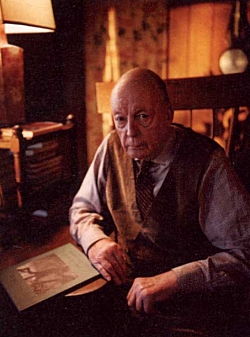
A Jargon Society bibliography checklist was published by the extraordinary and wonderful Jacket online magazine.
Appreciation of Jonathan and Jargon by Ron Silliman; an interview with Jonathan by Leverett T. Smith here; feature on JW in Jacket 38.
(Photos of Tom Meyer and Jonathan Williams by Reuben Cox)
Podcast: Play in new window | Download