
Katharine Weber: The Memory of All That
August 19, 2011 by David
Filed under Non-Fiction, WritersCast
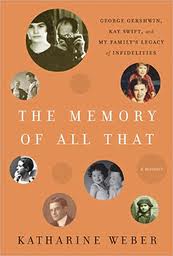 978-0307395887 – Crown – Hardcover – $24.00 – ebook editions also available
Katharine Weber is best known as a novelist – I interviewed her last year about her wonderful novel True Confections and she has written many more fine books. The Memory of All That, subtitled “George Gershwin, Kay Swift and My Family’s Legacy of Infidelities is both a memoir of her own family, as well as a history of a certain slice of twentieth century America, primarily focused on her grandmother, Kay Swift, whom she loved, and her quite unusual and difficult father, Sidney Kaufman, with whom her relationship was far more complicated to say the least.
Sidney Kaufman was a larger than life character, but mainly one of his own making, someone who spent years trying to “make it” in the movies and never succeeding. He was also a narcissist, a husband who literally neglected his wife and family, and who had numerous long lasting affairs. One most notable was an affair that lasted for years with Beatrice Buchman, wife of the famed (blacklisted) screenwriter, Sidney Buchman (who happens to be my father’s first cousin).
Sidney Kaufman also was a target of a decades long investigation by the FBI, initially because the agency confused him with another Sidney Kaufman, a longshoreman who joined the Abraham Lincoln Brigade to fight fascism in Spain. And hilariously, Kaufman was such a fantasist, that the FBI itself could not tell the facts about his life from the fiction. Not so hilariously was the effect of Kaufman’s absences and failures to relate to his family, which deeply affected the author of this book, as she recounts in some deeply moving passages in this book.
But in many ways, the focus of this book is really on Kay Swift, known even today for her wonderful music, as well as for her lengthy romance (and musical collaboration) with renowned composer George Gershwin. Weber tells her grandmother’s fascinating life story with a great deal of love, and of course intimacy, and provides an insider’s view of many details of her life and relationships with her husbands and lovers. Swift is in many ways an iconic, 20th century American woman, who made her way among men at a time when doing so was unusual and difficult, and required considerable verve and inner direction. And while she had many material advantages, the challenges she faced and overcame, both personally and professionally, were significant and testament to her powerful inner being.
Weber’s grandfather was James Paul Warburg, and here introduces us to him and the rest of his famous banking family. Interesting stories are here in abundance. Grandfather Warburg advised and feuded with President Franklin D. Roosevelt, great-uncle Aby Warburg, while eccentric to say the least, was responsible for significant theories in art and myth, and the family was at times dominated by the unusual psychoanalyst Gregory Zilboorg (who slept with his patients on a regular basis, and turned George Gershwin against Kay Swift when she decided to stop allowing him to sleep with her!)
Overall, this is an engaging, beautifully written and emotionally powerful book. Katharine Weber’s family has been complicated, brilliant, interesting, and influential in many areas of American life, and of course has made her the writer she is today. She tells the story of her family with humor, love and a keen eye for emotional detail, and gives us a portrait of herself at the same time.
In my conversation with Katharine we talked about her father, and the complexities of his life, as well as her relationship with Kay Swift and how this book came to be written. It’s a terrifically engaging story she has to tell and we had a great talk about her really great book.
Katharine Weber’s website is here. The Memory of All That got a terrific review in the NY Times:
“…Ms. Weber’s account of her relationship with her manipulative fabulist of a father brings to mind classic autobiographies of unmoored childhoods, like Mary Karr’s “Liars’ Club” and those companion volumes from the brothers Wolff, “This Boy’s Life” (Tobias) and “The Duke of Deception” (Geoffrey)…It’s when Ms. Weber remembers Papa that her considerable skills as a writer are most seductively on display. And it’s not just because the exasperating Kaufman is such a good subject. It’s that Ms. Weber is able to arrange words musically, so that they capture the elusive, unfinished melodies that haunt our memories of childhood. As her grandmother’s lover might have put it, she’s got rhythm.” – Ben Brantley
Podcast: Play in new window | Download
Nina Sankovitch: Tolstoy and the Purple Chair
June 5, 2011 by David
Filed under Non-Fiction, WritersCast
 978-0061999840 – Harper – $23.99 – Hardcover (ebook version also available)
This is truly a wonderful book by an exceptional writer. Nina Sankovitch was living a full, active life as an environmental lawyer, happily married with four children, when her beloved sister became ill with cancer and died far too young. As she recounts in Tolstoy and the Purple Chair: My Year of Magical Reading, her initial response to her sister’s death was to “live her life double,” doing everything she could to try to make up for her terrible and painful loss. After three frantic years she realized what she was doing was unsustainable.
Ironically, her apparent retreat from doing to experiencing through reading was in some ways no less radical. Nina committed to reading a book a day for an entire year, no small commitment in itself, but further, she committed herself to writing a review or think piece about every book she read. That is a very high bar to set for any modern parent, even with a patient and understanding family (when I started Writerscast, I committed myself to read at least one book each week and to interview its author, a far lesser commitment, and after two years of doing it, I know how difficult, even impossible it would be for me to read a book a day, for a short period of time, much less a full year).
But Nina turned to reading because reading has always been central to her life and experience. Her immigrant parents read and loved books, as did Nina, from an early age. In Tolstoy and the Purple Chair, Nina tells the story of both her families, the vibrant one she grew up in, and the supportive and happy one she has raised. Many of the books she read in her magical year of reading are discussed here, as the stories of these books are part of the weave of how she transformed her experience of death into a celebration of life. And that is the crux of this memoir. By leaving her own experience to enter the realms of literally hundreds of writers, and making a place for those other stories in her own life, Nina was able to recreate and restore her own psyche – that’s the magic, the alchemy, of her magical year.
I should mention that Nina lives near me and has become a valued friend, partly through books we’ve read and discussed, including a couple I gave her to read and which are included in her year of reading. During that year she started an excellent blog called Read All Day where you can find all of her well written and exceptionally perceptive book reviews and essays.
Podcast: Play in new window | Download
Paul David Pope: The Deeds of My Fathers
December 12, 2010 by David
Filed under Non-Fiction, WritersCast
 978-1442204867 – Hardcover – $24.95 – Philip Turner/Rowman & Littlefield (e-book editions available at $9.99)
Well this is truly an amazing 20th century American story, and really well told by the author, who spent many years working on this book. There are characters here as big as those in any historical novel. The full title of the book gets to what the story is about: The Deeds of My Fathers: How My Grandfather and Father Built New York and Created the Tabloid World of Today.
Paul David Pope’s grandfather, Generoso Pope Sr., came to this country alone and poor, at a very young age seeking a better life, as so many other immigrants did. That part of the story is hardly unique. But he was obviously a very special sort of person, and it did not take him very long, through hard work, intelligence and a certain amount of ruthlessness, to create a building trades empire in the greatest city in America, New York City.
His companies supplied the concrete that literally built the city in the boom years of New York. But he also managed to buy and control this country’s primary Italian language newspaper, Il Progresso, and his wealth, power and connections (including political kingmakers, the mob, and even FDR as well as the Pope) made him one of this country’s leading and most influential Italian Americans. Because he was able to use his newspaper to influence elections, he essentially became a kingmaker in the old school of American politics, and was truly an iconic emblem of his times.
But author Pope does not shy away from telling us the ugly along with the good. His grandfather was far too close to Mussolini in the 1930s, and was blatantly used by the Fascists to try to influence American public opinion in their favor during the lead up to World War II. And he was far from being a good husband and father. He always favored his youngest son, Gene (author Pope’s father), and selected him to run his businesses, over his older and more experienced brothers.
Early on, Gene Americanized his name to Pope. He was pushed out of the family business after his father’s death by his mother and his two older brothers. At that point, Gene, with a loan secured from his “Uncle Frank” Costello, bought a newspaper in decline, the New York Enquirer. With a combination of dedication and a brilliant natural understanding of what average readers would want to read, he created the pinnacle of all tabloids, the National Enquirer. Of course, the support of his Uncle Frank did not come without strings, and Frank required that the paper stop attacking the mob in its stories, and in fact it was to publish only positive stories about projects the mob was backing, and even that the Enquirer would attack and discredit the enemies and opponents of organized crime – which it did without hesitation.
But the heart of Gene Pope’s story is his single minded dedication to the newspaper he loved. He moved the company to Florida and made it almost the only thing he cared about. As he grew older, he was clearly eccentric in his behavior (some might say nighly neurotic and disturbed). But throughout, Gene Pope gives readers what they want, and as the National Enquirer covers the paranormal, medical cures, celebrities, always attentive to what the average American would read, and circulation soars, peaking with the 7 million copies sold of the Enquirer’s 1977 exposé on the death of Elvis Presley.
Paul David Pope gives us a fast paced, almost novelistic version of his family’s history. His story is based on hundreds of interviews, and a huge amount of research, but of course much of what happened in the earlier part of the story is reconstructed from the documentary record. It is a gripping narrative, and a compelling story for anyone who cares about the modern history of the United States as lived by some of its more colorful and successful citizens, and the author gets across the complexity of his real life family in their non-stop rush to make their marks.
Talking to the author gave me a chance to delve into the background of the story, what motivated Paul to do all this work and stay with it for so long, and for him to talk about how his family history has affected his own life. There’s more about the book at the author’s website too.
Podcast: Play in new window | Download
Bill Barich: Long Way Home: On the Trail of Steinbeck’s America
October 23, 2010 by David
Filed under Non-Fiction, WritersCast
 978-0802717542 – Walker & Co. – Hardcover – $26.00 (e-book version also available)
Bill Barich is a fine writer, comfortable with words, a natural storyteller who is self-aware and a careful observer of character as well as landscape. He’s got a great narrative voice that makes his books very easy to read and deeply engrossing.
In the summer of 2008, Barich, who has lived in Dublin, Ireland for some time, decided to take a journey across America, essentially following in the footsteps of the great John Steinbeck, who made the cross-country journey (ostensibly to rediscover America, but more likely a stab at rediscovering his own literary voice, which resulted in Travels with Charley in 1962).
Of course Barich and Steinbeck differ in significant ways. And the early 1960’s were a very different time than 2008 for America. Barich’s trip came at the time of our massive economic collapse, and the rising presidential campaign of Barack Obama, both of which become thematic backdrops for his story. Steinbeck traveled in pick up truck with a home made camper out back, and with his dog, Charley, whereas Barich drove a rented Ford Focus (almost 6000 miles!) and stayed in motels. But Steinbeck is the ever present model for the later traveler, whose outlook is certainly as different as the country he explores.
In fact, Barich’s story is engrossing from beginning to end. He starts the trip in Maryland, and stays on US 50 west to the Golden State, with stops and sidetrips along the way that are always interesting, even though often sad and sometimes even depressing. He is, after all, reporting on America as he finds it, which includes features and political themes that are not always what we might have wished or hoped for. It’s an honest portrait, and a story well told. I’ve done my share of cross-country traveling, and very much enjoyed this book and my conversation with Barich about it. There’s a good deal of back story and detail in this conversation we had some fun with and which I hope listeners will enjoy.
Bill Barich is the author of seven books, including Laughing in the Hills, which was named one of the hundred best sports books of all time. Other works include a novel, Carson Valley, and another work of nonfiction, A Fine Place to Daydream: Racehorses, Romance, and the Irish and recently, A Pint of Plain which describes the decline of the traditional Irish pub. A Guggenheim Fellow, and literary laureate of the San Francisco Public Library, Barich now lives and works in Dublin.
Podcast: Play in new window | Download
Nick Schou: Orange Sunshine: The Brotherhood of Eternal Love and Its Quest to Spread Peace, Love, and Acid to the World
October 13, 2010 by David
Filed under Non-Fiction
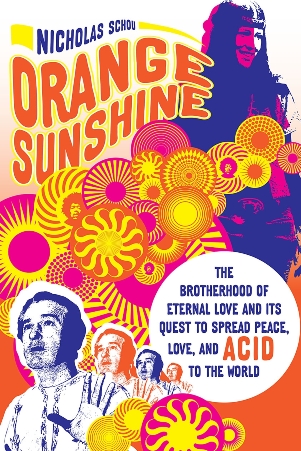 978-0312551834 – St. Martin’s Press – Hardcover – $24.99
Nick Schou writes for the excellent OC Weekly (one of the several Village Voice papers) based in Orange County, California, home of Disneyland, Knott’s Berry Farm, UC Irvine, the Los Angeles Angels of Anaheim, Little Saigon, and of course seemingly endless tracts of California suburbia. But Orange County in the 1960’s was also the birthplace of some of the most amazing scenes of hippiedom, and the little known “Brotherhood of Eternal Love.”
In this book, Schou tells their story from beginning to end, and it is a pretty incredible saga, including what was probably the largest LSD manufacturing and distribution operation of all time, a world wide hashish and marijuana smuggling cartel, incredible tales involving Timothy Leary, and much, much more.
Known as “Hippie Mafia,” the Brotherhood began in the mid-1960’s as a small band of surfers (and in many cases petty criminals) in Southern California. After they discovered LSD, they took to Timothy Leary’s mantra of “Turn on, tune in, and drop out” and resolved to make that vision a reality by becoming the biggest group of acid dealers and hashish smugglers in the nation, and literally providing the fuel for the psychedelic revolution in the process. In Orange Sunshine, Schou journeys deep inside the Brotherhood, combining exclusive interviews with many of the group’s surviving members, former hangers on and supporters, and interstingly, the law enforcement establishment who pursued them and by doing so helped to launch what has now become an institutionalized government war on drugs.
Schou tells a compelling story of sex, drugs, and rock ‘n’ roll (and more drugs) that runs from Laguna Beach to Maui to Afghanistan, and a time when America moved from the golden era of peace and free love into the much darker time that soon followed, marked by hard drugs, international crime and paranoia.
Talking to Nick Schou gave me a chance to explore with him some of the background to the book, and to talk about the large amount of research he did to put it together, and the challenges he faced in getting some of the participants to even tell him what they did in those days. We also talked about some of the more startling elements of the story of the Brotherhood, their involvement with Timothy Leary and Ram Dass, Orange County then and now, and much more.
This is a fascinating story, one that helps us understand some of the complex issues that began in the sixties and are still with us today. This kind of grassroots history is important to document as it can give us all a chance to better comprehend the always diverse and sometimes simply amazing culture in which we live.
Podcast: Play in new window | Download
Jared Duval: Next Generation Democracy
October 2, 2010 by David
Filed under Non-Fiction, WritersCast
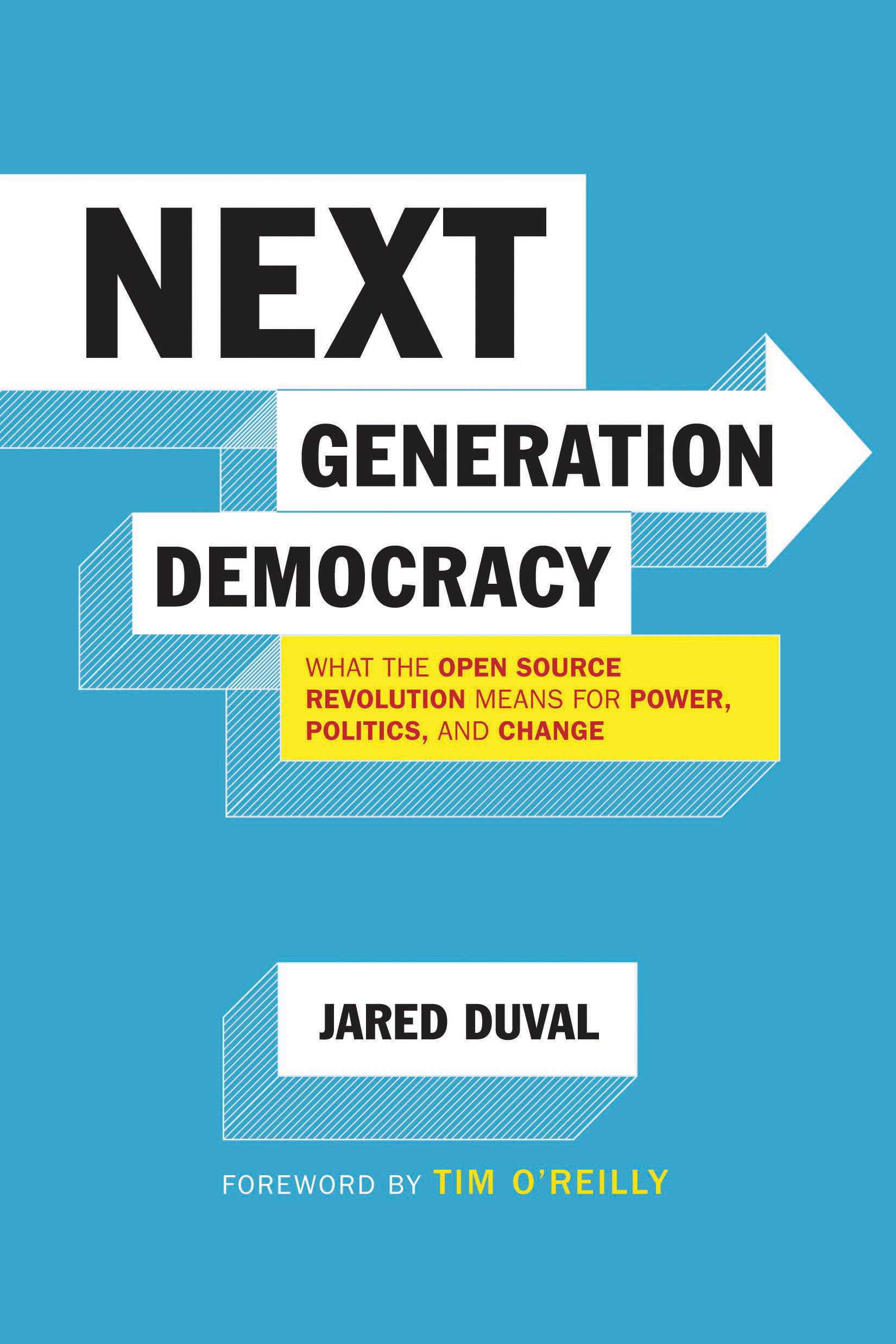 978-1608190669 – Bloomsbury – paperback – $15.00
Next Generation Democracy is an important book by a really smart and compelling young activist and writer, Jared Duval. I like what Bill McKibben says about the book and by extension the author: “God knows previous generations have left those that are coming of age a world of trouble. Happily, they’re figuring out a world of ways to set them right. Jared Duval’s book offers a behind-the-scenes tour of the next wave of activism, organizing, inspiration, and change. It will give you cause to hope–and cause to go to work.”
But even more than a behind-the-scenes look at how activists are working and thinking together in new ways, Duval gives us a strong sense of hope for making change in the future. I think it’s true enough that the past few generations have not succeeded in broadening democracy and making progressive change throughout the world, especially in environmental, social justice and peace, as broad stroke categories of change that is needed most. But it’s heartening to know that the younger generation includes individuals like Duval who are finding new ways to make change, resist the impulse to blame and create divisions, and who see the tools of change around them everywhere, and simply make use of them so easily and comfortably.
Jared sees open source software as the exact model needed for a reinvention of democracy. Our government can be as open and transparent as the development of Linux, a story he tells here almost as a parable for political thinkers and activists. In Next Generation Democracy, Jared covers key recent events, such as Hurricane Katrina, during which de-centralized leadership emerged to supersede traditional models. He documents the success stories of these new leaders, both inside the government and out, who are finding effective, directly democratic ways to address the critical public challenges of our time. As he tells the stories of participatory organizations such as the brilliant SeeClickFix (originated in New Haven, Connecticut and now spreading to other communities) and America Speaks (which shows us how to meaningful re-engage citizens in the processes of government) Duval describes a new approach to solving complex problems that draws on the contributions of a wide array of activated citizens everywhere.
I do wish this book had come out earlier in the year, actually in time for election season, as I am certain that the thinking here could benefit anyone involved in the political process. But in the end, what really matters is that people read Next Generation Democracy, become inspired in some way, small or large, to get involved, work with their fellow citizens, make change, small or large, and address the future in a positive way. Reading this book and then listening to Jared Duval talk about his ideas and experiences certainly inspired me, and I am happy to recommend him and his book to anyone listening to this talk.
Jared Duval is a busy guy. He is a fellow at the well respected Demos policy organization and earlier served as the National Director of the Sierra Student Coalition (SSC), the national student chapter of the Sierra Club and the largest student environmental organization in America. During this time he helped build the Energy Action Coalition and the Campus Climate Challenge campaign, serving as the effort’s co-chair for two years.
Podcast: Play in new window | Download
Paul De Angelis: Dear Mrs. Kennedy, The World Shares Its Grief, Letters November 1963
September 23, 2010 by David
Filed under Non-Fiction, WritersCast
 978-0312386153 – St. Martin’s Press – Hardcover – $19.99 (also available as an e-book at $9.99)
Are there more books about the Kennedys than about the Lincolns? I don’t know, but I am certain that there are many of them and my guess is that many who lived through the Kennedy era and many who did not, may feel they know everything they need to know about the Kennedys, JFK and Jackie, and the rest of the family. Reading this book may well change their minds.
In fact it’s a wonderful window into the heart and soul of America and in fact the world in the period just after the assassination of JFK in Dallas in November, 1963. Now almost a half century beyond that time, these letters, written by the famous and the ordinary, old and young, depict a period of extreme pain, emotional and social disruption, grief, sorrow, and disbelief that affected an incredible number of people all over the world. It gives us an opportunity to understand a great deal about how human beings respond to a devastating public tragedy. And some of the letters are simply beautiful, and transcendent in their expression of sympathy and emotion.
The story of the letters themselves is amazing – over 1 million condolence letters, notes and cards were sent to Jacqueline Kennedy in the months after the death of JFK. They were filed away and saved for many years, and despite a controversial culling in the 1980’s, there are still almost 400,000 letters, now cataloged and available for historians and journalists and the public to read and review. Editors Jay Mulvaney (who sadly passed away while working on this book) and subsequently Paul De Angelis, have given us a wonderful narrative and selection of letters that uses the words of the original writers to bring this terrible period in our history to life in an unusual and compelling tapestry of voices.
Paul De Angelis is a freelance editor and writer who lives in rural Connecticut. He’s been an editor, editorial director and editor-in-chief for a number of publishers. In our conversation about Dear Mrs. Kennedy, he talks about the process of putting this book together and highlights a number of the most interesting stories and letters in the book. For readers who lived through the 1960’s, this book will bring back many difficult emotions, and for readers for whom this is only history, these letters can bring the events of that period to life in a very powerful and compelling way, as the writers of these letters always speak from their hearts. You can see more from the book at Paul’s own website.
Full disclosure: the co-editor of this book, Paul De Angelis is a friend and occasional colleague, which does not make this book any less worth reading, of course.
Podcast: Play in new window | Download
Jason Turbow and Michael Duca: The Baseball Codes
July 22, 2010 by David
Filed under Non-Fiction, WritersCast
 978-0375424694 – Random House – $25.00 (e-book editions also available at $9.99)
The subtitle of this book is long but tells you why almost any baseball fan (and some cultural anthropologists and sociologists) will be interested in this book: “Beanballs, Sign Stealing, & Bench Clearing Brawls: The Unwritten Rules of America’s Pastime.”
This is both an entertaining and fun read. It will work for serious fans of course, but just as well for more desultory followers of baseball, and really even readers who only have a passing interest in baseball. The basic notion is that baseball has had unwritten codes of conduct covering all sorts of on and off field behavior, probably for as long as the game as been played professionally. In years past, it would have been unusual for anyone outside of the closed professional baseball fraternity and maybe the regular baseball writers and broadcasters to know the details of how “the code” works.
The code is really a set of home grown rules, in some instances expressing sportsmanship, in other instances expressing the underlying social (and economic) values between players and teams. It is really fascinating to think about just how comprehensive human beings are in creating ad hoc systems of governance. The formal rules of the game, enforced by team owners, leagues and ultimately the Commissioner of baseball are written down and codified, as are the contracts between players and teams. The day to day rules of behavior among players, of course, are unwritten, passed on from one generation to the next, and highly subject to interpretation, ongoing disagreement and of course the change in social mores and behavior in the overall culture as well.
To write this book, Turbow and Duca spent a great deal of time talking with former and current players, coaches and managers. They are able to report back about the code, past and present, but the richness of the book lies in their many anecdotal examples of its application. And of course how the code has actually changed over the years as baseball and its players have changed is another theme of the book.
The Baseball Codes express and amplify not only the great Game of Baseball itself, but the richness of human culture and its history. This book was alot of fun for me to read, I knew some of the stories, but there were many more that were new to me, or which, by hearing the players talk about them, enabled me to understand much better what I knew about some of the interesting events in baseball history. Talking to co-author Jason Turbow was also great fun. He’s a passionate observer of the sport of baseball, and knows how to tell great stories. It’s the middle of the 2010 baseball season as this interview is posted, and a great time to listen to some baseball lore. And the Jason maintains an active blog that will keep fans up to date on current code behavior, also fun and recommended.
Podcast: Play in new window | Download
Lee Kravitz: Unfinished Business
July 15, 2010 by David
Filed under Non-Fiction, WritersCast
 978-1596916753 – Bloomsbury – Hardcover – $25.00 (also available as e-book in various formats $9.99)
Well admittedly I might have liked Unfinished Business because I am roughly the same age as the author, have been through similar experiences in the same era, and like Lee Kravitz, have to confess to being something of a workaholic. Like him, when I look back on my past, I worry about some of the people I used to be friends with I no longer see, and doubtless, like him, have some “unfinished business” in my life that I’d be better off dealing with.
Today there must be literally thousands, hundreds of thousands of people who share many of Lee Kravitz’s experience of losing his job and having a crisis of identity, of being, and who like he did, feel a desperate need to reintegrate their lives, and their singular sense of self. Not everyone will have the opportunity to take the journey that he did, a full year of exploration and reconnecting with family, friends, teachers, people who literally made him who he is today.
I don’t think you have to literally share Lee’s direct experience, or feel as fragmented as lost as he did then to gain deeply from reading his book and sharing his journey. Lee spent many years as a journalist and editor, and writing seems to come easily to him. Many of his experiences are brilliantly described, and his honesty and clarity go a long way to making this book work for readers. This book can be transformative for many people who feel that modern life has separated them from those they once felt closest to, perhaps inspiring them to close their own circles and remake their own lives. Enough people have responded that way for the author to create a website “My Unfinished Business” on just that subject. I suspect that if you like this book, or even our conversation about it, his site is well worth a visit.
I very much enjoyed talked to Lee about his book and some of the stories about his family, friends and others whose stories he told in Unfinished Business. He’s as good a storyteller talking as he is writing.
Podcast: Play in new window | Download
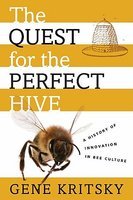
Gene Kritsky: The Quest for the Perfect Hive
July 8, 2010 by David
Filed under Non-Fiction, WritersCast
 978-0195385441 – Oxford University Press – Hardcover – $24.95
I have never kept bees, but am in love with honey, and the idea of beekeeping has always fascinated me. Gene Kritsky, who describes himself as “stung with the love of bees,” has written a wonderful book that will appeal to serious beekeepers, amateur bee lovers and even general readers with an interest in the history of humanity’s relationship with nature. The book is beautifully illustrated with amazing photographs, drawings and woodcuts representing hundreds of years of beekeping history.
Humans discovered honey thousands of years ago and have been working with these amazing insects for a very long time. What is interesting to the novice reader is how little beekeeping has changed. There have been many innovations in beekeeping, especially so during the past couple hundred years, but traditional beekeeping methods still exist in many parts of the world. And there is much that we can learn from past practices to help us understand how to stave off the epidemic of hive collapse that has become prevalent in so many places during the past few years.
Kritsky uggests that beekeeping’s long history may provide us with clues to help modern beekeepers fight the decline in honey bee numbers. Kritsky takes readers through the history of beekeeping, from early mud-based horizontal hives to the ascent of the simple straw skep (the inverted basket which has been in use for over 1,500 years), from the Golden Age of hive design in Victorian England up to and into the present day. In concise terms, aided by illustrated exampes, he talks about what has worked, what has not worked, and sometimes the things we have forgotten about hives of the past that might help counter the threats to modern bees and beekeeping. While scientists have now sequenced the honey bee genome and advanced our knowledge, we still keep bees in hives that have not changed very much during the past hundred years. Kritsky argues that we must start inventing again if we are going to save our bees. Thus the search for the “perfect hive” continues.
Gene Kritsky is a master of his subject in both depth and breadth, and thus is an easy author to interview. Doubtless he could talk in depth for hours about bees and maintain the listener’s interest. It was a pleasure to talk to him about this interesting and unusual book, and I am confident that listeners will enjoy our conversation as well.
Podcast: Play in new window | Download