
Mickey Leigh: I Slept with Joey Ramone
January 28, 2011 by David
Filed under Non-Fiction, WritersCast
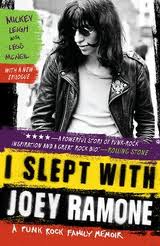 978-1439159750 – paperback – Simon & Schuster – $15.99 (ebook versions available $12.99)
Mickey Leigh grew up in Queens in the 1950s and 1960s as Mitchel Hyman. His brother was Jeffrey Hyman, more famously known as Joey Ramone, lead singer of the great American punk rock band, The Ramones. I Slept with Joey Ramone (subtitle: a punk rock family memoir) tells their story from the beginning to the end of Joey’s relatively short life and just a bit farther into the almost present day. Mickey had some writing help from rock journalist Legs McNeil, and throughout the book, the story is told compellingly in Mickey’s voice and from his perspective.
We start in Queens where the boys grow up somewhat rockily. Their family situation was never easy, and Mitchel and Jeff were bullied misfits. Joey had both physical and psychological issues that manifested early in his life. Music became their savior very early, but at the beginning it was Mitchel (Mickey) who was the musician, and it took some time before the very complicated Jeff got together with the band that became the Ramones and found not only his voice, but his new identity.
The Ramones story as told by Mickey Leigh, is pretty incredible, even for fans who know something about the band and were there during the glory days. The relationships between the various band members were legendarily terrible. How this band stayed together and made such incredible music is still a mystery. Mickey was there at the beginning; John Cummings, aka Johnny Ramone, was initially his best friend. Mickey ended up being the band’s first roadie, while Joey, the quintessential misfit outsider, became the front man singer of what eventually became one of the greatest rock bands of all time. Later Mickey had his own career with a number of bands, as well as being a songwriter too.
The many stories and incidents recounted in this book are never boring, even when the sometime strange and complicated elements of Joey Ramone’s personality begin to repeat themselves over years. There is a tremendous amount of love here, and some not so nice things as well. Mickey’s own story is complicated and he has alot to say about alot of the people he worked with, for and sometimes against throughout the years. Nothing here is ever boring. It’s sometimes sad and frustrating to know how things were for Joey Ramone and his family, friends and associates, as it was often difficult, confusing and painful for all of them. Even years later, when they were inducted into the Rock and Roll Hall of Fame, the Ramones created an emotionally complicated scene.
Ultimately, Mickey (and doubtless Legs too) has captured beautifully a unique and special part of modern musical history, that is also the story of redemption, which is after all, the real story of rock and roll. And at the end Joey and Mickey always did make up. As Mickey tells it, the last time really counted the most. “He pulled me down to him, and he just didn’t let go. I can still feel that hug.” This is a book well worth reading for anyone interested in New York punk rock. I had a great time talking to him about the book and his experiences in rock and roll.

Podcast: Play in new window | Download
Martin Lemelman: Two Cents Plain: My Brooklyn Boyhood
October 31, 2010 by David
Filed under Graphic Novels, WritersCast
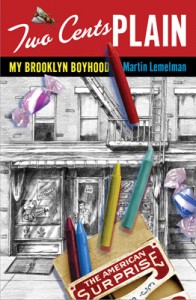 978-1608190041 – Bloomsbury – Hardcover – $26.00.
Martin Lemelman grew up in the back of a candy store in Brooklyn, NY. He has illustrated more than thirty children’s books and his work has appeared in numerous magazines. Lemelman is now a Professor in the Communication Design Department at Kutztown University and lives in Allentown, Pennsylvania.
Martin’s first memoir done in graphic format, with drawings, photographs of personal objects and places, was Mendel’s Daughter, published in 2006. Told in his mother, Gusta’s voice, the book recounts the story of her life, beginning in pre-war Poland, through her harrowing experience of survival in the Holocaust and displaced persons’ camps, and finally coming to Brooklyn, where she lived with her husband (also a survivor) and two children.
Two Cents Plain is not literally a sequel to Mendel’s Daughter, but it is a continuation of Lemelman’s family storytelling. Two Cents Plain collects the memories and artifacts of the author’s childhood in Brownsville, a neighborhood of Brooklyn filled with Jews speaking Yiddish and children growing up in a comfortable city neighborhood. Later in the story, as times change, Martin and his family’s experience in Brooklyn is not so pleasant. But that’s ultimately the background of the story Lemelman tells. His real focus is the dynamic story of his parents and how their life experiences in the Holocaust shaped them, and of course shaped their children’s experience as a family in post-War America.
Lemelman’s story is full of struggle, his parents were complicated and sometimes difficult for their children to understand, and life in a candy store was never easy. But his Brooklyn memories also is also include the joys of egg creams and comic books, malteds and novelty toys, where the neighbors, the deli man, the fish man, and the fruit man, all are brought to vivid life in story and illustration. The changes in the city during the sixties are very personalized for Martin and his family and in the climax of the story, the family must leave their home once again.
I really loved reading and absorbing this book, the combination of Lemelman’s story telling voice and gorgeous illustrations work beautifully to transport the reader into another time and place. And the author does a fine job of balancing between the sentiment of memory of his childhood with the clarity of the adult rememberer, which is keeps us anchored as the story unfolds. There are layers of memory, emotion, people and place that are richly evoked in this book.
In our interview, I wanted to explore with Martin not only the story of his life and his parents gripping and sometimes painful experiences, but the period of the fifties and sixties and how he used the graphic memoir form to reflect and amplify the power of his story. This is a unique and wonderful book whose creator is quite cogent about his work. Martin has put together a very interesting and useful website for the book that is worth visiting (most useful after you have read the book, I think). I am looking forward to reading the next book in this series of memory stories.
Podcast: Play in new window | Download
David M. Carroll: Following the Water
February 7, 2010 by David
Filed under Non-Fiction
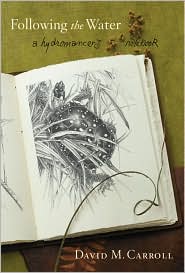 978-0547069647 – Hardcover – Harcourt Houghton Mifflin – $24.00
David M. Carroll has been “following the water” for almost his entire life. He grew up in Connecticut, then lived in Massachusetts, and moved to New Hampshire to find places less disturbed by humans, where he could study turtles and their woodland, waterine habitats. Which he has done now for many years. Following the Water is subtitled “A Hydromancer’s Notebook; a hydromancer would be one who divines by the motions or appearance of water, which is certainly descriptive of what David Carroll does in his life and in this book, a poetic journal of a year of divining the natural world by close observation of it.
Most of us spend far too little time in nature, and many of those who do “use” the natural world for entertainment or work in a way that would be difficult to distinguish from how they treat the non-natural world. What is so beautiful about Carroll’s work and his writing about it, is the depth of his observation, and his literal being in place. Reading his elegiac descriptions of the watery environments of New England transported me to an almost metaphysical trance-like state of mind where I could imagine myself inhabiting the outside space in which he spends so much of his time.
Of course there is a terrible sadness in this book, as Carroll experiences the changes in the places he has known so well and so long, always brought on by the effects of constantly encroaching human development. He knows the turtles and their environments will soon be threatened and knows there is almost nothing that can be done to protect them. This is a feeling that many who work in and strive to protect our remaining wild places share, an ever present sense of desperation, as we near the tipping point of urban and suburbanization.
Carroll writes beautifully, and his drawings are exquisite. Reading this book made me wonder how I had managed to miss reading his earlier books, and has spurred me to go out and get them all. Here’s a perfect example of the quiet power of his prose:
“As daylight diminishes, the peep-frog chorus intensifies in the backwaters of a fen a quarter mile away. With raucous clamor and a rushing wind of wings beats a flurry of grackles lifts off from the topmost canopy of the red maple swamp. In the quieting that follows, I hear again the drift of evensong from their red-winged cousins on the far side of the wetland mosaic. The season, like the water glimmering all around, extends before me.”
David Carroll is as enjoyable to hear talking as his writing is to read. Interviewing him was a pleasure, tinged with a shared sense of dismay about what has happened to our shared New England natural environment. Both this book and this talk are among my favorites, and I hope listeners will agree.
Podcast: Play in new window | Download
Alice Eve Cohen – What I Thought I Knew: A Memoir
August 10, 2009 by David
Filed under Non-Fiction
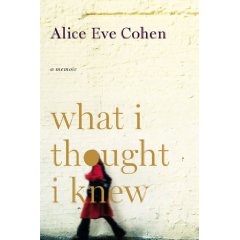 978-0670020959 – Hardcover
Viking – $24.95
Alice Eve Cohen’s memoir tells an incredible story – a writer and playwright, she was diagnosed as infertile in her thirties, she adopted a daughter with her then-husband (whom she later divorced). At 44 she began to experience strange physical symptoms – after six months of suffering she was finally recognized as being pregnant. In many ways that was only the beginning of her story – which is an incredible, honest, sometimes funny but as often a painful journey of discovery.
I generally am not that interested in the modern memoir – most people’s stories are just not that interesting. But I was attracted to Alice’s story right away, partly because of my own experience with DES and its damages to the children whose mothers took that fertility drug. Alice’s persona shines through her story. She is vivid and clear about everything that happened to her and how she felt at the time, and later, and she pulls no punches, including her own foibles, fears, and weaknesses throughout.
Overall What I Thought I Knew is a wonderful book that holds our attention throughout. It’s transformative for the author and for the reader. In my interview with Alice Eve Cohen, we talked in detail about the book and her experiences then and now (the events took place several years ago). She’s not only a wonderful writer but a great interview subject as well.
Podcast: Play in new window | Download
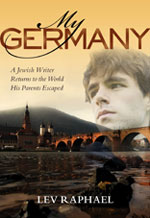
Lev Raphael – My Germany: A Jewish Writer Returns to the World his Parents Escaped
July 19, 2009 by David
Filed under Non-Fiction
 978-0299231507 – Hardcover
University of Wisconsin Press $26.95
Lev Raphael grew up loathing everything German. A son of Holocaust survivors, haunted by his parents’ suffering and traumatic losses under Nazi rule, he was certain that Germany was one place in the world he would never visit. Those feelings shaped his Jewish and gay identity, his life, and his career. In “My Germany.” Raphael explores many layers of his personal life, including his visits to Germany, his complex relationships with his parents and his inner self. My interview with this interesting and engaging writer ranges across a variety of subjects, including the author’s writing methods, a discussion about this new book and his life as a writer, the nature of memoir, memory, and the discovery of self.
Podcast: Play in new window | Download