
James Howard Kunstler: World Made by Hand
February 9, 2011 by David
Filed under Fiction, WritersCast
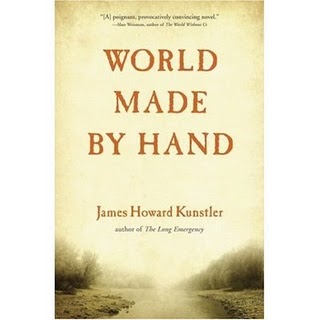 World Made by Hand – 978-0802144010 – paperback – Grove Press – $14.95 (e-book edition available)
The Witch of Hebron: a World Made by Hand novel – 978-0802119612 – hardcover – Atlantic Monthly Press – $24.00 (e-book edition available)
This is an unusual podcast for me as it covers two books, World Made by Hand and the next in what looks to be at least a trilogy for author Kunstler, The Witch of Hebron. I had heard of, but never read any of Jim Kunstler’s books before these two, which I read much the way I read science fiction and fantasy novels when I was young, voraciously, entering and imaginatively inhabiting the world the author has created, joyfully, and always wanting more.
These two books are set in a fictional town in a real region of upstate New York, near the Hudson River, several hours north of Albany, in a period that Kunstler has dubbed The Long Emergency. That is the title of his most recent and best-selling work of nonfiction, a book I subsequently read and now believe is one of the most important books of our time.
In The Long Emergency, Kunstler describes why our current civilization is inevitably going to collapse. This is by no means a joyful prediction, but as his novels illustrate, the world ahead as we might imagine it, is not completely grim or devoid of joy and earthly human pleasure either. It is a post-fossil fuel world, and therefore much, much larger – humans do not travel thousands of miles in a day any longer. Governments have, for the most part, collapsed along with the great powerful corporations that have come to dominate our landscape. There is effectively no interstate commerce. Agriculture based on human and animal power is the dominant feature of daily life for most people.
There is a rise in human suffering, but a massive decline in human population, and during the period in which these novels are set, relatively soon after the collapse of modern civilization, there is a great deal of rediscovery of the tools and methods on which human life was built over the many centuries preceding the 21st. There are still many who remember how things were, and their beings are marked by what they knew, and lost, and now, as they are relearning how to live, by rediscovery of a different set of values. The younger generations know nothing directly of the world we now take for granted. Their lives have always been slower than ours, more physically challenging, and much more about adaptation to one’s direct physical environment. In addition to the daily necessities, it is personal relationships, family, community and local culture that this world revolves around. It is a world made by hand, and sometimes much rougher and more painful for being so, but there is a palpable sense of redemption and concern for what is good and right that underlies the world that Kunstler has imagined, that gives meaning to the struggles his characters must face throughout these two books.
Kunstler is a terrific writer and storyteller. These are fully imagined characters living in a plausible future. I can’t wait to read the next book in the series, and since it won’t be published for some time, I have been reading Kunstler’s older novels (most of which are sadly, out of print). When we talked, I had not read The Long Emergency, so our conversation is focused solely on the two novels which followed it. I’d recommend to anyone who has not read these books to start with the fiction as I did, and then go back to the nonfiction. It’s important for us to have an understanding of where we are headed, and I think it helps us to face the difficulties ahead if we can imagine ourselves into a better place, just as Jim Kunstler has done with A World Made by Hand and The Witch of Hebron.
Do visit Jim’s website, which continuously presents valuable information about where we are and what we can do about it. Make sure you take a side trip to the mini-site for these novels, which is a beautifully put together experience in and of itself. A great author biography here. We had a fantastic wide-ranging conversation about the novels, the world they are set in, and how these characters and their stories illustrate the future Kunstler has so beautifully imagined and portrayed.

Podcast: Play in new window | Download
Publishing Talks: David Wilk interviews Rick Richter
February 2, 2011 by David
Filed under Ebooks and Digital Publishing, PublishingTalks, The Future
 In this series of interviews, called Publishing Talks, I have been talking to book industry professionals and other smart people about the future of publishing, books, and culture. This is a period of disruption and change for all media businesses. We must wonder now, how will publishing evolve as our culture is affected by technology, climate change, population density, and the ebb and flow of civilization and economics?
I believe these Publishing Talks conversations can help us understand the outlines of what is happening in the publishing industry, and how we might ourselves interact with and influence the future of publishing as it unfolds.
These interviews give people in and around the book business a chance to talk openly about ideas and concerns that are often only talked about “around the water cooler,” at industry conventions and events, and in emails between friends and they give people inside and outside the book industry a chance to hear first hand some of the most interesting and challenging thoughts, ideas and concepts being discussed by people in the book business.
I’ve known Rick Richter for a number of years. He is smart, energetic and incredibly creative. I am told he plays a mean guitar too. He’s unusual in publishing for having been a leader in both sales and editorial, and for being at heart, an innovator and entrepreneur. I have talked to him a number of times over the past couple of years about his thinking and ideas, and have been interested in his new venture, Ruckus Media since it was still a brainstorm generated idea. Unlike many brainstormed ideas, this one has become real, and very quickly too.
Ruckus represents at least one budding trend in publishing for kids – which is to be born digital and to stay that way. Print, ink and paper will be someone else’s job. At a recent Digital Book World presentation, Rick’s signature statement about his new work was this: “books you can play with and games you can read.”
Rick is currently President, CEO, and Chair, Ruckus Media Group. Previous to founding Ruckus, he was President and Publisher of the Simon & Schuster Children’s Division (1996 – 2008). In 1990, Rick co-founded Candlewick Press, the prestigious children’s publisher based in Boston.
“The goal of Ruckus is to combine the most creative minds in children’s media with tremendously exciting new mobile devices. We’ll be satisfied when a mom or dad can hand their phone or tablet to their child without one ounce of guilt, knowing that the experience the child is about to have will entertain them, challenge them, perhaps make them giggle, and be utterly satisfying.” Beginning in May, Rick will be an adjunct professor at the NYU Master of Science Program in Publishing.
Rick and I had a great talk, not just about what he is doing at Ruckus to make change and create a new way of publishing for kids, but also about the future of digital publishing and much more. Ruckus, along with a number of other new digital publishers are in the process of establishing new ways for children to experience books and reading in some very exciting ways. And it looks like they are having alot of fun doing it.
Podcast: Play in new window | Download
Mickey Leigh: I Slept with Joey Ramone
January 28, 2011 by David
Filed under Non-Fiction, WritersCast
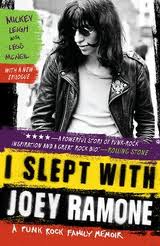 978-1439159750 – paperback – Simon & Schuster – $15.99 (ebook versions available $12.99)
Mickey Leigh grew up in Queens in the 1950s and 1960s as Mitchel Hyman. His brother was Jeffrey Hyman, more famously known as Joey Ramone, lead singer of the great American punk rock band, The Ramones. I Slept with Joey Ramone (subtitle: a punk rock family memoir) tells their story from the beginning to the end of Joey’s relatively short life and just a bit farther into the almost present day. Mickey had some writing help from rock journalist Legs McNeil, and throughout the book, the story is told compellingly in Mickey’s voice and from his perspective.
We start in Queens where the boys grow up somewhat rockily. Their family situation was never easy, and Mitchel and Jeff were bullied misfits. Joey had both physical and psychological issues that manifested early in his life. Music became their savior very early, but at the beginning it was Mitchel (Mickey) who was the musician, and it took some time before the very complicated Jeff got together with the band that became the Ramones and found not only his voice, but his new identity.
The Ramones story as told by Mickey Leigh, is pretty incredible, even for fans who know something about the band and were there during the glory days. The relationships between the various band members were legendarily terrible. How this band stayed together and made such incredible music is still a mystery. Mickey was there at the beginning; John Cummings, aka Johnny Ramone, was initially his best friend. Mickey ended up being the band’s first roadie, while Joey, the quintessential misfit outsider, became the front man singer of what eventually became one of the greatest rock bands of all time. Later Mickey had his own career with a number of bands, as well as being a songwriter too.
The many stories and incidents recounted in this book are never boring, even when the sometime strange and complicated elements of Joey Ramone’s personality begin to repeat themselves over years. There is a tremendous amount of love here, and some not so nice things as well. Mickey’s own story is complicated and he has alot to say about alot of the people he worked with, for and sometimes against throughout the years. Nothing here is ever boring. It’s sometimes sad and frustrating to know how things were for Joey Ramone and his family, friends and associates, as it was often difficult, confusing and painful for all of them. Even years later, when they were inducted into the Rock and Roll Hall of Fame, the Ramones created an emotionally complicated scene.
Ultimately, Mickey (and doubtless Legs too) has captured beautifully a unique and special part of modern musical history, that is also the story of redemption, which is after all, the real story of rock and roll. And at the end Joey and Mickey always did make up. As Mickey tells it, the last time really counted the most. “He pulled me down to him, and he just didn’t let go. I can still feel that hug.” This is a book well worth reading for anyone interested in New York punk rock. I had a great time talking to him about the book and his experiences in rock and roll.

Podcast: Play in new window | Download
Douglas Rushkoff: Program or be Programmed
January 11, 2011 by David
Filed under Non-Fiction, WritersCast
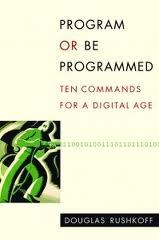 978-1935928157 – Paperback – OR Books – $16.00 (ebook edition $10.00)
with terrific original illustrations by Leland Purvis.
I think this book, Program or be Programmed: Ten Commands for a Digital Age by digital critic and thinker Douglas Rushkoff, should be required reading for anyone interested in modern culture, politics or economics. It’s a short book, densely argued, that requires careful reading and attention to its ideas. Which probably makes it daunting to many in this era of fragmented ideas and short subjects. But it’s divided into ten clear sections (note “commands” as in programming inputs, rather than “commandments” as in biblical instructions) and is well worth the effort a reader must put into reading it.
I spent more time with this short book than with many much longer books I have read recently. And I am very happy I did. As Howard Rheingold says “Thinking twice about our use of digital media, what our practices are doing to us, and what we are doing to each other, is one of the most important priorities people have today.” It’s impossible not to agree. And Rushkoff understands the complexity of behavior and thinking that the always-on, always-connected internet has brought to modern culture.
It’s not about whether the internet is good or bad, or whether online culture somehow supplants a more preferable offline one. As the publisher says about this book, “the real question is, do we direct technology, or do we let ourselves be directed by it and those who have mastered it? “Choose the former,” writes Rushkoff, “and you gain access to the control panel of civilization. Choose the latter, and it could be the last real choice you get to make.”
Having the opportunity to talk about these ideas with Rushkoff was tremendously exciting and invigorating. He’s a really smart guy whose clarity of thought I admire alot. I’ve spent alot of time participating in, reading about and analyzing new media and modern culture myself, and I know I have learned alot from Douglas Rushkoff’s books and ideas. I think Program or be Programmed is one of the most important books I have read in a long time.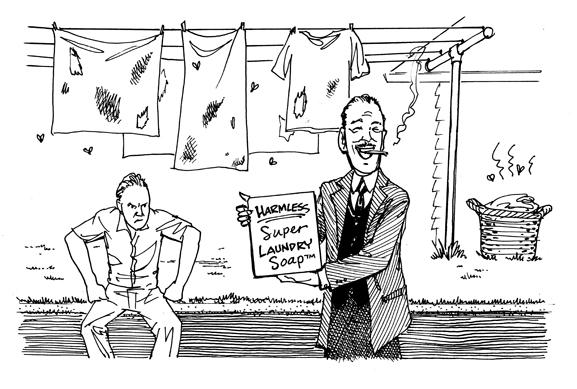
Podcast: Play in new window | Download
Publishing Talks: David Wilk Interviews Clint Greenleaf
January 6, 2011 by David
Filed under PublishingTalks, The Future
 In this series of interviews, called Publishing Talks, I have been talking to book industry professionals and other smart people about the future of publishing, books, and culture. This is a period of disruption and change for all media businesses. We must wonder now, how will publishing evolve as our culture is affected by technology, climate change, population density, and the ebb and flow of civilization and economics?
I believe these Publishing Talks conversations can help us understand the outlines of what is happening in the publishing industry, and how we might ourselves interact with and influence the future of publishing as it unfolds.
These interviews give people in and around the book business a chance to talk openly about ideas and concerns that are often only talked about “around the water cooler,” at industry conventions and events, and in emails between friends and they give people inside and outside the book industry a chance to hear first hand some of the most interesting and challenging thoughts, ideas and concepts being discussed by people in the book business.
Clint Greenleaf began the Greenleaf Book Group after writing and publishing two books, selling foreign publication rights, and securing a multibook contract with Adams Media. Since then, he has built the company into one of the industry’s leading book distributors. Greenleaf Book Group has represented more than five hundred titles and is one of the fastest-growing companies in America. Clint speaks at conferences and seminars across the country and has been featured in the Wall Street Journal, Inc. magazine, and Entrepreneur, and he is also a contributor to Inc.com. Greenleaf has had a number of publishing and distribution successes and has become a viable alternative for many authors and independent publishers that prefer an entrepreneurial approach to publishing that provides them with more control over the publishing process than the traditional publishing model.
Greenleaf Book Group describes itself: “Our publishing model was designed to support the independent author and to make it possible for writers to retain the rights to their work and still compete with the major publishing houses. In addition to the books we publish, we distribute select titles from small and independent publishers to major trade outlets, including bookstores, libraries, and airport retailers.” Clint Greenleaf is a dynamic and intelligent business leader who brings a powerful entrepreneurial spirit and positive outlook to the publishing process. He recognizes that companies must constantly innovate in order to succeed, remain committed to doing quality work and provide significant value throughout their efforts. Greenleaf’s success is evidence that there is growing demand for alternative publishing and distribution models as the bookselling landscape continues to change.
In our discussion, we covered a wide range of topics relating to the ways that publishing and distribution are changing and Greenleaf’s past, present and future work. I think it will be a fascinating conversation for anyone interested in how publishing is evolving today.
Podcast: Play in new window | Download
Publishing Talks: David Wilk interviews Allee Willis
December 28, 2010 by David
Filed under PublishingTalks, Technology, The Future
 In this series of interviews, called Publishing Talks, I have been talking to book industry professionals and other smart people about the future of publishing, books, and culture. This is a period of disruption and change for all media businesses. We must wonder now, how will publishing evolve as our culture is affected by technology, climate change, population density, and the ebb and flow of civilization and economics?
I hope these Publishing Talks conversations will help us understand the outlines of what is happening, and how we might ourselves interact with and influence the future of publishing as it unfolds.
These interviews give people in and around the book business a chance to talk openly about ideas and concerns that are often only talked about “around the water cooler,” at industry conventions and events, and in emails between friends and they give people inside and outside the book industry a chance to hear first hand some of the most interesting and challenging thoughts, ideas and concepts being discussed by people in the book business.
Allee Willis is one of my all-time favorite people. She is best known as a spectacular and hugely successful songwriter; her songs for Earth, Wind and Fire and the Pointer Sisters were giant hits, she wrote the theme song for “Friends,” the music for the Oprah Winfrey produced Broadway musical production of “The Color Purple, collaborated with the web sensation Pomplamoose (Jungle Music), and as of the date of this posting, her song “I’m Here” was sung by Jennifer Hudson for Oprah Winfrey’s Kennedy Center Honor Award. But all of this musical success notwithstanding, as she herself says, Allee is “a one-woman creative think-tank. A multi-disciplinary artist and visionary thinker whose range of imagination and productivity knows no bounds, her success exuberantly defies categorization-‘unique’ pales as a descriptor.” You have to visit her website to begin to get an idea of what a creative powerhouse she is. Her Allee Willis Museum of Kitsch is not to be missed. She’s constantly creating, integrating music, art, video, multi-media technology and lifestyle via a series of work which she co-composes, sings, plays, produces, draws, animates, directs, designs web worlds for and stars in. The first release, “Allee Willis Presents Bubbles & Cheesecake “It’s A Woman Thang”-part of a 6-song collaboration with singer-songwriter Holly Palmer (aka Cheesecake) was selected as Official Honoree in the 2008 Webby Awards, and won three 2008 W3 Awards. Her second video, “Allee Willis Presents Bubbles & Cheesecake “Editing Is Cool” was also ‘featured’ on YouTube. At one point, Willis’ 2009 video “Hey Jerrie,” co-starring 91-year-old female drummer on an oxygen tank Jerrie Thill, was the 12th most popular video in the world on YouTube.
I wanted to talk to Allee mainly because she has been working with the internet in her work almost since the ‘web went public – as she points out, the ‘web itself is her medium. She is the ultimate social being, her work itself is social art, her medium is her life. Anyone working in an artistic discipline today can learn from what she knows and how she conducts herself as an artist. I loved talking to Allee about her work and what she knows – which is a tremendous amount. And now I am addicted to her website too. Writers and publishers, please pay attention to what she has to say: art is social! books are bait!
Podcast: Play in new window | Download
Jaimy Gordon: Lord of Misrule
December 18, 2010 by David
Filed under Fiction, WritersCast
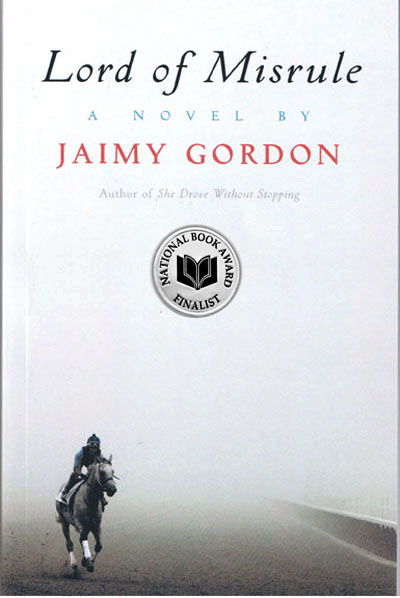 978-0-929701-83-7 – Hardcover – McPherson & Company – $25.00
I can’t say enough good things about Jaimy Gordon’s writing, up to and including Lord of Misrule, this year’s winner of the National Book Award. Although she has been writing for the past 40 years, producing five wonderful, interesting novels and a number of smaller works during that time, for the most part Jaimy’s audience has been small. Perhaps this is fitting for someone whose work does not easily fit the standard categories of commercial fiction, as the structure of the publishing and bookselling machinery has not provided much room for many writers and books outside the mainstream for quite some time.
That said, Jaimy Gordon is simply a terrific writer and Lord of Misrule may well be her best book yet. It’s set in a mythical down-and-out racetrack Indian Mound Downs, downriver from Wheeling, West Virginia. There are five main characters, all from disparate and desultory backgrounds, but all connected by their wishes, dreams and aspirations, which drive them and the novel forward. And the book is constructed of four sections, each named for a particular horse in a particular race. The story unfolds almost magically, and it’s one of those books that is literally impossible to put down. I was hooked early on and loved the ride the author took me on, peopled by wonderful down and out Runyonesque characters who speak amazing dialogue in the voices of Appalachian region horse people, and of course beautiful horses throughout.
Here’s a brief excerpt from the book that gets across a bit of the style of the book (and you can download a PDF excerpt of the novel at the publisher website here):
“They were all looking for a van like a Chinese jewel box, like no horse van that had ever been seen on a backside, something red and black and glossy, with gold letters, LORD OF MISRULE, arched across each side. All the same when a plain truck with Nebraska plates rolled in . . . they knew who it was. They were watching, though the van was unmarked and dirty white, one of those big box trailers with rusty quilting like an old mattress pad you’ve given to the dog. The van bounced and groaned on its springs along the backside fence, headed for the stallman’s office. Red dust boiled around it. They blinked as it dragged two wheels through the puddle that never dried, the puddle that had no bottom. . . . They peered through the vents when the van went by and saw the horse’s head, calm, black and poisonous of mien as a slag pile in a coal yard . . .
The van stopped, woof, down comes the ramp and a kid, unhealthy-looking like all racetrack kids, worm white, skull bones poking out of his skinny head, stood at the top of the ramp with a small black horse that couldn’t even stand right: Lord of Misrule . . . rocked on the flat floor of the van like a table with one short leg. And those legs – they were so swelled out from long-ago bowed tendons on both sides that they were one straight line from knee to ankle, drainpipes without contour. ”
I’ve been reading (and admiring) Jaimy’s work for a long time, since her first published work Shamp of the City-Solo was thrust into my hands by her publisher Bruce McPherson probably in 1975. It’s a thrill to see her work recognized more widely and gratifying to know that this excellent writer will now always have a much larger audience for her writing. She and this new book are getting great coverage in all sorts of media. Here’s an excellent profile of Jaimy by Chip McGrath in the New York Times: Writer Races to Victory From Way Off the Pace. There have been many others, many of which have focused more on the storyline of “obscure writer finds sudden fame” than on her book and writing career.
I wanted to spend a good amount of time talking in detail with Jaimy specifically about this book, Lord of Misrule, along with something of the story of how this book came to be published (it’s a good story, reflecting much about the nature of independent publishing and serious fiction – discussed in more detail in my companion interview with publisher Bruce McPherson).
Jaimy Gordon is a terrific writer who has a lot of important things to say, and I’m very pleased to have had this opportunity to talk to her about her work.
Podcast: Play in new window | Download
Publishing Talks: David Wilk Interviews Bruce McPherson
December 17, 2010 by David
Filed under Publishing History, PublishingTalks, The Future
 In this series of interviews, called Publishing Talks, I have been talking to book industry professionals and other smart people about the future of publishing, books, and culture. This is a period of disruption and change for all media businesses. We must wonder now, how will publishing evolve as our culture is affected by technology, climate change, population density, and the ebb and flow of civilization and economics?
I hope these Publishing Talks conversations will help us understand the outlines of what is happening, and how we might ourselves interact with and influence the future of publishing as it unfolds.
These interviews give people in and around the book business a chance to talk openly about ideas and concerns that are often only talked about “around the water cooler,” at industry conventions and events, and in emails between friends and they give people inside and outside the book industry a chance to hear first hand some of the most interesting and challenging thoughts, ideas and concepts being discussed by people in the book business.
I have had some really interesting conversations with people in the publishing industry this year. The present is a time of great upheaval and change for many in publishing. Recently, I had the pleasure of speaking with Andrew Steves of Canada’s relatively tiny Gaspereau Press, just before their book, The Sentimentalists won that country major book award, the Scotiabank Giller Prize. Soon after, I was able to talk to Bruce McPherson of McPherson & Co., about his many years of publishing and the great news that his recently published Lord of Misrule by old friend Jaimy Gordon had won the National Book Award (quite a surprise for all!). It’s unusual enough for a major national book award to recognize the work of independently published books, but to have two almost simultaneously in both the US and Canada must mean something about these times. In other words, I don’t think these are outlier events.
As it happens, I’ve known Bruce and Jaimy for about as long as I have known anyone, going back to when Bruce began publishing as Treacle Press right after graduating Brown in the early 1970’s. The first book he published was Jaimy’s superb and inventive novel, Shamp of the City-Solo. I read that book because Bruce told me I must, and loved its wildly inventive story and Jaimy’s brilliant writing. I’ve been a fan and reader of hers ever since. Bruce has published a wide range of interesting books in film, art and fiction. He’s developed a clear vision of who, what and how he will operate as a publisher, and has managed to invent a working business model that in many ways reflects his own independent thinking and unwillingness to compromise art for common business demands.
In many ways, the recognition of Jaimy Gordon as a great writer is a recognition of Bruce McPherson as a great publisher, and a validation of a somewhat old fashioned notion of commitment and loyalty to art, talent and human beings. Writers as living, breathing, suffering artists whose publishers support them, prod them to do their best work, and love them unabashedly and without compromise. That may sound sentimental in these harsh times, but it’s a sentiment I am willing to cherish and celebrate. I admire Bruce and the body of work he has produced in more than 35 years of struggle.
Neither Bruce nor McPherson & Co. promote anything other than the books and authors themselves, i.e., it’s not about the publisher, it’s about the books. I very much enjoyed the opportunity, therefore, to shine a bit of light on Bruce and his work, and hopefully to illuminate something of what his publishing has meant and means for our culture. And of course the experience of winning the NBA is present throughout. I hope listeners will enjoy this podcast in tandem with my current interview with Jaimy Gordon as well.
Podcast: Play in new window | Download
Paul David Pope: The Deeds of My Fathers
December 12, 2010 by David
Filed under Non-Fiction, WritersCast
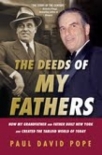 978-1442204867 – Hardcover – $24.95 – Philip Turner/Rowman & Littlefield (e-book editions available at $9.99)
Well this is truly an amazing 20th century American story, and really well told by the author, who spent many years working on this book. There are characters here as big as those in any historical novel. The full title of the book gets to what the story is about: The Deeds of My Fathers: How My Grandfather and Father Built New York and Created the Tabloid World of Today.
Paul David Pope’s grandfather, Generoso Pope Sr., came to this country alone and poor, at a very young age seeking a better life, as so many other immigrants did. That part of the story is hardly unique. But he was obviously a very special sort of person, and it did not take him very long, through hard work, intelligence and a certain amount of ruthlessness, to create a building trades empire in the greatest city in America, New York City.
His companies supplied the concrete that literally built the city in the boom years of New York. But he also managed to buy and control this country’s primary Italian language newspaper, Il Progresso, and his wealth, power and connections (including political kingmakers, the mob, and even FDR as well as the Pope) made him one of this country’s leading and most influential Italian Americans. Because he was able to use his newspaper to influence elections, he essentially became a kingmaker in the old school of American politics, and was truly an iconic emblem of his times.
But author Pope does not shy away from telling us the ugly along with the good. His grandfather was far too close to Mussolini in the 1930s, and was blatantly used by the Fascists to try to influence American public opinion in their favor during the lead up to World War II. And he was far from being a good husband and father. He always favored his youngest son, Gene (author Pope’s father), and selected him to run his businesses, over his older and more experienced brothers.
Early on, Gene Americanized his name to Pope. He was pushed out of the family business after his father’s death by his mother and his two older brothers. At that point, Gene, with a loan secured from his “Uncle Frank” Costello, bought a newspaper in decline, the New York Enquirer. With a combination of dedication and a brilliant natural understanding of what average readers would want to read, he created the pinnacle of all tabloids, the National Enquirer. Of course, the support of his Uncle Frank did not come without strings, and Frank required that the paper stop attacking the mob in its stories, and in fact it was to publish only positive stories about projects the mob was backing, and even that the Enquirer would attack and discredit the enemies and opponents of organized crime – which it did without hesitation.
But the heart of Gene Pope’s story is his single minded dedication to the newspaper he loved. He moved the company to Florida and made it almost the only thing he cared about. As he grew older, he was clearly eccentric in his behavior (some might say nighly neurotic and disturbed). But throughout, Gene Pope gives readers what they want, and as the National Enquirer covers the paranormal, medical cures, celebrities, always attentive to what the average American would read, and circulation soars, peaking with the 7 million copies sold of the Enquirer’s 1977 exposé on the death of Elvis Presley.
Paul David Pope gives us a fast paced, almost novelistic version of his family’s history. His story is based on hundreds of interviews, and a huge amount of research, but of course much of what happened in the earlier part of the story is reconstructed from the documentary record. It is a gripping narrative, and a compelling story for anyone who cares about the modern history of the United States as lived by some of its more colorful and successful citizens, and the author gets across the complexity of his real life family in their non-stop rush to make their marks.
Talking to the author gave me a chance to delve into the background of the story, what motivated Paul to do all this work and stay with it for so long, and for him to talk about how his family history has affected his own life. There’s more about the book at the author’s website too.
Podcast: Play in new window | Download
Publishing Talks: David Wilk Interviews Betsy Lerner
December 9, 2010 by David
Filed under Publishing History, PublishingTalks, The Future
 In this series of interviews, called Publishing Talks, I have been talking to book industry professionals and other smart people about the future of publishing, books, and culture. This is a period of disruption and change for all media businesses. We must wonder now, how will publishing evolve as our culture is affected by technology, climate change, population density, and the ebb and flow of civilization and economics?
I hope these Publishing Talks conversations will help us understand the outlines of what is happening, and how we might ourselves interact with and influence the future of publishing as it unfolds.
These interviews give people in and around the book business a chance to talk openly about ideas and concerns that are often only talked about “around the water cooler,” at industry conventions and events, and in emails between friends and they give people inside and outside the book industry a chance to hear first hand some of the most interesting and challenging thoughts, ideas and concepts being discussed by people in the book business.
A few weeks ago I read a piece by Betsy Lerner in Publishing Perspectives, the excellent online newsletter about the publishing business edited by Ed Nawotka. It was called “Should I Tweet” and was adapted from the new updated edition of Betsy’s book “The Forest for the Trees: An Editor’s Advice for Writers.” It’s a great piece, that says some important things about marketing and publishing aimed at writers (but good for everyone else in publishing to read too), and instantly made me want to talk to her (and buy her book). This little quote from near the end of the essay really grabbed me:
“I’m not saying that everyone can or should be creating a personal literary dynasty, but it’s essential for authors to be thinking about how to market themselves. Always has been. Sometimes they cry, “but I’m no good at marketing,” or “Isn’t that the publisher’s job?” I think publishers should help authors think about what they can do early on in the process, whether it’s creating a blog, developing mailing lists, or getting speaking engagements lined up. If you’re lucky enough to be signed up without a platform, start working on one! Marketing and selling books is not for the faint of heart. Whitman knew that. Palahniuk knows it. Jay Conrad Levinson preaches it.
But no one knew it better than P.T. Barnum, “Without promotion something terrible happens,” he said. “Nothing!”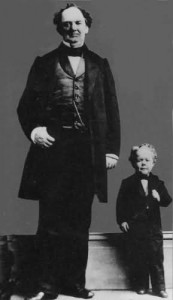
Betsy is herself of course, a terrific writer, as well as being a successful agent. I admire her blog, where she extends the work she did in The Forest for the Trees. She is funny and smart, entertaining and instructive, and obviously talented. Her opinions are definitely worth knowing, and her advice for writers is always great stuff. She’s a poet, and was for many years a successful commercial editor, and then became an agent with a great list of client writers; she is a partner at the Dunow, Carlson and Lerner Literary Agency. She wrote another book called Food and Loathing about her issues with eating and depression. She received an MFA from Columbia University in Poetry and was the recipient of a Thomas Wolfe Poetry Prize, an Academy of American Poets Poetry Prize, and was one of PEN’s Emerging Writers in 1987. She also received the Tony Godwin Publishing Prize for Editors Under 35. And Betsy also gives talks on every aspect of the publishing process from her perspective as a writer, former editor and agent.
We had a great conversation about books, publishing and marketing, during which I learned a few things and gained some valuable insights. A key point she makes is how important it is for writers to understand their role in the publishing process. While we are certainly in a period of heightened difficulties, the challenges writers (and publishers) face today are really not that different from what they have always been. The specific tools we use may change, but the principles of marketing books remain the same. Writers are in fact entrepreneurs, and not just “writers” and they must always be engaged in the public process of publishing, in a measure most likely equal to their own actual abilities. And she also reminds us of the central matter: that the quality of the work must always be the focus of everything. Everything else is secondary.
After talking to Betsy, I’m now looking forward to reading The Forest for the Trees – and sooner rather than later.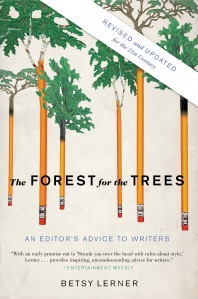
Podcast: Play in new window | Download