
Publishing Talks: David Wilk Interviews Lena Tabori
May 2, 2010 by David
Filed under Publishing History, PublishingTalks
 In this series of interviews, called Publishing Talks, I have been talking to book industry professionals about the future of publishing, books, and culture. This is a period of disruption and change for all media businesses.
How will publishing evolve as our culture is affected by technology, climate change, population density, and the ebb and flow of civilization and its economics? Publishing Talks interviews help us understand the outlines of what is happening, and how we might ourselves interact with and influence the future of publishing as it unfolds.
In this series of interviews, called Publishing Talks, I have been talking to book industry professionals about the future of publishing, books, and culture. This is a period of disruption and change for all media businesses.
How will publishing evolve as our culture is affected by technology, climate change, population density, and the ebb and flow of civilization and its economics? Publishing Talks interviews help us understand the outlines of what is happening, and how we might ourselves interact with and influence the future of publishing as it unfolds.
These interviews give people in the book business a chance to talk openly about ideas and concerns that are often only talked about “around the water cooler,” at industry conventions and events, and in emails between friends. I believe these interviews give people inside and outside the book industry a chance to hear first hand some of the most interesting and challenging thoughts, ideas and concepts being discussed within the industry.
Lena is the founder of Welcome Enterprises and is currently Welcome’s director and publisher of Welcome Books, the imprint under which the company publishes illustrated books. In addition to overseeing the development, production, operation, and promotion of Welcome’s publishing program, Lena continues to conceive, edit, and produce book projects, as she has done throughout her long career as a publishing professional.
She began her career in 1967 with Harry N. Abrams, where she rose to the position of vice president of Marketing and Special Sales. In 1980, Lena left Abrams to create Welcome Enterprises as well as to co-found Stewart, Tabori & Chang, the illustrated book publisher. Lena also found time to produce Ziggy’s Gift, an animated special for ABC television based on the Tom Wilson cartoon character and directed by Richard Williams. For her role as producer and executive producer of Ziggy’s Gift, she was awarded an Emmy in 1983.
In 1991, Lena moved to San Francisco to become president and publisher of CollinsPublishersSanFrancisco. In 1993, she returned to Stewart, Tabori & Chang as their president and publisher. In 1997, Lena returned to Welcome full-time.
Most noted for her work in illustrated books and highly original publishing projects Lena Tabori is one of the most successful figures in contemporary American publishing. In this interview, Lena talked to me mostly about the earliest stages of her long and very successful career. During that time she has never stopped innovating, being highly creative, and producing both artistically and commercially successful books, working with many great writers and artists, as well as talented people in publishing. She has published, conceived, created, or caused to exist an incredible number of exceptional books in many categories, shapes and sizes. Anyone interested in modern publishing and the principles that will endure during its current period of disruption will find this discussion interesting and valuable.
Podcast: Play in new window | Download
Publishing Talks: David Wilk interviews Ron Hogan
April 18, 2010 by David
Filed under PublishingTalks, The Future
 In this series of interviews, called Publishing Talks, I have been talking to book industry professionals about the future of publishing, books, and culture. This is a period of disruption and change for all media businesses.
How will publishing evolve as our culture is affected by technology, climate change, population density, and the ebb and flow of civilization and its economics? Publishing Talks interviews help us understand the outlines of what is happening, and how we might ourselves interact with and influence the future of publishing as it unfolds.
These interviews give people in the book business a chance to talk openly about ideas and concerns that are often only talked about “around the water cooler,” at industry conventions and events, and in emails between friends. I believe these interviews give people inside and outside the book industry a chance to hear first hand some of the most interesting and challenging thoughts, ideas and concepts being discussed within the industry.
Ron Hogan has been a very busy guy in the book business over the past fifteen years or so, starting in the book business at the well known and now lamented Dutton’s Bookstore in Los Angeles. He founded Beatrice.com in 1995 (the site is still going strong today as a popular book-centric blog), worked for Amazon, and then for Mediabistro’s Galleycat (“the first word on the book publishing business”), and is now the new Director of E-Marketing Strategy for publisher Houghton Mifflin Harcourt in New York City. If you look him up online, he seems to be everywhere at once, involved in many aspects of publishing, books and new media. It’s difficult to imagine someone more aware of how books and readers interact in the online environment.
Ron is also an author, including The Stewardess Is Flying the Plane!: American Films of the 1970s and most recently Getting Right with Tao: A Contemporary Spin on the Tao Te Ching.
In his new role at HMH, he will now have an opportunity to apply what he knows about marketing and online communities to the practical issues of helping to connect books and readers. In this interview, Ron talked with me about his past work, and particularly what he has learned from his experience in retail bookselling, as well as his extensive online experience, and provides some specific and useful advice for authors (and publishers) to help them thrive in the brave new world of publishing.
Podcast: Play in new window | Download
Publishing Talks: David Wilk interviews Jan Weissmiller
April 8, 2010 by David
Filed under PublishingTalks, The Future
 In this series of interviews, called Publishing Talks, I have been talking to book industry professionals about the future of publishing, books, and culture. This is a period of disruption and change for all media businesses.
How will publishing evolve as our culture is affected by technology, climate change, population density, and the ebb and flow of civilization and its economics? Publishing Talks interviews help us understand the outlines of what is happening, and how we might ourselves interact with and influence the future of publishing as it unfolds.
These interviews give people in the book business a chance to talk openly about ideas and concerns that are often only talked about “around the water cooler,” at industry conventions and events, and in emails between friends.
I believe these interviews give people inside and outside the book industry a chance to hear first hand some of the most interesting and challenging thoughts, ideas and concepts being discussed within the industry.
Jan Weissmiller recently achieved her fifteen minutes of fame when President Barack Obama visited her store – and the picture of her selling him a book went viral very quickly. But Prairie Lights Bookstore has more going for it than simply being the backdrop for the first citizen’s book buying habit writ large. It’s been a fixture in the strongly literary community of Iowa City since Jim Harris started the store there in the late ’70s.
As times have changed, so has the store, and today Prairie Lights has an active web presence in addition to its longstanding role as “the” local bookstore in one of the great small towns of middle America. I’ve been to the store many times over the years, and deeply admire the vision and care demonstrated first by Jim and Jan, when she was the first employee of the store, and now by Jan and her current wonderful staff of book devotees. Many towns no longer have the opportunity to experience the depth of knowledge that a great bookstore can provide. What Jan and Prairie Lights show us about bookselling is important – people use technology to make life easier, but people need other people to make life meaningful.
In case you missed it, here is the link to the NY Times story about Prairie Lights. And here’s the now famous photo.
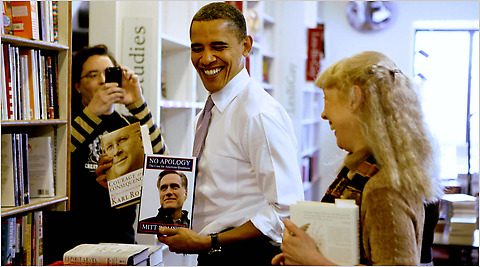
Jan Weissmiller was the first employee of Prairie Lights, beginning in 1979, and is now its co-owner.
Podcast: Play in new window | Download
Publishing Talks: David Wilk Interviews Peter Broderick
April 1, 2010 by David
Filed under PublishingTalks, The Future
 In this series of interviews, called Publishing Talks, I have been talking to book industry professionals about the future of publishing, books, and culture. This is a period of disruption and change for all media businesses.
How will publishing evolve as our culture is affected by technology, climate change, population density, and the ebb and flow of civilization and its economics? Publishing Talks interviews help us understand the outlines of what is happening, and how we might ourselves interact with and influence the future of publishing as it unfolds. These interviews give people in the book business a chance to talk openly about ideas and concerns that are often only talked about “around the water cooler,” at industry conventions and events, and in emails between friends.
I believe these interviews give people inside and outside the book industry a chance to hear first hand some of the most interesting and challenging thoughts, ideas and concepts being discussed within the industry.
Peter Broderick comes from an independent film background and has a perspective that I think is terrifically useful and important. Peter is President of Paradigm Consulting, which helps filmmakers and media companies develop strategies to maximize distribution, audience, and revenues. His work now is completely focused on working with film-makers to utilize new tools in marketing and distribution, and his ideas are very much in concert with my own thoughts about publishing. I strongly recommend reading his article “Maximizing Distribution” and his reports, “Welcome to the New World of Distribution” and “Declaration of Independence;” as concise and spot on as they are for film, they will be useful to anyone thinking about media distribution today and in the future.
I believe there should be more cross-discipline conversations like this one.
Podcast: Play in new window | Download
Publishing Talks: David Wilk interviews Kent Anderson
March 9, 2010 by David
Filed under PublishingTalks
 In this series of interviews, called Publishing Talks, I have been talking to book industry professionals, each of whom has a different perspective about the future of publishing, books, and culture. This is a period of disruption and change for all media businesses.
Publishing has been a crucial part of human culture for as long as people have been writing and reading.
In this series of interviews, called Publishing Talks, I have been talking to book industry professionals, each of whom has a different perspective about the future of publishing, books, and culture. This is a period of disruption and change for all media businesses.
Publishing has been a crucial part of human culture for as long as people have been writing and reading.
How will publishing evolve as our culture is affected by technology, climate change, population density, and the ebb and flow of civilization and its economics? Publishing Talks interviews help us understand the outlines of what is happening, and how we might ourselves interact with and influence the future of publishing as it unfolds. Publishing Talks interviews give people in the book business a chance to talk about ideas and concerns in a public forum that are often only talked about “around the water cooler,” at industry conventions and events, and in emails between friends.
I believe that these interviews give people inside and outside the book industry a chance to hear first hand some of the most interesting and challenging thoughts, ideas and concepts that are currently being discussed within the industry.
In this interview, I had the pleasure of talking to Kent Anderson, Editor-in-Chief of the Scholarly Kitchen, an Society for Scholarly Publishing member, and former Board member. Kent has a BA in English as well as an MBA. He is currently CEO/Publisher for the Journal of Bone & Joint Surgery. He formerly worked in the Massachusetts Medical Society’s Publishing Division in Product Development and International Business and as Publishing Director for the New England Journal of Medicine. He’s been a publisher, managing editor, copy editor, graphic designer, typesetter, editor, and author. He’s worked at the American Academy of Pediatrics, Medical Economics, and 3M, in addition to other odd jobs here and there (notice, this construction makes all the jobs odd). And interestingly, he also writes mystery novels in his spare time (he writes the Johnny Denovo Mysteries under the pen name Andrew Kent). He wrote a very intelligent article about publishing his latest book for the Self-Publishing Review. And lastly he is a member of an innovative authors’ collective Backwords Books. Busy guy!
We covered alot of interesting ground in our talk, starting with a long discussion about Jaron Lanier’s latest book, called You Are Not a Gadget, that Kent recently reviewed in depth in the Scholarly Kitchen, a book that raises a number of really interesting concerns about the way the open online economy is working. That was a great starting off point for a really interesting discussion about online publishing, devices, valuations and pricing, web business models, and many other related subjects.
Podcast: Play in new window | Download
Publishing Talks: David Wilk interviews Morgan Entrekin
February 26, 2010 by David
Filed under PublishingTalks
 In this series of interviews, called Publishing Talks, I am talking to book industry professionals who have varying perspectives and thoughts about the future of publishing, books, and culture. This is a period of disruption and change for all media businesses.
Publishing has been a crucial part of human culture for as long as people have been writing and reading.
In this series of interviews, called Publishing Talks, I am talking to book industry professionals who have varying perspectives and thoughts about the future of publishing, books, and culture. This is a period of disruption and change for all media businesses.
Publishing has been a crucial part of human culture for as long as people have been writing and reading.
How will publishing evolve as our culture is affected by technology, climate change, population density, and the ebb and flow of civilization and its economics? Publishing Talks interviews help us understand the outlines of what is happening, and how we might ourselves interact with and influence the future of publishing as it unfolds. Publishing Talks interviews give people in the book business a chance to talk about ideas and concerns in a public forum that are often only talked about “around the water cooler,” at industry conventions and events, and in emails between friends.
I hope that Publishing Talks interviews will give people inside and outside the book industry a chance to hear about some of the thoughts, ideas and concepts that are currently being discussed by engaged individuals within the industry.
Morgan Entrekin is the iconic publisher of Grove Atlantic, one of the most prominent and successful midsized literary publishers of the past couple of decades. He has all the chops of a “traditional” book publisher: a great commitment to authors and their texts, a belief in the enduring power of a great backlist. But he is also an astute marketer who understands readers and the necessity for publishers to pay attention to what readers want and need.
Entrekin grew up in Nashville, graduated from Stanford in 1977, started in the business at Delacorte Press, working under the late, great Seymour Lawrence and editing the likes of Jayne Anne Phillips, Richard Brautigan, and Kurt Vonnegut. In 1982 he moved over to Simon & Schuster, where he made his name by championing, acquiring and editing Bret Easton Ellis’s breakout novel Less Than Zero. In 1984 he created his own imprint within Atlantic Monthly Press, Morgan Entrekin Books and a few years later he bought Atlantic outright; two years after that, he purchased Grove Press, which featured one of the great backlists that included D.H. Lawrence, Henry Miller, and Samuel Beckett.
Entrekin’s gained well deserved fame and credit for publishing Charles Frazier’s Cold Mountain in 1995. In the course of promoting the novel, Entrekin is credited with more or less creating the pre-publication tour, sending Frazier to meet book buyers in various cities before the book landed in stores. It paid off: Cold Mountain was a huge success, sold over 1.5 million copies, won the National Book Award, and was made into a big-budget Hollywood movie. Other notable Grove/Atlantic titles include Mark Bowden’s Black Hawk Down, Candace Bushnell’s Sex and the City, as well as the works of Sherman Alexie and P.J. O’Rourke.
We had a terrific talk, covering a wide range of interesting topics, from the current state of the book business, to the kinds of things that Entrekin is doing at Grove/Atlantic to stay current. Morgan is thoughtful, intelligent and incisive on every topic he discusses; he cares deeply about the books he publishes, backlist and frontlist titles alike, and is clearly still motivated and excited by the same beliefs and ideas that brought him into the book business in the first place. Anyone interested in understanding how a publisher can navigate the changing landscape of the business will benefit from listening to what he has to say in this interview.
Podcast: Play in new window | Download
Publishing Talks: David Wilk interviews Richard Curtis
February 11, 2010 by David
Filed under PublishingTalks

In this series of interviews, called Publishing Talks, I am talking to book industry professionals who have varying perspectives and thoughts about the future of publishing, books, and culture. This is a period of disruption and change for all media businesses.
Publishing has been a crucial part of human culture for as long as people have been writing and reading.
How will publishing evolve as our culture is affected by technology, climate change, population density, and the ebb and flow of civilization and its economics? Publishing Talks interviews help us understand the outlines of what is happening, and how we might ourselves interact with and influence the future of publishing as it unfolds. Publishing Talks interviews give people in the book business a chance to talk about ideas and concerns in a public forum that are often only talked about “around the water cooler,” at industry conventions and events, and in emails between friends.
I hope that Publishing Talks interviews will give people inside and outside the book industry a chance to hear about some of the thoughts, ideas and concepts that are currently being discussed by engaged individuals within the industry.
Richard Curtis, president of Richard Curtis Associates, Inc., is a leading New York literary agent and a well-known author advocate. He is also the author of numerous works of fiction and nonfiction including several books about the publishing industry. His interest in emerging media and technology has enabled him to help authors anticipate trends in publishing and multimedia. He has lectured extensively and conducted panels and seminars devoted to raising consciousness in the author and agent community about the future of communications. He was the first president of the Independent Literary Agents Association and subsequently president of ILAA’s successor organization, the Association of Authors’ Representatives (AAR) He blogs regularly on www.ereads.com. He is also, uniquely among literary agents, a publisher himself, having founded the innovative digital publishing imprint, E-Reads almost ten years ago.
I have known Richard for a very long time, have done business with him, and collaborated with him on an experimental publishing project a few years ago, But mostly, over the years, Richard and I have talked about the book business, the future of publishing and of authors, and particularly, the future of digital publishing. So it made a lot of sense for me to talk to Richard as part of the Publishing Talks series, as I knew he would have a great deal of interesting and compelling ideas to share about these subjects, which he almost always does.
Podcast: Play in new window | Download
Publishing Talks: David Wilk interviews Tim O’Reilly
January 12, 2010 by David
Filed under PublishingTalks
 In this series of interviews, called Publishing Talks, I am talking to book industry professionals who have varying perspectives and thoughts about the future of publishing, books, and culture. This is a period of disruption and change for all media businesses.
Publishing has been a crucial part of human culture for as long as people have been writing and reading. How will publishing evolve as our culture is affected by technology, climate change, population density, and the ebb and flow of civilization and its economics? Publishing Talks interviews help us understand the outlines of what is happening, and how we might ourselves interact with and influence the future of publishing as it unfolds. Publishing Talks interviews give people in the book business a chance to talk about ideas and concerns in a public forum that are often only talked about “around the water cooler,” at industry conventions and events, and in emails between friends.
I hope that Publishing Talks interviews will give people inside and outside the book industry a chance to hear about some of the thoughts, ideas and concepts that are currently being discussed by engaged individuals within the industry.
It was very exciting for me to have a chance to interview Tim O’Reilly, widely considered to be one of the smartest and most innovative publishers around. He’s been involved in the World Wide Web and computers for a very long time, and throughout that time, his work has been marked by intelligence, innovation, and clarity about what matters to consumers. We talked about the history of his involvement in publishing, the web, publishing technology, and his views about the way publishing needs to evolve using new digital tools and establishing new business models – with examples.
Here’s his bio: Tim O’Reilly is the founder and CEO of O’Reilly Media, thought by many to be the best computer book publisher in the world. The company also publishes online through the O’Reilly Network and hosts conferences on technology topics. Tim is an activist for open source, open standards, and sensible intellectual property laws.
Since 1978, Tim has led the company’s pursuit of its core goal: to be a catalyst for technology change by capturing and transmitting the knowledge of “alpha geeks” and other innovators. His active engagement with technology communities drives both the company’s product development and its marketing. Tim has built a culture where advocacy, meme-making, and evangelism are key tenets of the business philosophy.
Tim has served on the board of trustees for both the Internet Society and the Electronic Frontier Foundation, two organizations devoted to making sure that the internet fulfills its promise. He was on the board of Macromedia up until the recent merger with Adobe. He is currently on the board of CollabNet.
Tim graduated from Harvard College in 1975 with a B.A. cum laude in Classics. His honors thesis explored the tension between mysticism and logic in Plato’s dialogues.
An archive of Tim’s online articles, talks, and interviews can be found at Tim’s archive page.
Podcast: Play in new window | Download
Publishing Talks: David Wilk interviews Joe Esposito
January 5, 2010 by David
Filed under PublishingTalks
 In this series of interviews, called Publishing Talks, I am talking to book industry professionals who have varying perspectives and thoughts about the future of publishing, books, and culture. This is a period of disruption and change for all media businesses.
Publishing has been a crucial part of human culture for as long as people have been writing and reading. How will publishing evolve as our culture is affected by technology, climate change, population density, and the ebb and flow of civilization and its economics? Publishing Talks interviews help us understand the outlines of what is happening, and how we might ourselves interact with and influence the future of publishing as it unfolds. Publishing Talks interviews give people in the book business a chance to talk about ideas and concerns in a public forum that are often only talked about “around the water cooler,” at industry conventions and events, and in emails between friends.
I hope that Publishing Talks interviews will give people inside and outside the book industry a chance to hear about some of the thoughts, ideas and concepts that are currently being discussed by engaged individuals within the industry.
I’ve been reading Joe Esposito’s writings about the book business – past, present and future – for quite some time with a great deal of admiration. He is smart, understands business, and cares deeply about books, ideas and people. Here is his “official” biography: Joseph J. Esposito is an independent consultant providing strategy assessment and interim management to the information industries. He has served as an executive at Simon & Schuster and Random House, as President of Merriam-Webster, and CEO of Encyclopaedia Britannica, where he was responsible for the launch of the first Internet service of its kind. Mr. Esposito has also served as CEO of Internet communications company Tribal Voice and SRI Consulting, both of which he led to successful exits. Among Mr. Esposito’s clients have been such technology companies as Microsoft and Hewlett Packard, various publishers of all stripes, and a growing number of not-for-profit organizations (e.g., JSTOR, the University of California Press, and the American Nationals Standards Institute). You can find his writing frequently at Scholarly Kitchen.
My interview with Joe covered alot of different subjects, including his background in publishing, current trends in digital media and e-reading, how publishing will change as it adapts to a digital marketing landscape. We spent a good deal of time talking about publishing strategy relating to e-book publishing, an issue that is important to many in the publishing industry today. His views and ideas, and his delivery of them, makes for a great conversation.
Podcast: Play in new window | Download
Publishing Talks: David Wilk interviews Kassia Kroszer of Booksquare
November 26, 2009 by David
Filed under PublishingTalks
 In this series of interviews, called Publishing Talks, I am talking to book industry professionals who have varying perspectives and thoughts about the future of publishing, books, and culture. This is a period of disruption and change for all media businesses. Publishing has been a crucial part of human culture for as long as people have been writing and reading. How will publishing evolve as our culture is affected by technology, climate change, population density, and the ebb and flow of civilization and its economics? Publishing Talks interviews help us understand the outlines of what is happening, and how we might ourselves interact with and influence the future of publishing as it unfolds. Publishing Talks interviews give people in the book business a chance to talk about ideas and concerns in a public forum that are often only talked about “around the water cooler,” at industry conventions and events, and in emails between friends. This series of talks will give people inside and outside the book industry a chance to hear about some of the thoughts, ideas and concepts that are currently being discussed by engaged individuals within the industry.
I have wanted to talk to Kassia Krozser for a long time. I’ve read her insightful and opinionated blogging and posting for quite a while, and like her approach to the book business – hard questions borne from a love of books, writing and the publishing business itself. Her primary vehicle is booksquare.com, which as she has told me “dissects this world with love and skepticism.”
Her “about” section on Booksquare is well worth a read – you will get to know Kassia and her approach very quickly. Here’s a quick quote:
In addition to ensuring that you get your regular dose of BS, Kassia is a founding partner of Medialoper, where she applies her natural love and skepticism to the ever-changing world of entertainment media. The daughter of a librarian, she finds dissecting and discussing books is like breathing — her insightful reviews appear at Paperback Reader. She’s a member of the LitBlog Co-op and a columnist for Romancing the Blog. She’s also published in a variety of other venues, and has, shockingly, received awards and accolades for her work. But she rarely mentions this as it seems like bragging.
In this interview Kassia and I covered alot of ground. She was just back from her first attendance at the major international book fair in Frankfurt, Germany. We talked about technology, comparing how it applies in developing nations versus the West, issues of elitism and access, cultural definitions, and the future of the book business, as well as the impending Google Book Settlement and e-book pricing strategies in this lively interview.
Podcast: Play in new window | Download