
Paul David Pope: The Deeds of My Fathers
December 12, 2010 by David
Filed under Non-Fiction, WritersCast
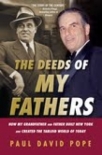 978-1442204867 – Hardcover – $24.95 – Philip Turner/Rowman & Littlefield (e-book editions available at $9.99)
Well this is truly an amazing 20th century American story, and really well told by the author, who spent many years working on this book. There are characters here as big as those in any historical novel. The full title of the book gets to what the story is about: The Deeds of My Fathers: How My Grandfather and Father Built New York and Created the Tabloid World of Today.
Paul David Pope’s grandfather, Generoso Pope Sr., came to this country alone and poor, at a very young age seeking a better life, as so many other immigrants did. That part of the story is hardly unique. But he was obviously a very special sort of person, and it did not take him very long, through hard work, intelligence and a certain amount of ruthlessness, to create a building trades empire in the greatest city in America, New York City.
His companies supplied the concrete that literally built the city in the boom years of New York. But he also managed to buy and control this country’s primary Italian language newspaper, Il Progresso, and his wealth, power and connections (including political kingmakers, the mob, and even FDR as well as the Pope) made him one of this country’s leading and most influential Italian Americans. Because he was able to use his newspaper to influence elections, he essentially became a kingmaker in the old school of American politics, and was truly an iconic emblem of his times.
But author Pope does not shy away from telling us the ugly along with the good. His grandfather was far too close to Mussolini in the 1930s, and was blatantly used by the Fascists to try to influence American public opinion in their favor during the lead up to World War II. And he was far from being a good husband and father. He always favored his youngest son, Gene (author Pope’s father), and selected him to run his businesses, over his older and more experienced brothers.
Early on, Gene Americanized his name to Pope. He was pushed out of the family business after his father’s death by his mother and his two older brothers. At that point, Gene, with a loan secured from his “Uncle Frank” Costello, bought a newspaper in decline, the New York Enquirer. With a combination of dedication and a brilliant natural understanding of what average readers would want to read, he created the pinnacle of all tabloids, the National Enquirer. Of course, the support of his Uncle Frank did not come without strings, and Frank required that the paper stop attacking the mob in its stories, and in fact it was to publish only positive stories about projects the mob was backing, and even that the Enquirer would attack and discredit the enemies and opponents of organized crime – which it did without hesitation.
But the heart of Gene Pope’s story is his single minded dedication to the newspaper he loved. He moved the company to Florida and made it almost the only thing he cared about. As he grew older, he was clearly eccentric in his behavior (some might say nighly neurotic and disturbed). But throughout, Gene Pope gives readers what they want, and as the National Enquirer covers the paranormal, medical cures, celebrities, always attentive to what the average American would read, and circulation soars, peaking with the 7 million copies sold of the Enquirer’s 1977 exposé on the death of Elvis Presley.
Paul David Pope gives us a fast paced, almost novelistic version of his family’s history. His story is based on hundreds of interviews, and a huge amount of research, but of course much of what happened in the earlier part of the story is reconstructed from the documentary record. It is a gripping narrative, and a compelling story for anyone who cares about the modern history of the United States as lived by some of its more colorful and successful citizens, and the author gets across the complexity of his real life family in their non-stop rush to make their marks.
Talking to the author gave me a chance to delve into the background of the story, what motivated Paul to do all this work and stay with it for so long, and for him to talk about how his family history has affected his own life. There’s more about the book at the author’s website too.
Podcast: Play in new window | Download
Tony Horwitz: A Voyage Long and Strange: On the Trail of Vikings, Conquistadors, Lost Colonists, and Other Adventurers in Early America
November 2, 2009 by David
Filed under Non-Fiction
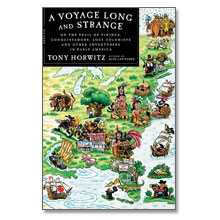 978-0312428327 – Paperback – Picador – $18.00
What a great book! This is one of those modern nonfiction books by a really smart and talented writer that communicates a great deal of information almost effortlessly. Tony Horwitz takes us on a wonderful journey, his own individualistic, funny, sometimes painful, and always fascinating tour of North American history. It all started with a chance visit to Plymouth Rock that made him realize how little he knew about the early colonization and settlement of North America before the Pilgrims arrival in 1620. It wasn’t long before he set out on a very long journey, as he puts it “in the footsteps of the many Europeans who preceded the Pilgrims to America.”
He traces many stories and visits many places on his own epic trek — from Florida’s Fountain of Youth to Plymouth’s sacred Rock, from desert pueblos to subarctic sweat lodges. Tony has a healthy regard for history and an equally healthy disregard for accepting the accepted wisdom and stories about the Europeans of all kinds who managed to get to America, muck about the place, sometimes with disastrous or horrific results, and he does not forget to talk about the people who were already here when the Europeans arrived. Overall, he is funny, tells great stories, brilliantly illuminates the people, places and myths that dot our past, and while it is trite to say, he definitely brings a long run of history vividly to life. For those of us who do know our American history, this book is fun and rewarding, and for those who missed it, I can think of no better way to learn about this early period of North American history up close and personal than to read A Voyage Long and Strange.
I heard Tony talk about this book and read from it at the Martha’s Vineyard Book Festival this summer and knew instantly that I wanted to read it myself. He definitely has one of the most engaging approaches to history and story telling you will ever run across. Probably reflecting his own engaging personality, as my interview with Tony will show you. He has a great website with alot of information about this, his newest book, and his other four books at www.tonyhorwitz.com.
Podcast: Play in new window | Download
James McCommons: Waiting on a Train: The Embattled Future of Passenger Rail Service–A Year Spent Riding across America
October 18, 2009 by David
Filed under Non-Fiction
 978-1603580649 – Paperback – Chelsea Green Publishing – $17.95
I learned a great deal from reading this excellent book. Not just information about trains – there’s alot here – but about the people who around the United States who are working to make train travel a viable alternative to driving, about the communities and states where rail is succeeding, about the history and scope of railroads in America and around the world, and specifically a great deal about Amtrak, its ongoing struggles, as well as the modern freight railroads that are thriving today. Jim McCommons has alot to tell, but he never lectures us. Because the book is built on the backbone of his year spent traveling around America by rail, and because McCommons is an experienced and talented journalist, Waiting on a Train beautifully combines travelogue, personal memoir and transportation analysis and history that gives us a great introduction to an important and large subject that might otherwise seem opaque and difficult to approach.
McCommons spent much of 2008 in trains. He talked to travelers, workers on the railroads, policy makers, professional planners, politicians, including many of the people who have been most involved in passenger rail policy for the past 35 years. Waiting on a Train is not a sentimentalist’s approach to rail travel. McCommons tells us plainly what the challenges are for those of us who want to see mass transit developed into a meaningful alternative to automobile and air travel. And he does not pull punches – developing passenger railroads is not going to be easy and it will not happen quickly. It’s important to realize that only 2% of the American public has actually ever ridden a train – a stunning fact I learned from this book. I’d recommend this book for anyone who loves trains, an easy call, but I’d also like to see people who have never even thought about riding on a train read this book so they will understand why rail must be an essential component of the American transportation system of the future.
In my interview with James McCommons, we talked in detail about what it was like for him to spend so much time in trains, writing this book, and many of the subjects he covered. He talks about high speed rail, the differences between Europe and America, meeting railroad policy makers, and talking to regular travelers from many different backgrounds. It’s a fascinating story I hope will be widely read and discussed.
Podcast: Play in new window | Download
Russ Baker – Family of Secrets – Part 1 of a two part interview
April 14, 2009 by David
Filed under Non-Fiction
 978-1596915572
Bloomsbury Press, $30.00
Hardcover
Writerscast host David Wilk interviews investigative journalist Russ Baker, author of the newly released FAMILY OF SECRETS: The Bush Dynasty, the Powerful Forces That Put It in the White House, and What Their Influence Means for America. Baker started his investigation into the Bush family during the most recent Bush administration, thinking that he would be able to understand how the “unlikely” George W actually became President of the most powerful nation on earth. This simple investigation turned into something far deeper – and ultimately Baker learned details about the Bush family going back three generations that connects them to some of the major political events of the last 75 years. In Wilk’s two part interview with Baker, they discuss much of the startling and controversial content of the book. Baker talks in detail about his background as a journalist and many of the intriguing Bush family stories. Warning: some of what you learn here will be frightening!
Podcast: Play in new window | Download