
Lew Paper: Perfect-Don Larsen’s Miraculous World Series Game and the Men who made it Happen
January 18, 2010 by David
Filed under Non-Fiction
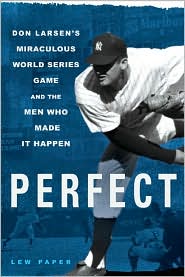
978-0451228192 – Hardcover – New American Library – $24.95
An entire book about one baseball game is probably unimaginable to many people. Even diehard fans, even those who feel they have heard the story of Don Larsen’s unique feat more than enough times, will be surprised at how easy this book is to (avidly) consume. Lew Paper manages to keep our attention, even though we know how the story comes out, even though we may know the game, the players, the era so well. And there are plenty of surprises in these pages.
Paper is a very good writer, almost effortless, and a he is a natural storyteller who plainly loves the material he is writing about. He uses the game as the structure for telling much more than the story of a single game, of course. He portrays many of the players in this game, Dodger greats like Jackie Robinson, Carl Furillo, Roy Campanella, Junior Gilliam, and hard-luck pitcher Sal Maglie, the powerful Yankee team of the fifties, which sported Mickey Mantle, Yogi Berra, Billy Martin, Gil McDougal, Moose Skowron and Hank Bauer, all in the prime of their careers. He brings to life the story of this great team rivalry between two boroughs of the greatest city on earth in the middle of the 1950s, an era that still can fascinate and enthrall us. And of course baseball is the constant through time, whose essence does not change at all.
It does help to be a baseball fan to like this book, I am sure, and maybe having grown up in or near this great era of intra-New York City competition adds to one’s interest as well. It was definitely a different time than today, when even star players held real jobs during the off season, and the amount of money won in a World Series could be just enough to give a player some modest luxuries and fleeting financial security. And of course many of these players had grown up during the Depression, lived through or even fought in World War II or the Korean War. That may account for some of the different attitudes and behaviors they exhibited on the field and among friends.
But there can be no doubt that Lew Paper has brought this game, these players, this era, vividly to life in a beautiful and brilliant manner. Talking to him about this book, the research he did to write it, and some of his experiences in talking to surviving players, relatives and witnesses to Don Larsen’s spectacular (and still unique) feat , was a great pleasure for me. I do love baseball, the game and its history have a terrific pull on me, as it does on many others, but baseball is also just a wonderful lens through which to see human beings, our culture, our foibles, our strengths and our desires. Thanks to Lew Paper for this book and a terrific interview about it.
Podcast: Play in new window | Download
Tom Matlack: The Good Men Project
January 15, 2010 by David
Filed under Non-Fiction
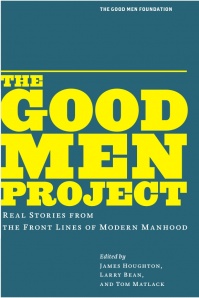 978-0615316741 – Paperback – The Good Men Foundation – $14.99
A bit more than year ago, longtime friends and former venture capitalist partners Tom Matlack and James Houghton began talking about exploring the meaning of manhood by getting men to share their stories. Today, the Good Men Project is a nonprofit foundation that benefits at-risk boys through the sales of its recently released book and a companion documentary, both titled “The Good Men Project: Real Stories from the Front Lines of Modern Manhood.” The book is a collection of 31 essays by men from all over the country, gay and straight, revealing experiences that are often harrowing but ultimately redemptive. There’s also a DVD of the film available.
Not long ago, I read a story about this book and the fact that the editors could not find a publisher (“no one wants to read about men”). Being entrepreneurs and successful business people, of course they went ahead and published the book themselves – and did a very nice job of it too. The book is divided into sections – Fathers, Sons, Husbands, Workers – pretty much all the categories that men will identify themselves at one time or another. The stories are powerful, emotional without being cloying or sentimental, transformative, in some cases, plain and simply the telling of personal truths that benefit others.
This is a new generation of men talking about their lives, and while some things are different for men certainly than they were in the era when talking about one’s emotional life was unimaginable and unaccepted, it’s still not easy for men to talk meaningfully about the real things that motivate them, or worry them, or even scare them deeply. The book certainly resonated with me, as I am sure it will for many men.
The Good Men Project is not, however, about therapy and simply talking to each other. There’s a real agenda here, to make a difference, to make change, to do good (The Good Men Foundation is a registered New York State 501(c)(3) charitable corporation dedicated to helping organizations that provide educational, social, financial or legal support to men and boys at risk. All proceeds from the sales of The Good Men Project: Real Stories from the Front Lines of Modern Manhood book and documentary film DVD will be distributed to the Foundation and will be used exclusively for the charitable mission of the Foundation).
The book features a wide range of writers, some professionals, many not. The writing is very good throughout. My interview with Tom Matlack covered alot of territory, including the story behind the whole project, and about this book, the other men who are involved with it, and how the Good Men Project works. This is a valuable effort that I hope will be broadly successful.
Podcast: Play in new window | Download
Publishing Talks: David Wilk interviews Tim O’Reilly
January 12, 2010 by David
Filed under PublishingTalks
 In this series of interviews, called Publishing Talks, I am talking to book industry professionals who have varying perspectives and thoughts about the future of publishing, books, and culture. This is a period of disruption and change for all media businesses.
Publishing has been a crucial part of human culture for as long as people have been writing and reading. How will publishing evolve as our culture is affected by technology, climate change, population density, and the ebb and flow of civilization and its economics? Publishing Talks interviews help us understand the outlines of what is happening, and how we might ourselves interact with and influence the future of publishing as it unfolds. Publishing Talks interviews give people in the book business a chance to talk about ideas and concerns in a public forum that are often only talked about “around the water cooler,” at industry conventions and events, and in emails between friends.
I hope that Publishing Talks interviews will give people inside and outside the book industry a chance to hear about some of the thoughts, ideas and concepts that are currently being discussed by engaged individuals within the industry.
It was very exciting for me to have a chance to interview Tim O’Reilly, widely considered to be one of the smartest and most innovative publishers around. He’s been involved in the World Wide Web and computers for a very long time, and throughout that time, his work has been marked by intelligence, innovation, and clarity about what matters to consumers. We talked about the history of his involvement in publishing, the web, publishing technology, and his views about the way publishing needs to evolve using new digital tools and establishing new business models – with examples.
Here’s his bio: Tim O’Reilly is the founder and CEO of O’Reilly Media, thought by many to be the best computer book publisher in the world. The company also publishes online through the O’Reilly Network and hosts conferences on technology topics. Tim is an activist for open source, open standards, and sensible intellectual property laws.
Since 1978, Tim has led the company’s pursuit of its core goal: to be a catalyst for technology change by capturing and transmitting the knowledge of “alpha geeks” and other innovators. His active engagement with technology communities drives both the company’s product development and its marketing. Tim has built a culture where advocacy, meme-making, and evangelism are key tenets of the business philosophy.
Tim has served on the board of trustees for both the Internet Society and the Electronic Frontier Foundation, two organizations devoted to making sure that the internet fulfills its promise. He was on the board of Macromedia up until the recent merger with Adobe. He is currently on the board of CollabNet.
Tim graduated from Harvard College in 1975 with a B.A. cum laude in Classics. His honors thesis explored the tension between mysticism and logic in Plato’s dialogues.
An archive of Tim’s online articles, talks, and interviews can be found at Tim’s archive page.
Podcast: Play in new window | Download
Steve Berry: The Paris Vendetta
 978-0345505477 – Hardcover -Ballantine Books – $26.00
Steve Berry’s latest adventure. The Paris Vendetta, is a terrific read, grounded in some pretty riveting historical mysteries, with a powerful story that grabs you right away and just will not let go. I really enjoyed reading it. Steve’s own description of the book (his site is one of the best author sites I have visited) is the best way to summarize the story without giving too much away:
When Napoleon Bonaparte died in exile in 1821, he took to the grave a powerful secret. As general and Emperor, he had stolen uncountable riches from palaces, national treasuries, even the Knights of Malta and the Vatican. In his final days, his British captors hoped to learn where the loot lay hidden. But he told them nothing and in his will he made no mention of his treasure.
Or did he?
Former-Justice Department operative Cotton Malone is about to find out after trouble comes knocking at his Copenhagen bookshop. Actually, it breaks and enters in the form of an American Secret Service agent with a pair of assassins on his heels. Malone has his doubts about the anxious young man, but narrowly surviving a ferocious firefight convinces him to follow his unexpected new ally.
Their first stop is the secluded estate of Malone’s good friend, Henrik Thorvaldsen. The wily Danish tycoon has uncovered the insidious plans of the Paris Club, a cabal of multi-millionaires bent on manipulating the global economy. Only by matching wits with a terrorist-for-hire, foiling a catastrophic attack, and plunging into a desperate hunt for Napoleon’s legendary lost treasure can Malone hope to avert international financial anarchy.
But Thorvaldsen’s real objective is much more personal: a vendetta to avenge the murder of his son by the larcenous aristocrat at the heart of the conspiracy. Which places Malone in an impossible quandary-one that forces him to choose between friend and country, past and present. Starting in Denmark, moving to England, and ending up in the storied streets and cathedrals of Paris, Malone plays a breathless game of duplicity and death, all to claim a prize of untold value.
I really enjoyed talking to Steve about The Paris Vendetta. Even though it’s the latest in a series he’s done featuring Cotton Malone, you definitely do not need to start at the beginning of the series. This book has all the requisite elements for readers who enjoy intelligent, historically grounded adventure novels; it’s almost impossible not to compare Berry to Dan Brown, and in my opinion, Berry is clearly the better writer. And as an added bonus, Steve is an author who can talk incisively about his own work. This interview should be fun for his many current fans as well as those who have never read his books.
Podcast: Play in new window | Download
Publishing Talks: David Wilk interviews Joe Esposito
January 5, 2010 by David
Filed under PublishingTalks
 In this series of interviews, called Publishing Talks, I am talking to book industry professionals who have varying perspectives and thoughts about the future of publishing, books, and culture. This is a period of disruption and change for all media businesses.
Publishing has been a crucial part of human culture for as long as people have been writing and reading. How will publishing evolve as our culture is affected by technology, climate change, population density, and the ebb and flow of civilization and its economics? Publishing Talks interviews help us understand the outlines of what is happening, and how we might ourselves interact with and influence the future of publishing as it unfolds. Publishing Talks interviews give people in the book business a chance to talk about ideas and concerns in a public forum that are often only talked about “around the water cooler,” at industry conventions and events, and in emails between friends.
I hope that Publishing Talks interviews will give people inside and outside the book industry a chance to hear about some of the thoughts, ideas and concepts that are currently being discussed by engaged individuals within the industry.
I’ve been reading Joe Esposito’s writings about the book business – past, present and future – for quite some time with a great deal of admiration. He is smart, understands business, and cares deeply about books, ideas and people. Here is his “official” biography: Joseph J. Esposito is an independent consultant providing strategy assessment and interim management to the information industries. He has served as an executive at Simon & Schuster and Random House, as President of Merriam-Webster, and CEO of Encyclopaedia Britannica, where he was responsible for the launch of the first Internet service of its kind. Mr. Esposito has also served as CEO of Internet communications company Tribal Voice and SRI Consulting, both of which he led to successful exits. Among Mr. Esposito’s clients have been such technology companies as Microsoft and Hewlett Packard, various publishers of all stripes, and a growing number of not-for-profit organizations (e.g., JSTOR, the University of California Press, and the American Nationals Standards Institute). You can find his writing frequently at Scholarly Kitchen.
My interview with Joe covered alot of different subjects, including his background in publishing, current trends in digital media and e-reading, how publishing will change as it adapts to a digital marketing landscape. We spent a good deal of time talking about publishing strategy relating to e-book publishing, an issue that is important to many in the publishing industry today. His views and ideas, and his delivery of them, makes for a great conversation.
Podcast: Play in new window | Download
Joann Davis: The Book of the Shepherd
 978-0061732300 – Hardcover – HarperCollins – $19.99
The Book of the Shepherd: The Story of One Simple Prayer and How it Changed the World is a beautifully written parable that made me think of writers like Paulo Coelho and Kahlil Gibran. The conceit of the book is that the author finds a manuscript in a house in Vermont, and has it translated, thus this story. It’s a short book, and an easy read, but of course, because it is a parable, the book demands to be re-read and thought about deeply.
The story has no distinct place or time. Joshua is the shepherd who is troubled by the code of “an eye for an eye” that governs his world. He has a dream about “a new way” and sets off on a quest to find it.
Stone the builder who erects a house that falls on its occupants. Sever the hands of the criminal who pilfers livestock or grain or another’s garment. Whip the child who defies an elder. For such is the law and the law must be obeyed.
For generations, these ironclad rules had governed the people. Nobody questioned whether it was right to humiliate a child or execute a murderer. An eye for an eye was the way of the world.
But was there another way?
Joshua is accompanied by Elizabeth, a former slave who is kind and generous, and David, a boy who must learn to walk in new shoes. Joshua believes that “an age of miracles” will come when the new way is found.
As with any quest, there is adventure along the way. En route to a cave near the Great Inland Sea, the travelers meet a number of interesting and compelling characters, including the Storyteller, the Apothecary, the Blind Man, and the Stranger. Each passes on an important lesson as the travelers journey toward what we realize is their destiny. At the cave, Joshua must see if he can bring forth secrets long buried. But he, Elizabeth, and David will discover that what they have been searching for has been inside them all along. In the end, The Book of the Shepherd is compelling and meaningful, whatever your political, social or religious outlook or beliefs. It’s not heavy handed or preachy, and even for many secularists, will be well worth the investment of time to read.
Joann Davis is an experienced writer and former book editor. She is extremely articulate and passionate about her work, and was a pleasure to interview. We talked about her work as a writer, her own spirituality, and how The Book of the Shepherd can change people and the world for good.
Podcast: Play in new window | Download
Publishing Talks: David Wilk interviews Brian O’Leary
December 29, 2009 by David
Filed under Children's Authors, PublishingTalks
 In this series of interviews, called Publishing Talks, I am talking to book industry professionals who have varying perspectives and thoughts about the future of publishing, books, and culture. This is a period of disruption and change for all media businesses.
Publishing has been a crucial part of human culture for as long as people have been writing and reading. How will publishing evolve as our culture is affected by technology, climate change, population density, and the ebb and flow of civilization and its economics? Publishing Talks interviews help us understand the outlines of what is happening, and how we might ourselves interact with and influence the future of publishing as it unfolds. Publishing Talks interviews give people in the book business a chance to talk about ideas and concerns in a public forum that are often only talked about “around the water cooler,” at industry conventions and events, and in emails between friends.
This series of talks will give people inside and outside the book industry a chance to hear about some of the thoughts, ideas and concepts that are currently being discussed by engaged individuals within the industry.
Brian O’Leary is a publishing industry consultant with broad and intelligent experience in books and magazines and who operates Magellan Media Partners. Brian is a thinker and researcher whose writing about publishing I have always found interesting and solidly grounded in data and its intelligent analysis and application. As he says, he tries to help publishers work faster, better and smarter. His (shortened) bio: In addition to his consulting assignments, O’Leary is the author of a research report on the impact of free content and digital piracy on paid book sales, as well as the editor and primary contributor for a study of the use of XML in book publishing. Both reports were published by O’Reilly Media in 2009. Brian was a senior executive at Hammond, and prior to that spent a dozen years working for Time, Inc. He earned an A.B. in chemistry from Harvard College and an M.B.A. from Harvard Business School.
In this interview Brian and I talked in depth about his very interesting work in analyzing the impact of piracy on books sales, the lack of real data in the book business, and his compelling views about the future of publishing in a digital environment.
Podcast: Play in new window | Download
Summer Brenner: I-5, A Novel of Crime, Transport, and Sex
 978-1-60486-019-1 – Paperback – PM Press – $15.95
This is a slim novel that packs a pretty powerful punch. Summer Brenner was best known to me as a poet, but it turns out she has been writing fiction for quite some time. She has a political interest, as this novel demonstrates, but it is not a tract. It’s a sensitive portrayal of an Eastern European woman who has been tricked into coming to America, where she has been enslaved in a money for sex ring that makes a business out of the correlation between the desires of women to escape the misery of their lives and men who are willing to pay for sex of all kinds with women, whose real lives they care nothing about.
As the story of I-5 unfolds, Anya, the main character, is traveling the interstate corridor up central California from Los Angeles to Oakland; adventures ensue, some of them strange, some of them desperate, all of them painful and sad. Still, Brenner’s characters matter, she is sympathetic to all of them as human beings, even the worst exploiters in the crew. That makes this novel much more than a book about sex, money, power and violence; in Brenner’s hands, these characters transcend their typologies to become real people trapped in their individual gulags. She writes visually, so that with a relatively few words, we can see what she wants us to see, the places her characters inhabit, and even their interior worlds. It’s gut wrenching book, but our faith in the ability of people to overcome the obstacles between themselves and their humanity is never lost.
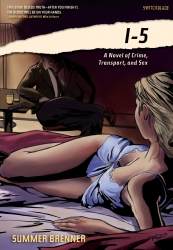
This is really a terrific book; yes, the cover makes it look like a trashy paperback from the 50s, but done in a modern enough way that there is no mistaking it for anything exploitative. I-5 is a hardboiled story, and it is as noir as any book you will read, but it’s a transformative experience to read and one that should not be missed. In my interview with Summer, we talked quite a bit about the how she came to write this book, and many of the issues of sexual slavery in America and worldwide today. She expresses a deep emotional connection with the characters in her novel, based on her own experiences as a woman. Her abilities to imagine her characters and their stories is remarkable. Summer Brenner is a writer more people should know, and one who important things to say.
Podcast: Play in new window | Download
Publishing Talks: David Wilk interviews Mac Slocum
December 19, 2009 by David
Filed under PublishingTalks
 In this series of interviews, called Publishing Talks, I am talking to book industry professionals who have varying perspectives and thoughts about the future of publishing, books, and culture. This is a period of disruption and change for all media businesses.
Publishing has been a crucial part of human culture for as long as people have been writing and reading. How will publishing evolve as our culture is affected by technology, climate change, population density, and the ebb and flow of civilization and its economics? Publishing Talks interviews help us understand the outlines of what is happening, and how we might ourselves interact with and influence the future of publishing as it unfolds. Publishing Talks interviews give people in the book business a chance to talk about ideas and concerns in a public forum that are often only talked about “around the water cooler,” at industry conventions and events, and in emails between friends.
This series of talks will give people inside and outside the book industry a chance to hear about some of the thoughts, ideas and concepts that are currently being discussed by engaged individuals within the industry.
Today’s interview is with Mac Slocum, whose experience is in a variety of different media, including newspapers, books and online media. I know him from his work at O’Reilly’s Tools of Change and his eponymous blog which is among those I read most frequently. He’s currently at the Nieman Journalism Lab at Harvard and freelancing projects in media and here’s his interesting bio from his website:
I am a Web guy. I write, edit, produce, develop, manage and code Web content.
I’ve worked as an online editor, writer and producer at a variety of outlets (publishing, film, TV, electronics, trade, tech, hyper-local, national/international … you name it). Through all of these experiences, I’ve remained committed to the Web as a platform. I love the thing, and I love working to make it better.
My areas of interest/expertise include:
* Development of Web-friendly content (writing and editing)
* Audience development via social media (blogs, Twitter, social networks)
* Web production (HTML, CSS, Movable Type and other content management systems)
* Independent publishing
* Web journalism education
* Pontificating, analyzing and consulting on the future of publishing/journalism, digital distribution, Web content, and audience aggregation (Note: If you’re in a rush, don’t ever get me started on piracy and free content …)
I have organized conferences, spoken on panels, and moderated sessions (and I actually enjoyed these activities).
I teach Web journalism courses at Emerson College and I’m a contributor on Poynter’s E-Media Tidbits blog. I also run a number of independent Web sites and I’m owner of The Fodder Network.
Mac and I had an interesting conversation, covering a range of topics under the overall rubric of media change, how consumers and producers interact, continuing disruption of business models for all traditional media forms, and how those businesses must change in the future, both near term and longer. Mac’s view of the future for publishers is positive and worth listening to.
Podcast: Play in new window | Download
James A. Owen: Here, There be Dragons
 978-1416912279 – Hardcover – Simon & Schuster – $17.95 (a paperback edition is also available – but the price difference is small enough for me to recommend you buy the hardcover)
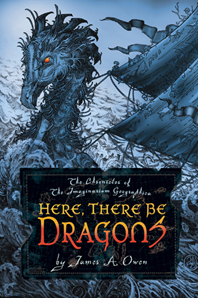
James A. Owen is a wonderful writer. It’s interesting to me how many really excellent writers there are who are categorized as “young adult” writers because the books they write are about things like dragons, or boys who are heroes or even young wizards in an imaginary school in an imaginary part of England. In my opinion anyway, Here, There be Dragons is a book for readers of all ages or any age. It’s well written, has characters with depth, beautifully done line drawings by the author, and a fast moving, engaging story line that includes heroes who are connected to our literary history in some very interesting ways. What more can one ask for in a novel?
“What is it?” John asked.
The little man blinked and arched an eyebrow.
“It is the world, my boy,” he said. “All the world, in ink and blood, vellum and parchment, leather and hide. It is the world, and it is yours to save or lose.”
An unusual murder brings together three strangers, John, Jack, and Charles, on a rainy night in London during the first World War. An eccentric little man called Bert tells them that they are now the caretakers of the Imaginarium Geographica — an atlas of all the lands that have ever existed in myth and legend, fable and fairy tale. These lands, Bert claims, can be traveled to in his ship the Indigo Dragon, one of only seven vessels that is able to cross the Frontier between worlds into the Archipelago of Dreams.
Pursued by strange and terrifying creatures, the companions flee London aboard the Dragonship. Traveling to the very realm of the imagination itself, they must learn to overcome their fears and trust in one another if they are to defeat the dark forces that threaten the destiny of two worlds. And in the process, they will share a great adventure filled with clues that lead readers to the surprise revelation of the legendary storytellers these men will one day become.
It’s a pretty good bet that if you like this book, you will be pleased to know you can continue to read. This is the first volume in the Chronicles of Imaginarium Geographica series, which has now reached a total of four books, with more to come. It’s probably true that this book and its series will appeal most to a certain type of reader, one who has read and enjoyed adventure stories, particularly those well written classics of the past (again, I don’t think it’s about the age of the reader but rather one’s interests). Unlikely heroes, normal people faced with challenges to which they rise, mythological characters brought to life, and above all, dragons, definitely motivate some of us more than others. I guess I am one of those.
I had the pleasure of meeting James A. Owen at Comicon in San Diego. I was impressed to see a writer so willing to engage with his readers – Comicon can be exhausting for exhibitors and for creators even more so. In this interview, he displays his engaging personality, and talks with me about the origin of his work as a novelist, his work in comics, contacts with film makers (the film adaptation is in development and appears scheduled as a 2011 release), and his attempt to revive the classic magazine, Argosy. Owen started as a comic book writer and illustrator, and even was a publisher of comics, and then moved into writing novels almost accidentally. This is a lucky turn of events for readers of fiction. You can learn much more about James A. Owen and his work at this website and he also has a beautiful blog based site, the Wonder Cabinet, that is well worth regular visits. I’m hopeful that over time, Owen’s work will reach the wider audience it deserves.
Note to listeners: this interview is slightly longer than most at 27 minutes, but should provide sufficient interest to reward your investment of time.
Podcast: Play in new window | Download