
Publishing Talks Interview: Kathleen Schmidt, Publishing Confidential
March 9, 2026 by David
Filed under Publishing History, PublishingTalks, The Future
 I started Publishing Talks as a series of conversations with book industry professionals and others involved in media and technology, mostly talking about the future of publishing, books, and culture. It has been great fun talking with people in the book industry about the evolution of publishing in the context of technology, culture, and economics.
These conversations have been inspirational to me. I have had the pleasure of speaking with visionaries and entrepreneurs, editors, publishers and others who have influenced and changed contemporary literature and culture. I’ve also had the opportunity to speak with a number of friends and colleagues in the book business.
I really enjoy the opportunities to find out about the boundless creativity that motivates so many of us in the book business, and I also really enjoy talking to others in the business, who like me, have tried to make sense of it all in some way or another.
Today’s conversation is with Kathleen Schmidt, a long time book publicist whose Substack newsletter Publishing Confidential, is widely read within the book business. Her newsletter is always a great source of thoughtful ideas and commentary about the current state of publishing and book marketing and promotion. I was inspired to speak with her after reading one of her truly great posts this past December, “Marketing + Publicity in 2026: Change Needs to Happen: The good, the bad, and the ugly.”
Here’s a key quote from that piece that caught my attention right away:
“The industry must accept that some books absolutely will not get attention from legacy media and move towards what works for each book, whether that’s a marketing-heavy campaign or just pitching podcasts. Why are we still creating arbitrary publicity plans for every title when we know most of it is b.s.?”
She went on from there to provide a meaningful list of ideas and practices that any publisher, publicist or author can learn from, be inspired by, and adapt for their own best practices. I appreciate her honesty, willingness to try new things, and her understanding that failure is not a bad thing, but a way to learn and get better at what we do. Everyone in the book business is frustrated by the current media landscape and by the massive number of new (and old) book titles that makes getting attention for any new book so difficult, not to mention the competition from other media forms, social media included, that take attention away from books and reading. But that frustration needs to be converted into positive energy. Otherwise you may as well quit doing what you love to do.
Having a chance to speak with Kathleen was rewarding for me, and I am sure will be for you as well. She’s smart, creative and realistic. I am sure she is a good marketer too. We need more radical honesty, more innovation and more enjoyment in book marketing!
Her bio: Kathleen is the founder and CEO of Kathleen Schmidt Public Relations with three decades of experience spanning publicity, literary representation, acquisitions editing, and ghostwriting. She has worked on more than 50 New York Times bestsellers and led global media and branding campaigns for politicians, A-list celebrities, athletes, and other high-profile figures.
I found another recent interview with Kathleen by Christelle Lujan at She Writes Magazine. In that interviewsays: “First and foremost, I want Publishing Confidential to be a resource for authors to learn about the publishing industry.”
And here are a couple more of her posts:
30 Years in Book Publishing: What I’ve Learned
Why Advertising Doesn’t Work for Books
And here is her business website, Kathleen Schmidt Public Relations.
Podcast: Play in new window | Download
Todd Goddard: Devouring Time: Jim Harrison a Writer’s Life
February 1, 2026 by David
Filed under Fiction, Non-Fiction, WritersCast
 Devouring Time: Jim Harrison, a Writer’s Life — Todd Goddard — 9781799902362 – Blackstone Publishing — Hardcover — 558 pages — $29.99 — November 4, 2025
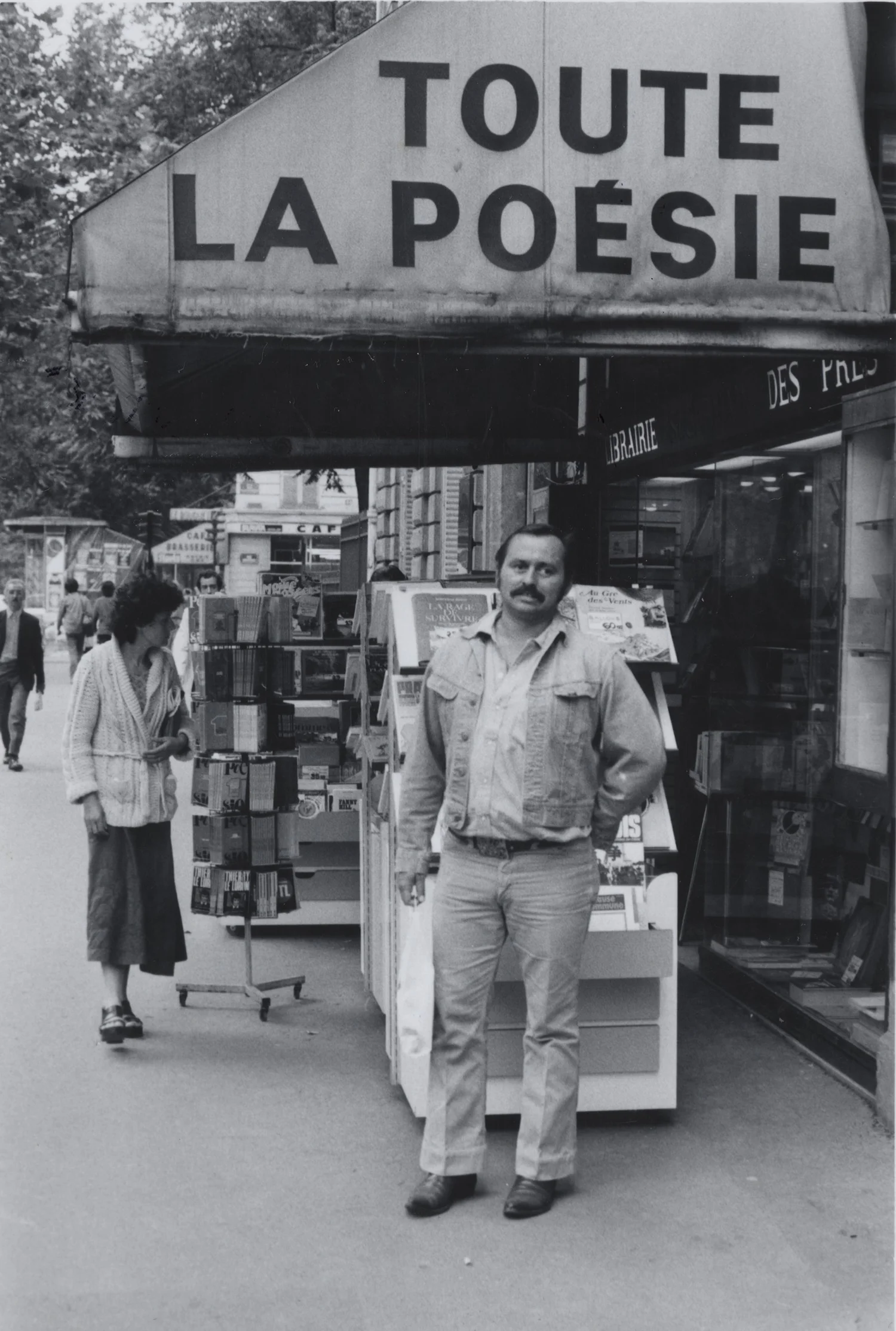
Jim Harrison was for so many readers – and other writers – one of the central voices of American literature for the last half century. When Harrison began writing, it was as a poet, and most readers came to his fiction and nonfiction much later. It was the novels and many novellas that drew large numbers of readers to him, while his first hand style nonfiction writing about food and his many adventures introduced him to a completely different audience who in many case, I am sure, also read his fiction. And then there was the film writing and the stories of fishing, carousing and gourmand like intake of food, alchohol, and drugs with friends like Thomas McGuane, Peter Matthiessen, Jimmy Buffett, and Jack Nicholson in Key West, Montana and Hollywood. Harrison became more than a writer, but also a publicly imagined character much like Ernest Hemingway and F. Scott Fitzgerald, whose persona became entwined with his writing and made him that much more attractive to some of his readers.
His output as a writer was amazing: poetry, novels, novellas, short stories, magazine nonfiction, film scripts. His appetite for life was immense. His friendships were legendary and he was loved by many whose lives he touched. Fittingly, he died alone while in the midst of writing a poem.
In Devouring Time, Todd Goddard presents a meaningful account of this writer’s life, from beginning to end, including much about his persona that many readers could not have otherwise known. I’ve read much of Jim Harrison’s writing, and knew more than a little about his life. But I learned much more from this book, feeling after reading it that I understood Harrison more clearly both as a writer and a person. This is not a celebratory paean to someone’s hero, or the work of a starry eyed fan. Nor is it a reductionist scholarly account. This book is a carefully constructed narrative worthy of the subject’s complicated, sometimes very painful, but always meaningful life. Goddard refuses to turn away from Harrison as a human being whose life included physical and emotional challenges, who suffered, who lived a full life also of joy and beauty, and despite his foibles, his accomplishments were immense and lasting.
Jim Harrison was born in Michigan in 1937 and died Patagonia, Arizona in 2016. He wrote twenty-one books of fiction and fourteen books of poetry that influenced many other writers of all kinds and won him legions of readers. Harrison helped shape the course of contemporary American literature, revitalizing in particular the novella, a form he mastered and reinvigorated.
Though it was his fiction, nonfiction, and film writing that made him famous (and by which he made his living), it was always poetry that he loved most, and while he was a thoroughly social writer who enjoyed the company of many friends (and lovers), he was simultaneously a private person who cherished remoteness, the singularity of the wilderness, and solitude, and also the company of his wife and children at home.
Todd Goddard conducted over a hundred interviews and had full access to Harrison’s collected papers, as well as the cooperation of Harrison’s family to create this fully formed literary biography of one of our most important writers of the last half century.
I very much enjoyed the opportunity to speak with Todd. We talked about Harrison, of course, but also about the art of biography and the process of writing a book with so much depth of attention and detail. Whether you are a reader of Jim Harrison’s poetry or prose, this biography will capture your attention and in all likelihood, lead you to want to read further in Harrison’s extensive body of work.
“Todd Goddard tells the story of this bon vivant, outdoorsman, hellion, and great poet from his ancestors to his end with grace, momentum, generosity, and insight…and what a great American life it was, wreckage, glory, gifts, and ALL.”—Rebecca Solnit, author of Orwell’s Roses
Calendars
Back in the blue chair in front of the green studio
another year has passed, or so they say, but calendars lie.
They’re a kind of cosmic business machine like
their cousin clocks but break down at inoppormne times.
Fifty years ago I learned to jump off the calendar
but I kept getting drawn back on for reasons
of greed and my imperishable stupidity.
Of late I’ve escaped those fatal squares
with their razor-sharp numbers for longer and longer.
I had to become the moving water I already am,
falling back into the human shape in order
not to frighten my children, grandchildren, dogs and friends.
Our old cat doesn’t care. He laps the water where my face used to be.
from IN SEARCH OF SMALL GODS, Copper Canyon Press, 2010

Podcast: Play in new window | Download
Shirley C. Strum: Echoes of Our Origins: Baboons, Humans, and Nature
January 8, 2026 by David
Filed under Non-Fiction, WritersCast
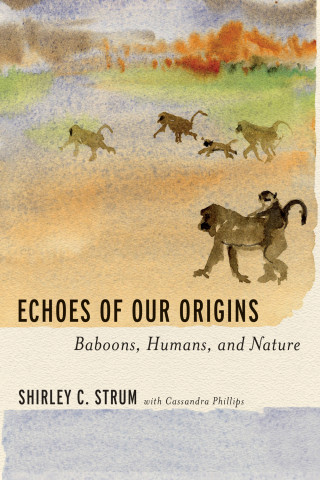 Echoes of Our Origins: Baboons, Humans, and Nature — Shirley C. Strum, with Cassandra Phillips — Johns Hopkins University Press — Hardcover — 978-1-4214-5203-6 — 376 pages — $32.95 — September 9, 2025 — ebook edition available.
This book was a fantastic discovery for me. I consider myself fairly well read; I’ve studied anthropology extensively and I even briefly went to graduate school to study biology, but my knowledge of primates is woefully poor. Shirley’s book was a great introduction for me to one part of a much wider field, and got me excited and engaged with baboons, who turn out to be incredibly interesting animals, and of course connect us not only to issues of human evolution, but also historical and modern ecology, issues of human/animal interactions, and human responsibilities in relation to other animals, especially primates.
I feel like I learned more from this book than almost anything I have read in the past year. Shirley Strum’s story of her fifty years studying baboons is completely compelling.
Her baboon story started in 1972, when as a graduate student, Strum traveled to Kenya to study the origins of human aggression by observing baboons. Her earliest discoveries completely changed the scientific study of baboons, and many long-held assumptions about primate behavior.
Living closely with a number of different populations of baboons over the past half century, and closely observing their lives, Strum has learned more than any other human about baboons’ complex strategies of negotiation, collaboration, and resilience. And through her work, Strum has had to deal with an array of challenges – not just within her field itself, but in the changing ecology and landscape of Africa, as more people have taken over former baboon (and many other animals’) territories, creating new forms of human/animal conflicts, and changing the evolution of baboon society itself.
In addition to illustrating the incredibly interesting lives of baboons, Strum’s experiences tell us a great deal about how human science works, and the challenges that we face in trying to deal with the massive effects of the anthropocene on our fellow beings in the world. I know it’s simplistic to say that baboons and other primates have a lot to teach homo sapiens about how to live cooperatively together, but I do think that understanding more about primate life can in fact teach us a great deal about ourselves, if only we can begin to see that we humans are not at the top of a hierarchy that makes us “better than” or “smarter than” our evolutionary cohort.
Echoes of Our Origins combines natural history, adventure, memoir, feminism and like some of the its best antecedents in nature writing, asks us to think about and empathize with the natural world in previously unfamiliar ways.
I hope you enjoy our wide-ranging conversation as much as I did. While it is doubtful that I will ever get to Africa to see baboons in the wild for myself, Echoes has given me an unmatched opportunity to imagine these incredible animals.
I’ve been recommending this book to anyone interested in humanity, ecology, our history and our future.
Dr. Shirley C. Strum is a Professor of Anthropology and a Professor of the Graduate Division, School of Social Sciences, at the University of California, San Diego, and Director of the Uaso Ngiro Baboon Project in Kenya. Her first book was Almost Human: A Journey into the World of Baboons.
More about Dr. Shirley C. Strum here.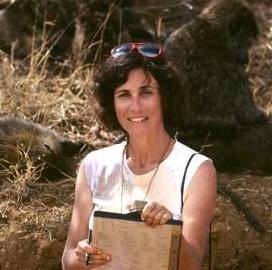
Podcast: Play in new window | Download